
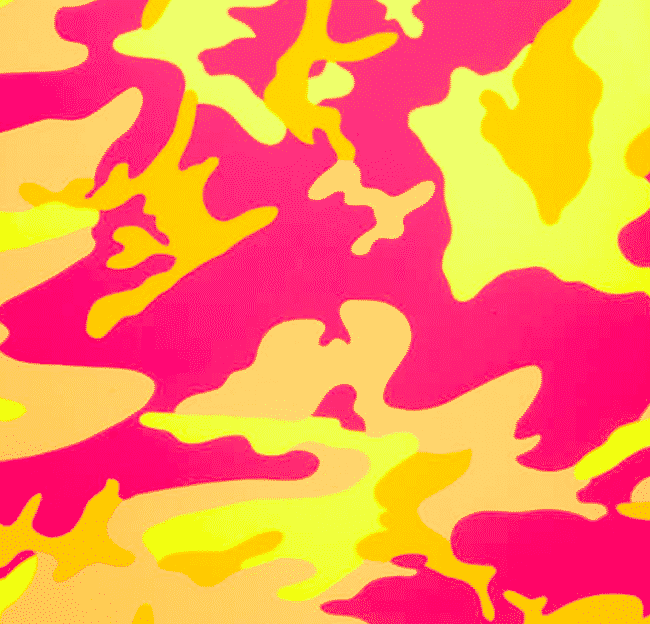
Camouflage 409
by Andy Warhol
Year: 1987
Medium: Screen print on Lenox Museum Board
Size: 38 x 38 in (96.52 x 96.52 cm)
Edition: 80
Signed
Few motifs reveal Andy Warhol’s late fascination with pattern as vividly as Camouflage 409 (1987), a 38 × 38-inch screenprint on Lenox Museum Board. Here, military camouflage becomes a sophisticated Pop Art vocabulary of colour, concealment, and repetition. Signed and drawn from a limited edition of 80, the work combines impressive scale with graphic force, offering collectors a distinctive example from Warhol’s celebrated late period.
Camouflage 409 by Andy Warhol belongs to his late Camouflage series, first exhibited at the Gagosian Gallery in New York in 1986. Warhol took a military camouflage pattern and transformed it through bold, artificial color into a meditation on identity, concealment, and visibility. What was once designed to hide becomes impossible to ignore. The pattern also reflects Warhol’s fascination with turning familiar images into repeatable, commercial visual language.
There is no recognized street-graffiti version. Warhol’s Camouflage works were produced through his studio-based screen-printing practice, while contemporary street art developed as a separate movement.
For collectors, Camouflage is an important late-career series with strong market recognition. Rarity, edition, colorway, condition, signature, and provenance all influence demand. The series is especially attractive to collectors seeking a more experimental side of Warhol beyond Marilyn Monroe and Campbell’s Soup.
From our gallery perspective, Camouflage 409 has a rare visual confidence. It feels both military and decorative, controlled and chaotic. That tension gives the work lasting appeal.
Artistically, it reflects Warhol’s 1980s return to major cultural symbols and connects with his Self-Portraits, Dollar Signs, and other late screen-print works. For a serious collector, it offers a compelling piece of Warhol’s final creative period.
More Andy Warhol Works to Explore
Camouflage 409
by Andy Warhol
Year: 1987
Medium: Screen print on Lenox Museum Board
Size: 38 x 38 in (96.52 x 96.52 cm)
Edition: 80
Few motifs reveal Andy Warhol’s late fascination with pattern as vividly as Camouflage 409 (1987), a 38 × 38-inch screenprint on Lenox Museum Board. Here, military camouflage becomes a sophisticated Pop Art vocabulary of colour, concealment, and repetition. Signed and drawn from a limited edition of 80, the work combines impressive scale with graphic force, offering collectors a distinctive example from Warhol’s celebrated late period.
Camouflage 409 by Andy Warhol belongs to his late Camouflage series, first exhibited at the Gagosian Gallery in New York in 1986. Warhol took a military camouflage pattern and transformed it through bold, artificial color into a meditation on identity, concealment, and visibility. What was once designed to hide becomes impossible to ignore. The pattern also reflects Warhol’s fascination with turning familiar images into repeatable, commercial visual language.
There is no recognized street-graffiti version. Warhol’s Camouflage works were produced through his studio-based screen-printing practice, while contemporary street art developed as a separate movement.
For collectors, Camouflage is an important late-career series with strong market recognition. Rarity, edition, colorway, condition, signature, and provenance all influence demand. The series is especially attractive to collectors seeking a more experimental side of Warhol beyond Marilyn Monroe and Campbell’s Soup.
From our gallery perspective, Camouflage 409 has a rare visual confidence. It feels both military and decorative, controlled and chaotic. That tension gives the work lasting appeal.
Artistically, it reflects Warhol’s 1980s return to major cultural symbols and connects with his Self-Portraits, Dollar Signs, and other late screen-print works. For a serious collector, it offers a compelling piece of Warhol’s final creative period.