
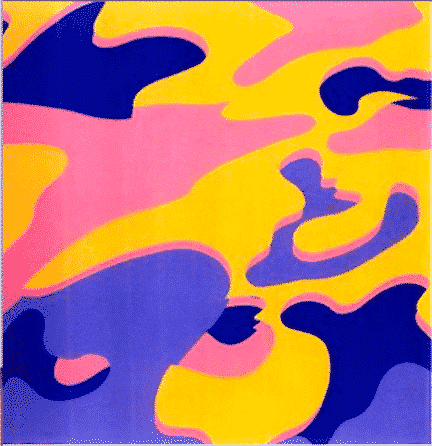
Camouflage 410
by Andy Warhol
Year: 1987
Medium: Screen print on Lenox Museum Board
Size: 38 x 38 in (96.52 x 96.52 cm)
Edition: 80
Signed
Marked by its bold interplay of concealment and colour, Andy Warhol’s Camouflage 410 (1987) is a 38 × 38-inch screenprint on Lenox Museum Board. Created within his celebrated Camouflage series, the work transforms military pattern into a vibrant study of identity, repetition, and visual culture. Signed and drawn from an edition of just 80, it offers commanding scale, distinctive character, and strong desirability for discerning Pop Art collectors.
Camouflage 410 by Andy Warhol belongs to the artist’s landmark Camouflage series, created in 1986 during the final phase of his career. It first appears within Warhol’s exploration of military camouflage as a source of Pop imagery, transforming a pattern designed for concealment into a bold work of contemporary art. The repeated organic shapes suggest themes of conflict, identity, disguise, power, and visibility, while also reflecting Warhol’s fascination with turning familiar images into desirable cultural symbols.
There is no recognized street-graffiti version. Warhol’s Camouflage works were created through his studio-based screen-printing process, not the later street-art tradition. Their significance comes from the tension between military function, fashion, commercial design, and fine art.
For collectors, Camouflage works remain important examples of Warhol’s late career. Rarity, colorway, scale, condition, edition, signature, and provenance all influence desirability. The series is especially attractive to collectors looking for a Warhol that feels both instantly recognizable and less conventional than his celebrity or Campbell’s Soup imagery.
From our gallery perspective, the appeal is immediate: Warhol takes a symbol of concealment and makes it impossible to ignore. The work captures his ability to turn even functional imagery into a statement about modern culture.
Artistically, Camouflage 410 belongs to Warhol’s late Pop period and connects to his Self-Portraits, Flowers, and other 1980s works. It is a strong choice for collectors seeking a sophisticated example of Warhol’s mature visual language.
More Andy Warhol Works to Explore
Camouflage 410
by Andy Warhol
Year: 1987
Medium: Screen print on Lenox Museum Board
Size: 38 x 38 in (96.52 x 96.52 cm)
Edition: 80
Marked by its bold interplay of concealment and colour, Andy Warhol’s Camouflage 410 (1987) is a 38 × 38-inch screenprint on Lenox Museum Board. Created within his celebrated Camouflage series, the work transforms military pattern into a vibrant study of identity, repetition, and visual culture. Signed and drawn from an edition of just 80, it offers commanding scale, distinctive character, and strong desirability for discerning Pop Art collectors.
Camouflage 410 by Andy Warhol belongs to the artist’s landmark Camouflage series, created in 1986 during the final phase of his career. It first appears within Warhol’s exploration of military camouflage as a source of Pop imagery, transforming a pattern designed for concealment into a bold work of contemporary art. The repeated organic shapes suggest themes of conflict, identity, disguise, power, and visibility, while also reflecting Warhol’s fascination with turning familiar images into desirable cultural symbols.
There is no recognized street-graffiti version. Warhol’s Camouflage works were created through his studio-based screen-printing process, not the later street-art tradition. Their significance comes from the tension between military function, fashion, commercial design, and fine art.
For collectors, Camouflage works remain important examples of Warhol’s late career. Rarity, colorway, scale, condition, edition, signature, and provenance all influence desirability. The series is especially attractive to collectors looking for a Warhol that feels both instantly recognizable and less conventional than his celebrity or Campbell’s Soup imagery.
From our gallery perspective, the appeal is immediate: Warhol takes a symbol of concealment and makes it impossible to ignore. The work captures his ability to turn even functional imagery into a statement about modern culture.
Artistically, Camouflage 410 belongs to Warhol’s late Pop period and connects to his Self-Portraits, Flowers, and other 1980s works. It is a strong choice for collectors seeking a sophisticated example of Warhol’s mature visual language.