
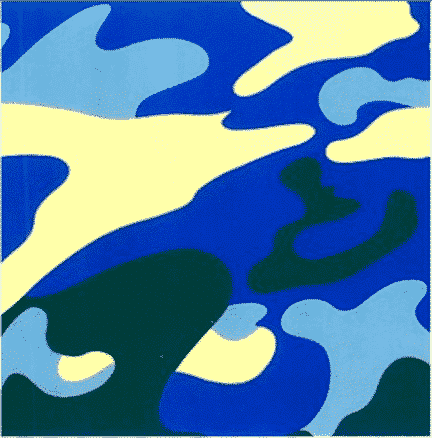
Camouflage 411
by Andy Warhol
Year: 1987
Medium: Screen print on Lenox Museum Board
Size: 38 x 38 in (96.52 x 96.52 cm)
Edition: 80
Signed
From Warhol’s late-career exploration of pattern and popular imagery, Camouflage 411 (1987) recasts a military motif as a vivid meditation on visibility, concealment, and modern visual culture. This 38 × 38-inch screenprint on Lenox Museum Board is signed and drawn from an edition of 80. Its scarce edition, commanding scale, and distinctive Pop Art vocabulary give the work strong appeal for collectors seeking a notable Warhol print.
Camouflage 411 (F. & S. II.411) first appeared in 1987 as part of Andy Warhol’s final print portfolio, Camouflage. The screenprint uses a military pattern in bold blue, green, and cream, turning a design made for concealment into something impossible to ignore. There is no street-graffiti version: Warhol’s language was Pop Art and screenprinting, not graffiti.
The work plays with visibility, identity, power, and the tension between hiding and being seen. Its bright palette defeats camouflage’s original purpose, while the repeated pattern also challenges traditional ideas of abstraction and originality.
For collectors, this is a strong late Warhol print: the edition was limited to 80, and a documented example sold at Phillips for £98,280, setting a world auction record for a single print in the edition.
In our experience, Camouflage 411 has the rare quality of being instantly recognizable yet conceptually deep. It belongs to Warhol’s final creative period, alongside the other Camouflage prints and his celebrated self-portraits. For collectors seeking a museum-level Warhol with strong market history, it is an especially compelling choice.
More Andy Warhol Works to Explore
Camouflage 411
by Andy Warhol
Year: 1987
Medium: Screen print on Lenox Museum Board
Size: 38 x 38 in (96.52 x 96.52 cm)
Edition: 80
From Warhol’s late-career exploration of pattern and popular imagery, Camouflage 411 (1987) recasts a military motif as a vivid meditation on visibility, concealment, and modern visual culture. This 38 × 38-inch screenprint on Lenox Museum Board is signed and drawn from an edition of 80. Its scarce edition, commanding scale, and distinctive Pop Art vocabulary give the work strong appeal for collectors seeking a notable Warhol print.
Camouflage 411 (F. & S. II.411) first appeared in 1987 as part of Andy Warhol’s final print portfolio, Camouflage. The screenprint uses a military pattern in bold blue, green, and cream, turning a design made for concealment into something impossible to ignore. There is no street-graffiti version: Warhol’s language was Pop Art and screenprinting, not graffiti.
The work plays with visibility, identity, power, and the tension between hiding and being seen. Its bright palette defeats camouflage’s original purpose, while the repeated pattern also challenges traditional ideas of abstraction and originality.
For collectors, this is a strong late Warhol print: the edition was limited to 80, and a documented example sold at Phillips for £98,280, setting a world auction record for a single print in the edition.
In our experience, Camouflage 411 has the rare quality of being instantly recognizable yet conceptually deep. It belongs to Warhol’s final creative period, alongside the other Camouflage prints and his celebrated self-portraits. For collectors seeking a museum-level Warhol with strong market history, it is an especially compelling choice.