
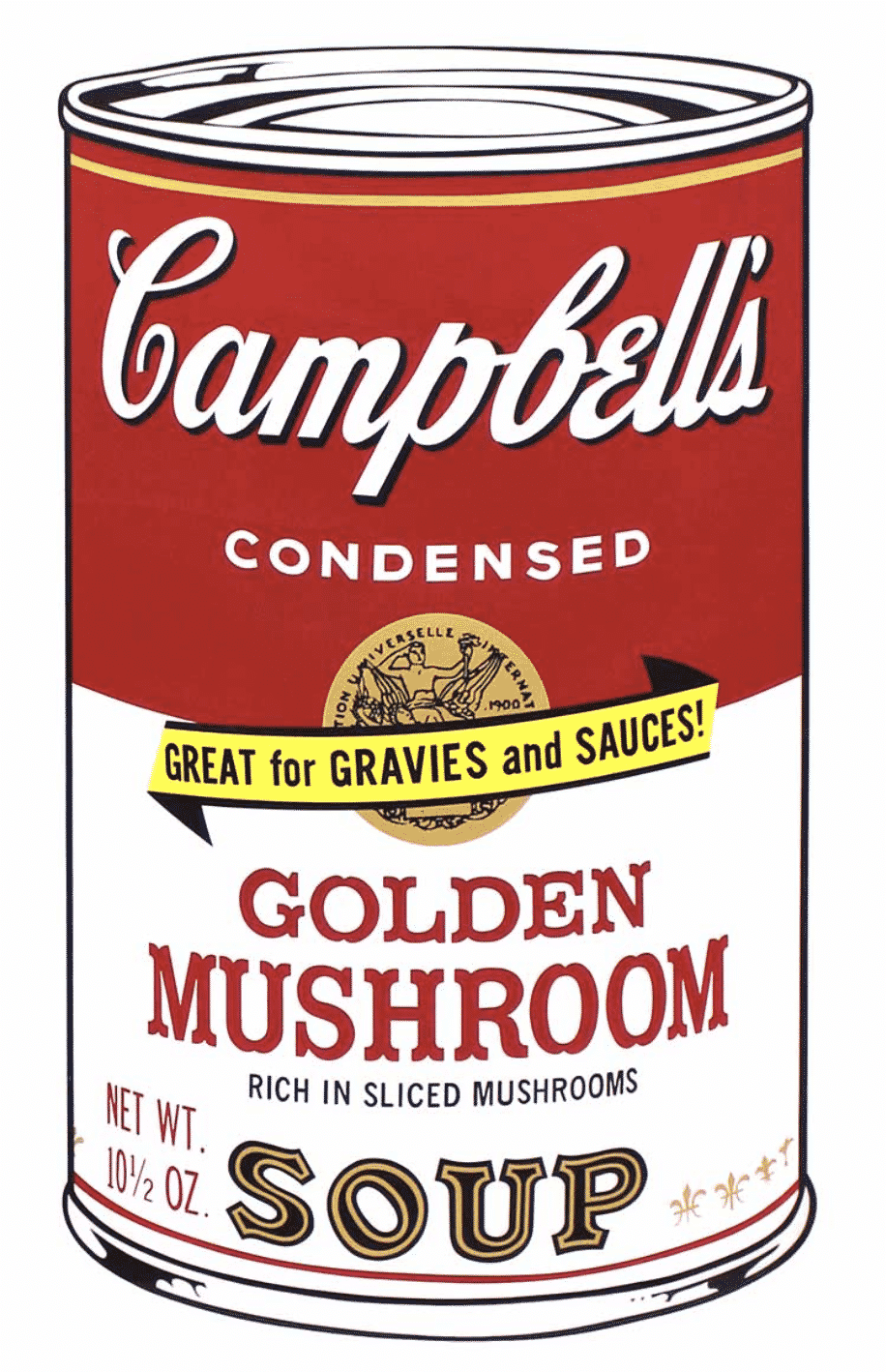
Campbell’S Golden Mushroom
by Andy Warhol
Year: 1968
Medium: Screenprint
Size: 35 x 23 in (88.9 x 58.42 cm)
Edition: 250
Signed
An emblem of Andy Warhol’s fascination with everyday Americana, Campbell’s Golden Mushroom (1968) elevates a familiar pantry label into a refined Pop Art icon. This screenprint measures 35 × 23 inches and comes from an edition of 250, with the present example signed. Its crisp commercial imagery, cultural resonance, and strong connection to Warhol’s celebrated Campbell’s Soup series give it lasting appeal for discerning collectors.
Campbell’s Golden Mushroom by Andy Warhol extends his iconic Campbell’s Soup language into a more playful, richly colored image rooted in American commercial culture. It belongs to Warhol’s later exploration of familiar consumer brands, where packaging becomes a vehicle for repetition, color, and cultural memory. Rather than appearing first as street art, the work comes from Warhol’s studio and printmaking practice. There is no authentic street-graffiti version; later urban adaptations should not be confused with an original Warhol edition.
The Golden Mushroom label is especially intriguing because it shifts the soup can from a simple grocery item into a bold Pop symbol. Its metallic, warm palette suggests abundance, nostalgia, and the seductive power of branding. Warhol turns an ordinary pantry object into a polished statement about American taste and mass consumption.
For collectors, Campbell’s Soup imagery remains among Warhol’s most recognizable and market-important subjects. Works with distinctive color treatments can offer strong visual appeal and collector differentiation.
From a curatorial standpoint, this piece shows Warhol’s ability to make familiarity feel fresh. It connects directly to his celebrated Campbell’s Soup Cans and broader consumer-brand works, while complementing subjects such as Dollar Signs and Coca-Cola. For collectors building a focused Warhol collection, it offers an accessible yet highly recognizable expression of his Pop Art legacy.
More Andy Warhol Works to Explore
Campbell’S Golden Mushroom
by Andy Warhol
Year: 1968
Medium: Screenprint
Size: 35 x 23 in (88.9 x 58.42 cm)
Edition: 250
An emblem of Andy Warhol’s fascination with everyday Americana, Campbell’s Golden Mushroom (1968) elevates a familiar pantry label into a refined Pop Art icon. This screenprint measures 35 × 23 inches and comes from an edition of 250, with the present example signed. Its crisp commercial imagery, cultural resonance, and strong connection to Warhol’s celebrated Campbell’s Soup series give it lasting appeal for discerning collectors.
Campbell’s Golden Mushroom by Andy Warhol extends his iconic Campbell’s Soup language into a more playful, richly colored image rooted in American commercial culture. It belongs to Warhol’s later exploration of familiar consumer brands, where packaging becomes a vehicle for repetition, color, and cultural memory. Rather than appearing first as street art, the work comes from Warhol’s studio and printmaking practice. There is no authentic street-graffiti version; later urban adaptations should not be confused with an original Warhol edition.
The Golden Mushroom label is especially intriguing because it shifts the soup can from a simple grocery item into a bold Pop symbol. Its metallic, warm palette suggests abundance, nostalgia, and the seductive power of branding. Warhol turns an ordinary pantry object into a polished statement about American taste and mass consumption.
For collectors, Campbell’s Soup imagery remains among Warhol’s most recognizable and market-important subjects. Works with distinctive color treatments can offer strong visual appeal and collector differentiation.
From a curatorial standpoint, this piece shows Warhol’s ability to make familiarity feel fresh. It connects directly to his celebrated Campbell’s Soup Cans and broader consumer-brand works, while complementing subjects such as Dollar Signs and Coca-Cola. For collectors building a focused Warhol collection, it offers an accessible yet highly recognizable expression of his Pop Art legacy.