
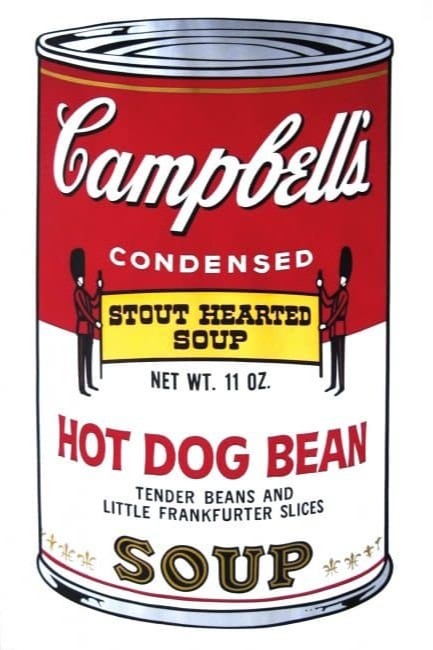
Campbell’S Hot Dog Bean
by Andy Warhol
Year: 1968
Medium: Screen print
Size: 35 x 23 in (88.9 x 58.42 cm)
At the heart of Andy Warhol’s celebrated Campbell’s Soup imagery, Campbell’s Hot Dog Bean (1968) transforms an everyday American food label into a refined statement on consumer culture and mass production. This 35 × 23-inch screenprint reflects Warhol’s enduring fascination with commercial design and repetition. Its bold, instantly recognisable composition makes it a compelling Pop Art work, offering collectors a distinctive example of one of Warhol’s defining subjects.
Campbell’s Hot Dog Bean by Andy Warhol belongs to the landmark Campbell’s Soup series that helped define American Pop Art in the early 1960s. It first appears within Warhol’s exploration of Campbell’s commercial packaging, where ordinary grocery products became subjects worthy of fine art. The unusual flavor combines the familiar soup label with a distinctly American food reference, turning everyday consumption into a study of branding, repetition, and desire.
There is no recognized street-graffiti version. Warhol’s Campbell’s works were created through his studio-based painting and screen-printing methods, not the later street-art tradition. Their power comes from presenting commercial imagery with the authority of fine art.
For collectors, Campbell’s Soup works remain among Warhol’s most recognizable and market-important images. Rarity, edition size, condition, signature, and provenance all influence desirability. Distinctive flavors can add character to a collection because they extend the story beyond the best-known Tomato label.
From our gallery perspective, the appeal is immediate: Warhol makes a humble supermarket product feel iconic. The work captures the moment when advertising, consumer culture, and contemporary art became inseparable.
Artistically, it belongs to Warhol’s breakthrough Pop period and connects to his Brillo, Coca-Cola, and other consumer-product works. It is a strong choice for collectors seeking a direct link to the foundation of Warhol’s career.
More Andy Warhol Works to Explore
Campbell’S Hot Dog Bean
by Andy Warhol
Year: 1968
Medium: Screen print
Size: 35 x 23 in (88.9 x 58.42 cm)
At the heart of Andy Warhol’s celebrated Campbell’s Soup imagery, Campbell’s Hot Dog Bean (1968) transforms an everyday American food label into a refined statement on consumer culture and mass production. This 35 × 23-inch screenprint reflects Warhol’s enduring fascination with commercial design and repetition. Its bold, instantly recognisable composition makes it a compelling Pop Art work, offering collectors a distinctive example of one of Warhol’s defining subjects.
Campbell’s Hot Dog Bean by Andy Warhol belongs to the landmark Campbell’s Soup series that helped define American Pop Art in the early 1960s. It first appears within Warhol’s exploration of Campbell’s commercial packaging, where ordinary grocery products became subjects worthy of fine art. The unusual flavor combines the familiar soup label with a distinctly American food reference, turning everyday consumption into a study of branding, repetition, and desire.
There is no recognized street-graffiti version. Warhol’s Campbell’s works were created through his studio-based painting and screen-printing methods, not the later street-art tradition. Their power comes from presenting commercial imagery with the authority of fine art.
For collectors, Campbell’s Soup works remain among Warhol’s most recognizable and market-important images. Rarity, edition size, condition, signature, and provenance all influence desirability. Distinctive flavors can add character to a collection because they extend the story beyond the best-known Tomato label.
From our gallery perspective, the appeal is immediate: Warhol makes a humble supermarket product feel iconic. The work captures the moment when advertising, consumer culture, and contemporary art became inseparable.
Artistically, it belongs to Warhol’s breakthrough Pop period and connects to his Brillo, Coca-Cola, and other consumer-product works. It is a strong choice for collectors seeking a direct link to the foundation of Warhol’s career.