
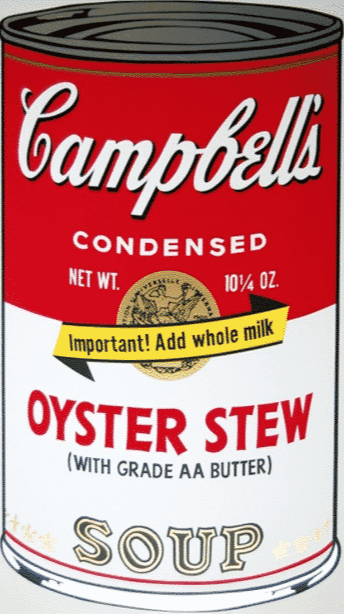
Campbell’S Oyster Stew
by Andy Warhol
Year: 1968
Medium: Screen print
Size: 35 x 23 in (88.9 x 58.42 cm)
Edition: 250
Signed
A refined emblem of Warhol’s fascination with American consumer culture, Campbell’s Oyster Stew (1968) is a 35 × 23-inch screenprint from his iconic Campbell’s Soup imagery. By elevating an everyday grocery label into Pop Art, Warhol blurs the boundaries between commerce, design, and fine art. Signed and numbered from an edition of 250, the work offers strong historical resonance and lasting appeal for discerning collectors.
Campbell’s Oyster Stew, from Campbell’s Soup II (F. & S. II.60), is a 1969 screenprint that extends Andy Warhol’s most important Pop Art subject: the everyday American soup can. The image traces back to Warhol’s breakthrough 1962 Campbell’s Soup Cans, first shown at Ferus Gallery in Los Angeles. By 1969, Warhol was revisiting the can through a larger, more polished portfolio, turning supermarket packaging into high art.
There is no recognized street-graffiti version. The power of this work lies in Warhol’s commercial screenprint language, where repetition, branding, and familiar packaging challenge the boundary between advertising and fine art. Oyster Stew also carries a sense of nostalgia, linking consumer culture with memory, comfort, and ordinary American life.
For collectors, the work is particularly attractive because it is an original signed Warhol screenprint from an edition of 250, with 26 artist’s proofs. Its strong auction history reflects sustained demand for the Campbell’s Soup imagery.
From our gallery perspective, Oyster Stew is Warhol at his most direct: simple, recognizable, and quietly radical.
It remains a smart acquisition for collectors seeking an accessible, historically important Warhol with enduring Pop Art appeal.
More Andy Warhol Works to Explore
Campbell’S Oyster Stew
by Andy Warhol
Year: 1968
Medium: Screen print
Size: 35 x 23 in (88.9 x 58.42 cm)
Edition: 250
A refined emblem of Warhol’s fascination with American consumer culture, Campbell’s Oyster Stew (1968) is a 35 × 23-inch screenprint from his iconic Campbell’s Soup imagery. By elevating an everyday grocery label into Pop Art, Warhol blurs the boundaries between commerce, design, and fine art. Signed and numbered from an edition of 250, the work offers strong historical resonance and lasting appeal for discerning collectors.
Campbell’s Oyster Stew, from Campbell’s Soup II (F. & S. II.60), is a 1969 screenprint that extends Andy Warhol’s most important Pop Art subject: the everyday American soup can. The image traces back to Warhol’s breakthrough 1962 Campbell’s Soup Cans, first shown at Ferus Gallery in Los Angeles. By 1969, Warhol was revisiting the can through a larger, more polished portfolio, turning supermarket packaging into high art.
There is no recognized street-graffiti version. The power of this work lies in Warhol’s commercial screenprint language, where repetition, branding, and familiar packaging challenge the boundary between advertising and fine art. Oyster Stew also carries a sense of nostalgia, linking consumer culture with memory, comfort, and ordinary American life.
For collectors, the work is particularly attractive because it is an original signed Warhol screenprint from an edition of 250, with 26 artist’s proofs. Its strong auction history reflects sustained demand for the Campbell’s Soup imagery.
From our gallery perspective, Oyster Stew is Warhol at his most direct: simple, recognizable, and quietly radical.
It remains a smart acquisition for collectors seeking an accessible, historically important Warhol with enduring Pop Art appeal.