
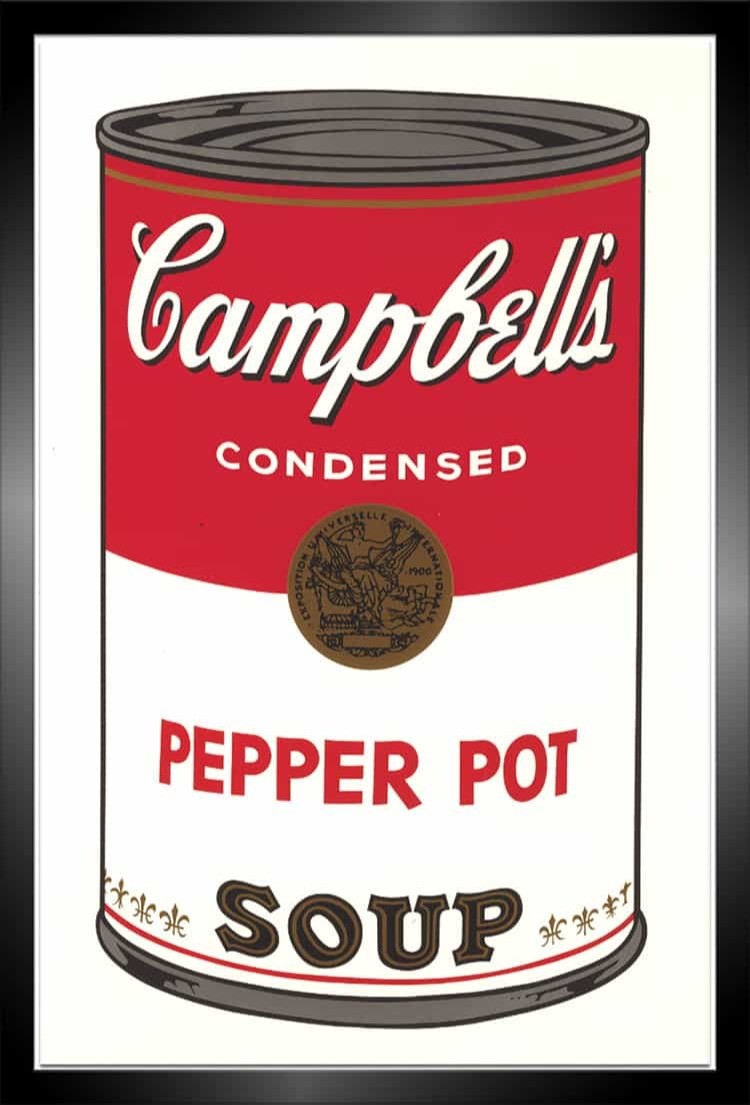
Campbell’S Soup - Pepper Pot
by Andy Warhol
Year: 1968
Medium: Screenprint
Size: 35 x 23 in (88.9 x 58.42 cm)
Edition: 250
Signed
Few images embody Andy Warhol’s Pop Art legacy as vividly as Campbell’s Soup – Pepper Pot, created in 1968 as a 35 × 23 in screenprint. By elevating an everyday pantry staple into a polished cultural emblem, Warhol blurred the line between commerce and fine art. Signed and limited to 250 examples, this sought-after work offers collectors a distinctive piece of post-war American visual culture.
Campbell’s Soup – Pepper Pot is part of Andy Warhol’s breakthrough Campbell’s Soup series, first presented in 1962 at Ferus Gallery in Los Angeles. By reproducing an ordinary supermarket label as fine art, Warhol made consumer packaging a portrait of postwar American life. There is no authentic street-graffiti version; the work was created through Warhol’s studio-based painting and screen-printing practice, not as a public-wall intervention.
For collectors, Pepper Pot is an important example of the Campbell’s Soup imagery that established Warhol as a leading Pop artist. Its appeal comes from the instantly recognizable label, strong cultural history, and connection to one of the most influential movements in modern art. Provenance, condition, edition details, and authentication are key when assessing market value.
From our curatorial perspective, Warhol’s achievement is deceptively simple: he made a pantry staple feel monumental. The work explores branding, repetition, convenience, mass production, and the changing idea of what could belong in a museum.
Pepper Pot sits at the foundation of Warhol’s mature Pop Art career, alongside other Campbell’s Soup varieties and later icons such as Marilyn, Mao, and Dollar Sign. For collectors, it offers an immediate and highly marketable connection to Warhol’s defining visual language.
More Andy Warhol Works to Explore
Campbell’S Soup - Pepper Pot
by Andy Warhol
Year: 1968
Medium: Screenprint
Size: 35 x 23 in (88.9 x 58.42 cm)
Edition: 250
Few images embody Andy Warhol’s Pop Art legacy as vividly as Campbell’s Soup – Pepper Pot, created in 1968 as a 35 × 23 in screenprint. By elevating an everyday pantry staple into a polished cultural emblem, Warhol blurred the line between commerce and fine art. Signed and limited to 250 examples, this sought-after work offers collectors a distinctive piece of post-war American visual culture.
Campbell’s Soup – Pepper Pot is part of Andy Warhol’s breakthrough Campbell’s Soup series, first presented in 1962 at Ferus Gallery in Los Angeles. By reproducing an ordinary supermarket label as fine art, Warhol made consumer packaging a portrait of postwar American life. There is no authentic street-graffiti version; the work was created through Warhol’s studio-based painting and screen-printing practice, not as a public-wall intervention.
For collectors, Pepper Pot is an important example of the Campbell’s Soup imagery that established Warhol as a leading Pop artist. Its appeal comes from the instantly recognizable label, strong cultural history, and connection to one of the most influential movements in modern art. Provenance, condition, edition details, and authentication are key when assessing market value.
From our curatorial perspective, Warhol’s achievement is deceptively simple: he made a pantry staple feel monumental. The work explores branding, repetition, convenience, mass production, and the changing idea of what could belong in a museum.
Pepper Pot sits at the foundation of Warhol’s mature Pop Art career, alongside other Campbell’s Soup varieties and later icons such as Marilyn, Mao, and Dollar Sign. For collectors, it offers an immediate and highly marketable connection to Warhol’s defining visual language.