
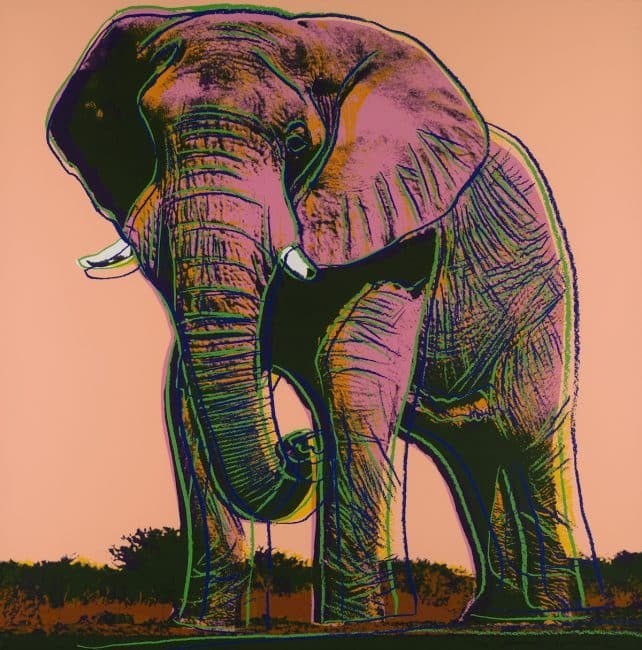
Elephant
by Andy Warhol
Year: 1983
Medium: Screen print on Lenox Museum Board
Size: 38 x 38 in (96.52 x 96.52 cm)
Edition: 150
Signed
Commanding yet refined, Andy Warhol’s Elephant (1983) brings the majesty of wildlife into the artist’s celebrated Pop Art language. Executed as a 38 × 38-inch screenprint on Lenox Museum Board, this signed work comes from an edition of 150. Its bold graphic presence and place within Warhol’s acclaimed animal imagery make it a compelling acquisition for collectors seeking distinctive works of late 20th-century Pop Art.
Elephant is part of Andy Warhol’s celebrated Endangered Species portfolio of 1983, created with Ronald and Frayda Feldman. The project presented ten threatened animals through Warhol’s signature silkscreen process, bringing conservation into the world of Pop art. The series was first presented in New York in 1983, turning wildlife into the same kind of instantly recognizable image Warhol had once reserved for celebrities and consumer brands.
There is no original street-graffiti version. Warhol made Elephant as a studio screenprint, not public-wall art. Its bold colours and enlarged photographic form, however, give it the direct visual force associated with street imagery.
The elephant becomes a symbol of strength, memory, dignity, and vulnerability. By placing an endangered animal within a Pop framework, Warhol also draws attention to the tension between nature and mass culture.
For collectors, Elephant has lasting appeal as a key work from Warhol’s mature period. Edition size, colour, condition, provenance, and rarity all influence market desirability.
From our gallery experience, the elephant has remarkable presence. It is approachable, highly decorative, and still carries a serious conservation message.
The work fits Warhol’s 1980s practice alongside Giant Panda, Grevy’s Zebra, Camouflage, and his late portraits. For collectors seeking a Warhol beyond Marilyn and Campbell’s Soup, Elephant offers strong visual impact, cultural meaning, and enduring Pop art importance.
More Andy Warhol Works to Explore
Elephant
by Andy Warhol
Year: 1983
Medium: Screen print on Lenox Museum Board
Size: 38 x 38 in (96.52 x 96.52 cm)
Edition: 150
Commanding yet refined, Andy Warhol’s Elephant (1983) brings the majesty of wildlife into the artist’s celebrated Pop Art language. Executed as a 38 × 38-inch screenprint on Lenox Museum Board, this signed work comes from an edition of 150. Its bold graphic presence and place within Warhol’s acclaimed animal imagery make it a compelling acquisition for collectors seeking distinctive works of late 20th-century Pop Art.
Elephant is part of Andy Warhol’s celebrated Endangered Species portfolio of 1983, created with Ronald and Frayda Feldman. The project presented ten threatened animals through Warhol’s signature silkscreen process, bringing conservation into the world of Pop art. The series was first presented in New York in 1983, turning wildlife into the same kind of instantly recognizable image Warhol had once reserved for celebrities and consumer brands.
There is no original street-graffiti version. Warhol made Elephant as a studio screenprint, not public-wall art. Its bold colours and enlarged photographic form, however, give it the direct visual force associated with street imagery.
The elephant becomes a symbol of strength, memory, dignity, and vulnerability. By placing an endangered animal within a Pop framework, Warhol also draws attention to the tension between nature and mass culture.
For collectors, Elephant has lasting appeal as a key work from Warhol’s mature period. Edition size, colour, condition, provenance, and rarity all influence market desirability.
From our gallery experience, the elephant has remarkable presence. It is approachable, highly decorative, and still carries a serious conservation message.
The work fits Warhol’s 1980s practice alongside Giant Panda, Grevy’s Zebra, Camouflage, and his late portraits. For collectors seeking a Warhol beyond Marilyn and Campbell’s Soup, Elephant offers strong visual impact, cultural meaning, and enduring Pop art importance.