
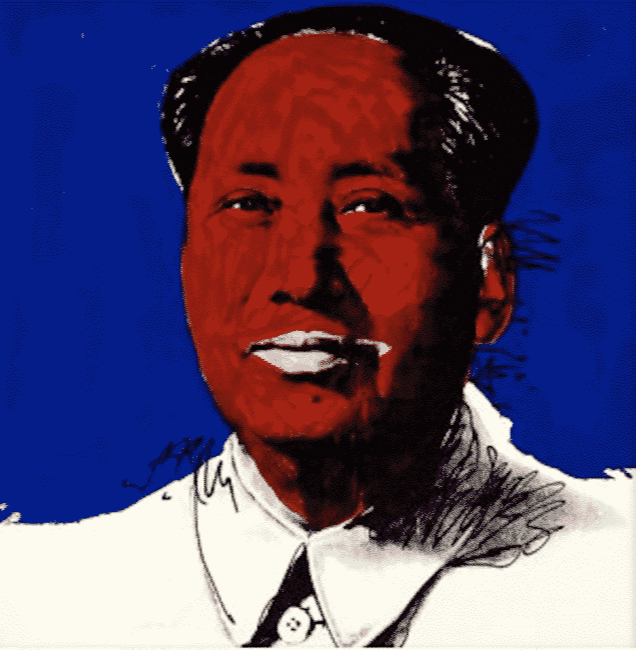
Mao 98
by Andy Warhol
Year: 1972
Medium: Screen print
Size: 36 x 36 in (91.44 x 91.44 cm)
Edition: 250
Signed
A striking example of Andy Warhol’s engagement with political imagery, Mao 98 (1972) transforms the portrait of China’s revolutionary leader into a commanding Pop Art icon. This 36 × 36-inch screenprint, signed and numbered from an edition of 250, reflects Warhol’s fascination with celebrity, power, and mass-media reproduction. Its bold graphic language and documented edition details enhance its appeal to discerning collectors of postwar art.
Mao 98 belongs to Andy Warhol’s landmark Mao series, first presented in 1972 after his famous Mao portraits transformed a political icon into Pop Art. There is no street-graffiti version because Warhol’s practice was studio-based screen printing, not street art. The image turns Mao into a mass-media symbol, exploring power, celebrity, repetition, and political spectacle.
For collectors, the Mao series remains one of Warhol’s most important bodies of work. Strong demand, instantly recognizable imagery, and limited editioned prints make works from the series highly collectible and commercially compelling.
From our gallery perspective, Mao 98 has the visual clarity that makes Warhol endure: a familiar face becomes a luxury object and a statement about modern culture.
The work sits within Warhol’s early-1970s political portrait period, alongside other Mao works and his portraits of cultural and political figures. It also connects to his broader fascination with celebrity and repetition. For collectors seeking an iconic Warhol with strong historical recognition, Mao 98 offers lasting cultural relevance and market appeal.
More Andy Warhol Works to Explore
Mao 98
by Andy Warhol
Year: 1972
Medium: Screen print
Size: 36 x 36 in (91.44 x 91.44 cm)
Edition: 250
A striking example of Andy Warhol’s engagement with political imagery, Mao 98 (1972) transforms the portrait of China’s revolutionary leader into a commanding Pop Art icon. This 36 × 36-inch screenprint, signed and numbered from an edition of 250, reflects Warhol’s fascination with celebrity, power, and mass-media reproduction. Its bold graphic language and documented edition details enhance its appeal to discerning collectors of postwar art.
Mao 98 belongs to Andy Warhol’s landmark Mao series, first presented in 1972 after his famous Mao portraits transformed a political icon into Pop Art. There is no street-graffiti version because Warhol’s practice was studio-based screen printing, not street art. The image turns Mao into a mass-media symbol, exploring power, celebrity, repetition, and political spectacle.
For collectors, the Mao series remains one of Warhol’s most important bodies of work. Strong demand, instantly recognizable imagery, and limited editioned prints make works from the series highly collectible and commercially compelling.
From our gallery perspective, Mao 98 has the visual clarity that makes Warhol endure: a familiar face becomes a luxury object and a statement about modern culture.
The work sits within Warhol’s early-1970s political portrait period, alongside other Mao works and his portraits of cultural and political figures. It also connects to his broader fascination with celebrity and repetition. For collectors seeking an iconic Warhol with strong historical recognition, Mao 98 offers lasting cultural relevance and market appeal.