
Mao (Fs Ii.94)
by Andy Warhol
Year: 1972
Medium: Color Screenprint on Beckett High White Paper
Size: 36 in x 36 in (91.4 cm x 91.4 cm)
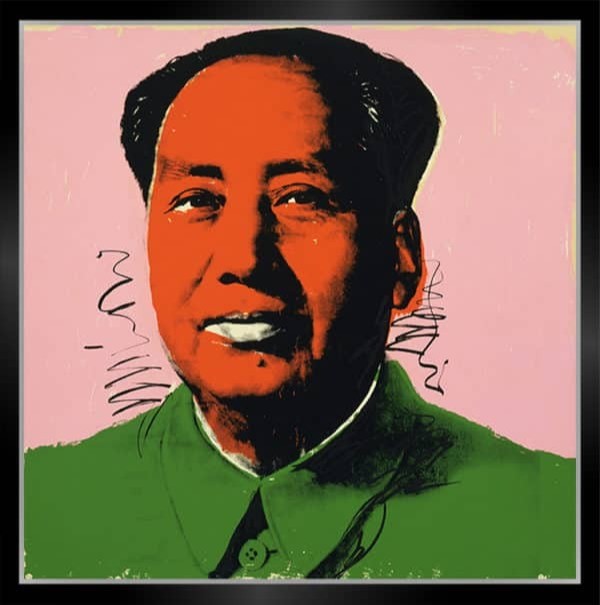
A defining image of Warhol’s 1970s practice, Mao (F.S. II.94) (1972) transforms the portrait of Chinese leader Mao Zedong into a striking meditation on power, politics, and celebrity. Executed as a 36 × 36-inch colour screenprint on Beckett High White paper, the work reflects Warhol’s fascination with mass-media imagery. Its commanding format and historical resonance make it a compelling proposition for discerning collectors of Pop Art.
Mao (F.S. II.94) by Andy Warhol belongs to his landmark Mao series, first presented in 1972. Warhol drew from the widely circulated official portrait of Chinese leader Mao Zedong, turning a powerful political image into a Pop Art icon. By repeating and recoloring Mao’s face, he blurred the line between political power, celebrity, mass media, and consumer culture. The work explores image-making, authority, fame, and the way repetition can weaken or amplify a public figure’s power.
There is no recognized street-graffiti version. Warhol’s Mao works were created through his studio-based screen-printing practice, before contemporary street art became the global movement it is today.
For collectors, Mao remains one of Warhol’s most important portrait series. Rarity, edition, color, condition, signature, and provenance all influence demand. Strong examples have lasting market appeal because the image is instantly associated with Warhol’s mature Pop period.
From our gallery perspective, Mao is compelling because Warhol turns political authority into visual currency. The result feels both historic and surprisingly contemporary.
Artistically, it follows Warhol’s Marilyn Monroe and celebrity portraits while opening a more political chapter in his career. For collectors seeking a defining Warhol image, Mao (F.S. II.94) offers exceptional cultural and market significance.
More Andy Warhol Works to Explore
Mao (Fs Ii.94)
by Andy Warhol
Year: 1972
Medium: Color Screenprint on Beckett High White Paper
Size: 36 in x 36 in (91.4 cm x 91.4 cm)
A defining image of Warhol’s 1970s practice, Mao (F.S. II.94) (1972) transforms the portrait of Chinese leader Mao Zedong into a striking meditation on power, politics, and celebrity. Executed as a 36 × 36-inch colour screenprint on Beckett High White paper, the work reflects Warhol’s fascination with mass-media imagery. Its commanding format and historical resonance make it a compelling proposition for discerning collectors of Pop Art.
Mao (F.S. II.94) by Andy Warhol belongs to his landmark Mao series, first presented in 1972. Warhol drew from the widely circulated official portrait of Chinese leader Mao Zedong, turning a powerful political image into a Pop Art icon. By repeating and recoloring Mao’s face, he blurred the line between political power, celebrity, mass media, and consumer culture. The work explores image-making, authority, fame, and the way repetition can weaken or amplify a public figure’s power.
There is no recognized street-graffiti version. Warhol’s Mao works were created through his studio-based screen-printing practice, before contemporary street art became the global movement it is today.
For collectors, Mao remains one of Warhol’s most important portrait series. Rarity, edition, color, condition, signature, and provenance all influence demand. Strong examples have lasting market appeal because the image is instantly associated with Warhol’s mature Pop period.
From our gallery perspective, Mao is compelling because Warhol turns political authority into visual currency. The result feels both historic and surprisingly contemporary.
Artistically, it follows Warhol’s Marilyn Monroe and celebrity portraits while opening a more political chapter in his career. For collectors seeking a defining Warhol image, Mao (F.S. II.94) offers exceptional cultural and market significance.