
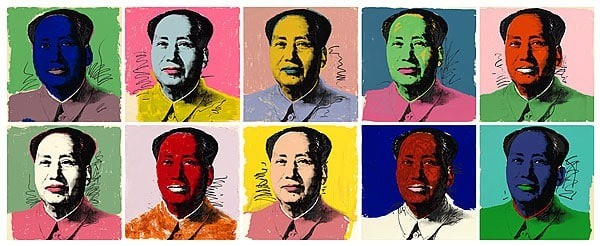
Mao The Complete Portfolio
by Andy Warhol
Year: 1972
Medium: Screen print
Size: 36 x 36 in (91.44 x 91.44 cm)
Edition: 250
Signed
Andy Warhol’s Mao: The Complete Portfolio (1972) transforms the image of Mao Zedong into a defining statement of American Pop Art and political imagery. Executed as screenprints measuring 36 × 36 inches, the portfolio reflects Warhol’s fascination with celebrity, propaganda, repetition, and mass communication. Signed and numbered from an edition of 250, it presents a culturally significant acquisition with compelling historical resonance for serious collectors.
Mao: The Complete Portfolio is one of Andy Warhol’s most important political Pop Art statements. Created in 1972, the portfolio followed President Richard Nixon’s historic 1972 visit to China and Warhol’s fascination with Mao Zedong as both political leader and mass-produced cultural image. Warhol transformed Mao’s official portrait into a glamorous, repeatable icon.
There is no recognized street-graffiti version of the complete portfolio. Its strength comes from Warhol’s disciplined screenprint process, large scale, vivid color, and deliberate variations across the images. The work explores power, propaganda, celebrity, and the way repeated images can reshape public perception.
For collectors, the complete portfolio is considerably rarer and more significant than individual Mao prints. Its completeness, edition status, condition, color, and provenance are central to value. In my experience, major Warhol portfolios attract serious international collectors because they offer both visual impact and historical depth.
Our curatorial view is straightforward: Mao shows Warhol turning political authority into celebrity culture. That tension makes the portfolio exceptionally compelling.
It sits firmly within Warhol’s mature 1970s practice, alongside his Ladies and Gentlemen, Mick Jagger, and Skulls portfolios. For a collector seeking a major Warhol statement, the complete Mao portfolio is a powerful acquisition.
More Andy Warhol Works to Explore
Mao The Complete Portfolio
by Andy Warhol
Year: 1972
Medium: Screen print
Size: 36 x 36 in (91.44 x 91.44 cm)
Edition: 250
Andy Warhol’s Mao: The Complete Portfolio (1972) transforms the image of Mao Zedong into a defining statement of American Pop Art and political imagery. Executed as screenprints measuring 36 × 36 inches, the portfolio reflects Warhol’s fascination with celebrity, propaganda, repetition, and mass communication. Signed and numbered from an edition of 250, it presents a culturally significant acquisition with compelling historical resonance for serious collectors.
Mao: The Complete Portfolio is one of Andy Warhol’s most important political Pop Art statements. Created in 1972, the portfolio followed President Richard Nixon’s historic 1972 visit to China and Warhol’s fascination with Mao Zedong as both political leader and mass-produced cultural image. Warhol transformed Mao’s official portrait into a glamorous, repeatable icon.
There is no recognized street-graffiti version of the complete portfolio. Its strength comes from Warhol’s disciplined screenprint process, large scale, vivid color, and deliberate variations across the images. The work explores power, propaganda, celebrity, and the way repeated images can reshape public perception.
For collectors, the complete portfolio is considerably rarer and more significant than individual Mao prints. Its completeness, edition status, condition, color, and provenance are central to value. In my experience, major Warhol portfolios attract serious international collectors because they offer both visual impact and historical depth.
Our curatorial view is straightforward: Mao shows Warhol turning political authority into celebrity culture. That tension makes the portfolio exceptionally compelling.
It sits firmly within Warhol’s mature 1970s practice, alongside his Ladies and Gentlemen, Mick Jagger, and Skulls portfolios. For a collector seeking a major Warhol statement, the complete Mao portfolio is a powerful acquisition.