
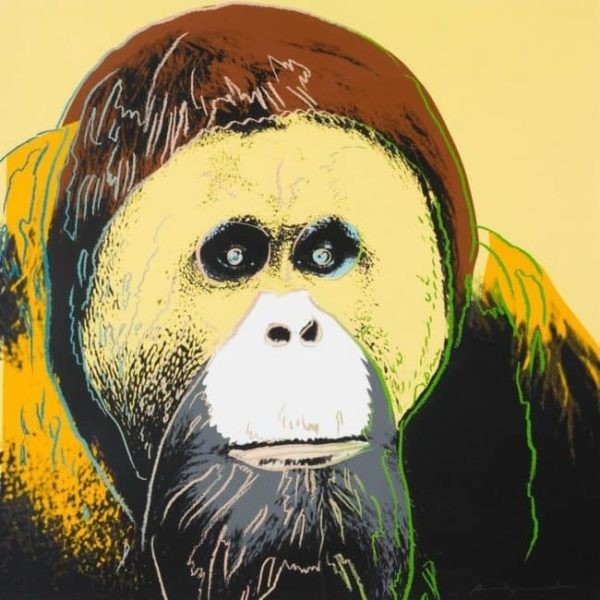
Orangutan
by Andy Warhol
Year: 1983
Medium: Screenprint on Lenox Museum Board
Size: 38 x 38 in (96.52 x 96.52 cm)
Edition: 150
Signed
With its vivid presence and refined graphic language, Andy Warhol’s Orangutan (1983) transforms a distinctive animal subject into a striking Pop Art image. This 38 × 38-inch screenprint on Lenox Museum Board is from a signed edition of 150. Representing Warhol’s celebrated engagement with wildlife imagery, the work offers visual impact, rarity, and strong appeal for collectors of important 20th-century prints.
Orangutan connects to Andy Warhol’s late fascination with wildlife, particularly the endangered-animal imagery that shaped his 1980s practice. It should be distinguished from the ten-animal Endangered Species portfolio of 1983: Warhol explored other animals in related works, using photography and silkscreen to bring nature into the same visual world as his celebrity and commercial subjects.
There is no original street-graffiti version. Warhol’s animal images were created through his studio process, where photographic sources, bold colour, and silkscreen allowed him to turn a recognizable creature into a Pop image.
The orangutan carries strong themes of intelligence, individuality, vulnerability, and the uneasy relationship between humans and the natural world. Warhol’s treatment also invites a familiar question: when an animal becomes a reproduced image, what is gained—and what is lost?
For collectors, Orangutan offers a distinctive alternative to Warhol’s famous Marilyn, Soup Can, and celebrity works. Exact edition details, rarity, condition, and provenance are essential when assessing market importance.
In our gallery experience, Warhol’s animal subjects often appeal to collectors seeking something more unexpected. The orangutan has both graphic strength and emotional presence.
It fits Warhol’s mature 1980s period, alongside Camouflage, Ads, and his late portraiture. For a collector building a sophisticated Pop art collection, Orangutan offers an unusual combination of Warhol’s signature technique, wildlife imagery, and contemporary relevance.
More Andy Warhol Works to Explore
Orangutan
by Andy Warhol
Year: 1983
Medium: Screenprint on Lenox Museum Board
Size: 38 x 38 in (96.52 x 96.52 cm)
Edition: 150
With its vivid presence and refined graphic language, Andy Warhol’s Orangutan (1983) transforms a distinctive animal subject into a striking Pop Art image. This 38 × 38-inch screenprint on Lenox Museum Board is from a signed edition of 150. Representing Warhol’s celebrated engagement with wildlife imagery, the work offers visual impact, rarity, and strong appeal for collectors of important 20th-century prints.
Orangutan connects to Andy Warhol’s late fascination with wildlife, particularly the endangered-animal imagery that shaped his 1980s practice. It should be distinguished from the ten-animal Endangered Species portfolio of 1983: Warhol explored other animals in related works, using photography and silkscreen to bring nature into the same visual world as his celebrity and commercial subjects.
There is no original street-graffiti version. Warhol’s animal images were created through his studio process, where photographic sources, bold colour, and silkscreen allowed him to turn a recognizable creature into a Pop image.
The orangutan carries strong themes of intelligence, individuality, vulnerability, and the uneasy relationship between humans and the natural world. Warhol’s treatment also invites a familiar question: when an animal becomes a reproduced image, what is gained—and what is lost?
For collectors, Orangutan offers a distinctive alternative to Warhol’s famous Marilyn, Soup Can, and celebrity works. Exact edition details, rarity, condition, and provenance are essential when assessing market importance.
In our gallery experience, Warhol’s animal subjects often appeal to collectors seeking something more unexpected. The orangutan has both graphic strength and emotional presence.
It fits Warhol’s mature 1980s period, alongside Camouflage, Ads, and his late portraiture. For a collector building a sophisticated Pop art collection, Orangutan offers an unusual combination of Warhol’s signature technique, wildlife imagery, and contemporary relevance.