
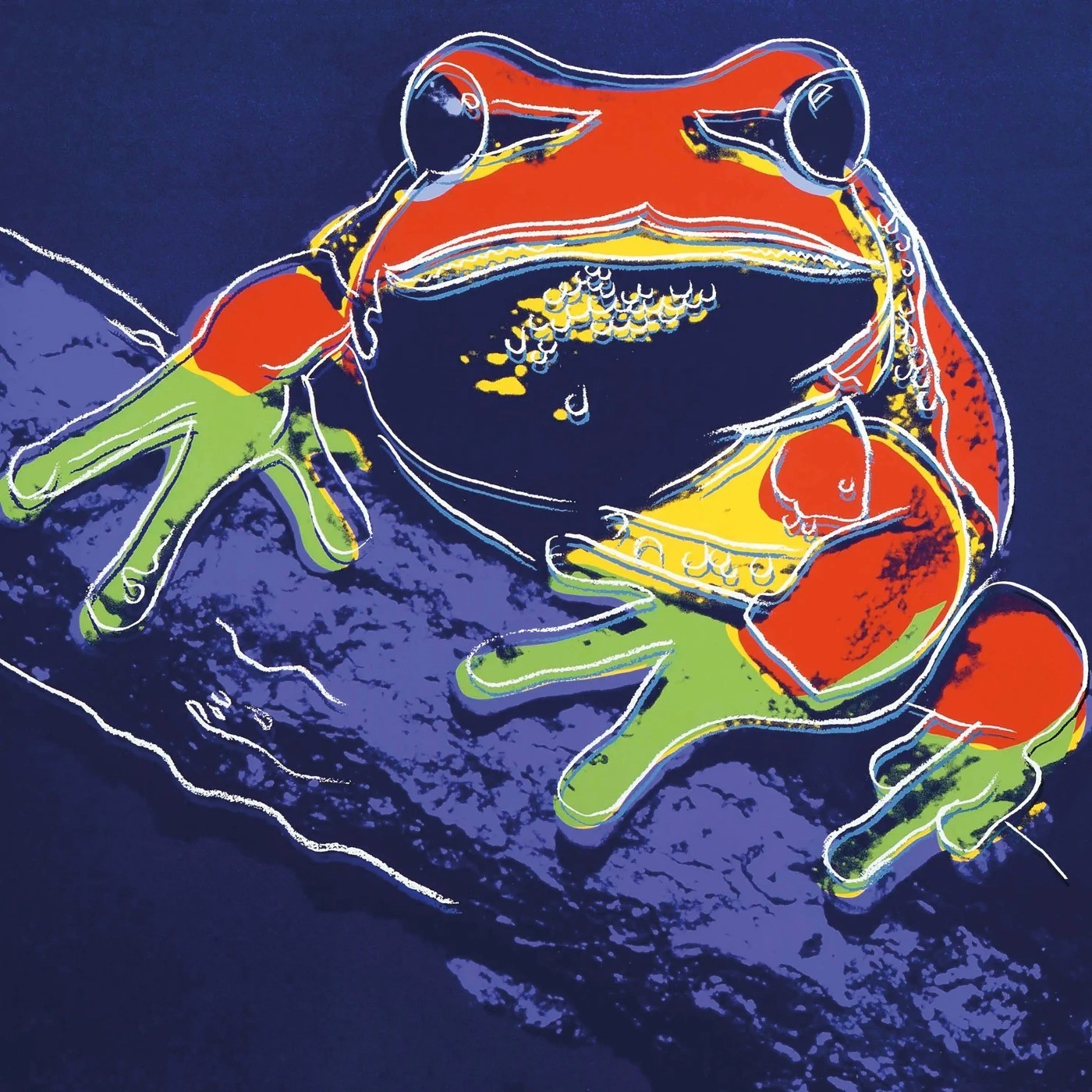
Pine Barrens Tree Frog (Fs Ii.294)
by Andy Warhol
Year: 1983
Medium: Screen print on Lenox Museum Board
Size: 38 x 38 in (96.52 x 96.52 cm)
Edition: 150
Signed
Nature takes on Pop Art glamour in Andy Warhol’s Pine Barrens Tree Frog (FS II.294) (1983), a 38 × 38-inch screenprint on Lenox Museum Board. Part of Warhol’s celebrated animal imagery, the work elevates an endangered American species into a bold study of colour, reproduction, and visual culture. Signed and numbered from an edition of 150, it offers notable rarity and strong appeal for discerning collectors.
Pine Barrens Tree Frog (F. S. II.294) belongs to Andy Warhol’s late Endangered Species series, created in 1983 with the environmentalist Ronald Feldman. The portfolio brought rare animals into Warhol’s Pop vocabulary, turning conservation into striking contemporary imagery. The Pine Barrens tree frog, native to the wetlands of New Jersey, carries a strong message about fragile habitats and disappearing wildlife.
There is no recognized street-graffiti version. Warhol’s original is a screenprint, where saturated color, clean contours, and repetition transform a vulnerable species into a bold Pop icon. The frog suggests survival, ecological balance, and the tension between natural beauty and human development.
For collectors, this work offers a compelling entry into Warhol’s later market. Scarcity, edition size, signature, condition, color, and provenance all influence value. The Endangered Species series remains important because it connects Warhol’s commercial imagery with a lasting environmental theme.
From our gallery perspective, the appeal is immediate: Warhol makes conservation memorable without sacrificing visual sophistication. The image is playful, but its subject is serious.
Artistically, it belongs to Warhol’s mature 1980s period and relates closely to the other Endangered Species portraits, including works depicting elephants, tigers, pandas, and eagles. For collectors, it combines Pop Art recognition with a meaningful conservation story.
More Andy Warhol Works to Explore
Pine Barrens Tree Frog (Fs Ii.294)
by Andy Warhol
Year: 1983
Medium: Screen print on Lenox Museum Board
Size: 38 x 38 in (96.52 x 96.52 cm)
Edition: 150
Nature takes on Pop Art glamour in Andy Warhol’s Pine Barrens Tree Frog (FS II.294) (1983), a 38 × 38-inch screenprint on Lenox Museum Board. Part of Warhol’s celebrated animal imagery, the work elevates an endangered American species into a bold study of colour, reproduction, and visual culture. Signed and numbered from an edition of 150, it offers notable rarity and strong appeal for discerning collectors.
Pine Barrens Tree Frog (F. S. II.294) belongs to Andy Warhol’s late Endangered Species series, created in 1983 with the environmentalist Ronald Feldman. The portfolio brought rare animals into Warhol’s Pop vocabulary, turning conservation into striking contemporary imagery. The Pine Barrens tree frog, native to the wetlands of New Jersey, carries a strong message about fragile habitats and disappearing wildlife.
There is no recognized street-graffiti version. Warhol’s original is a screenprint, where saturated color, clean contours, and repetition transform a vulnerable species into a bold Pop icon. The frog suggests survival, ecological balance, and the tension between natural beauty and human development.
For collectors, this work offers a compelling entry into Warhol’s later market. Scarcity, edition size, signature, condition, color, and provenance all influence value. The Endangered Species series remains important because it connects Warhol’s commercial imagery with a lasting environmental theme.
From our gallery perspective, the appeal is immediate: Warhol makes conservation memorable without sacrificing visual sophistication. The image is playful, but its subject is serious.
Artistically, it belongs to Warhol’s mature 1980s period and relates closely to the other Endangered Species portraits, including works depicting elephants, tigers, pandas, and eagles. For collectors, it combines Pop Art recognition with a meaningful conservation story.