
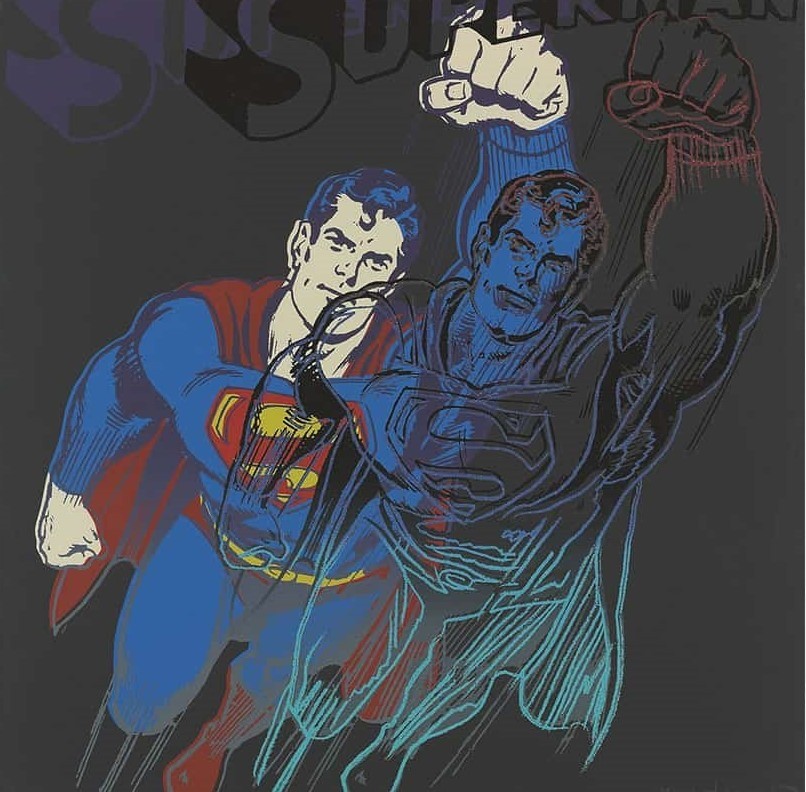
Superman
by Andy Warhol
Year: 1981
Medium: Color Screenprint With Diamond Dust
Size: 38 × 38 in 96.5 × 96.5 cm
Edition 198/200
Rising from the visual language of American comics, Andy Warhol’s Superman (1981) is a commanding 38 × 38-inch colour screenprint enhanced with diamond dust. Warhol transforms the iconic superhero into a shimmering meditation on celebrity, fantasy, and mass culture. Numbered 198/200, the work combines bold graphic impact with tactile brilliance, offering a distinctive example of Warhol’s mature Pop Art and an appealing opportunity for collectors.
Superman by Andy Warhol belongs to his 1960s Pop period, when comic-book heroes, advertising, and mass media became central to his visual language. The image first appears in his 1961–62 Superman paintings and drawings, made as Warhol turned a familiar comic character into fine art. He strips the hero of narrative and presents him as a bold symbol of American fantasy, power, and consumer culture.
There is no recognized street-graffiti version. Warhol’s Superman is firmly tied to his early studio-based Pop practice, where mechanical reproduction and commercial imagery replaced the spontaneous mark-making associated with street art. The work plays with ideas of celebrity, identity, masculinity, and the manufactured nature of heroism.
For collectors, Superman is especially important because it belongs to the formative years of Warhol’s career, before his iconic Marilyn Monroe and Campbell’s Soup images. Early Superman works are comparatively scarce, and strong provenance can significantly enhance their appeal and market value.
From our gallery perspective, Warhol’s genius here is simple: he turns a comic-book hero into a cultural mirror. Superman represents the ideal America sold to the public—powerful, recognizable, and endlessly reproducible.
The work connects directly to Warhol’s early comic paintings, including Dick Tracy, Batman, and Popeye, marking a pivotal step toward the Pop language that made him one of the most influential artists of the 20th century.
More Andy Warhol Works to Explore
Superman
by Andy Warhol
Year: 1981
Medium: Color Screenprint With Diamond Dust
Size: 38 × 38 in 96.5 × 96.5 cm
Edition 198/200
Rising from the visual language of American comics, Andy Warhol’s Superman (1981) is a commanding 38 × 38-inch colour screenprint enhanced with diamond dust. Warhol transforms the iconic superhero into a shimmering meditation on celebrity, fantasy, and mass culture. Numbered 198/200, the work combines bold graphic impact with tactile brilliance, offering a distinctive example of Warhol’s mature Pop Art and an appealing opportunity for collectors.
Superman by Andy Warhol belongs to his 1960s Pop period, when comic-book heroes, advertising, and mass media became central to his visual language. The image first appears in his 1961–62 Superman paintings and drawings, made as Warhol turned a familiar comic character into fine art. He strips the hero of narrative and presents him as a bold symbol of American fantasy, power, and consumer culture.
There is no recognized street-graffiti version. Warhol’s Superman is firmly tied to his early studio-based Pop practice, where mechanical reproduction and commercial imagery replaced the spontaneous mark-making associated with street art. The work plays with ideas of celebrity, identity, masculinity, and the manufactured nature of heroism.
For collectors, Superman is especially important because it belongs to the formative years of Warhol’s career, before his iconic Marilyn Monroe and Campbell’s Soup images. Early Superman works are comparatively scarce, and strong provenance can significantly enhance their appeal and market value.
From our gallery perspective, Warhol’s genius here is simple: he turns a comic-book hero into a cultural mirror. Superman represents the ideal America sold to the public—powerful, recognizable, and endlessly reproducible.
The work connects directly to Warhol’s early comic paintings, including Dick Tracy, Batman, and Popeye, marking a pivotal step toward the Pop language that made him one of the most influential artists of the 20th century.