
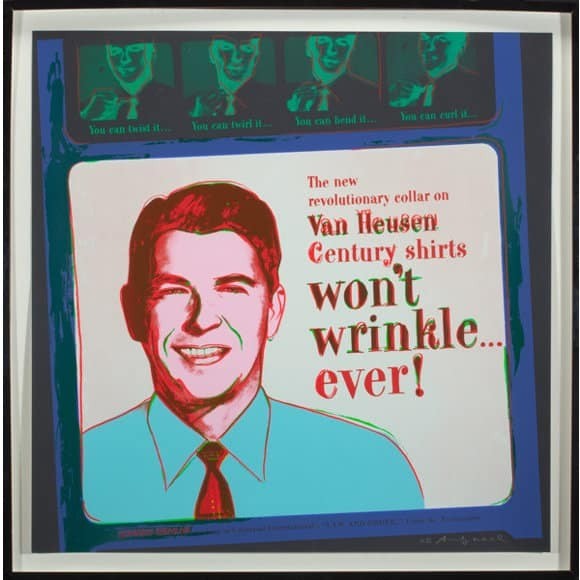
Van Heusen (Ronald Reagan) (Fs Ii.356)
by Andy Warhol
Year: 1985
Medium: Screenprint on Lenox Museum Board.
Size: 38″x 38″
Edition of 190, 30 AP, 5 PP, 5 EP, 10 HC, 10 numbered in Roman numerals, 1 BAT, 30 TP, signed and numbered in pencil.
Portfolio of 10.
Bringing politics, celebrity, and advertising into sharp focus, Andy Warhol’s Van Heusen (Ronald Reagan) (FS II.356) (1985) is a 38 × 38-inch screenprint on Lenox Museum Board. Part of a portfolio of 10, the work turns Reagan’s public image into a study of American branding and mass media. Signed and numbered in pencil, its varied edition structure adds distinction and collector interest.
Van Heusen (Ronald Reagan) (F. S. II.356) comes from Andy Warhol’s late advertising-inspired Pop Art, based on Ronald Reagan’s earlier career as a Hollywood actor and spokesman for Van Heusen shirts. Warhol revisited this image in the 1985–86 Ads series, when Reagan was serving as U.S. president. The work blends celebrity, fashion, politics, and consumer culture.
There is no recognized street-graffiti version. Its power comes from Warhol’s screenprint language, where a polished commercial image becomes a commentary on how fame and political identity are packaged and sold. Reagan’s confident pose suggests status, aspiration, and the carefully constructed image of American success.
For collectors, this work has strong market appeal because it links Warhol to both celebrity culture and American political history. Scarcity, edition, condition, signature, and provenance remain key factors. In my experience, works from the Ads series attract collectors who want a more sophisticated side of Warhol beyond the classic Campbell’s Soup and Marilyn images.
Our gallery view is that the work is especially compelling today: it shows how closely advertising, celebrity, and power can overlap.
It belongs to Warhol’s mature 1980s practice and relates to his Ads, Portraits, and celebrity-focused works. For collectors, it offers cultural relevance, strong visual presence, and a distinctive Warhol narrative.
More Andy Warhol Works to Explore
Van Heusen (Ronald Reagan) (Fs Ii.356)
by Andy Warhol
Year: 1985
Medium: Screenprint on Lenox Museum Board.
Size: 38″x 38″
Edition of 190, 30 AP, 5 PP, 5 EP, 10 HC, 10 numbered in Roman numerals, 1 BAT, 30 TP, signed and numbered in pencil.
Bringing politics, celebrity, and advertising into sharp focus, Andy Warhol’s Van Heusen (Ronald Reagan) (FS II.356) (1985) is a 38 × 38-inch screenprint on Lenox Museum Board. Part of a portfolio of 10, the work turns Reagan’s public image into a study of American branding and mass media. Signed and numbered in pencil, its varied edition structure adds distinction and collector interest.
Van Heusen (Ronald Reagan) (F. S. II.356) comes from Andy Warhol’s late advertising-inspired Pop Art, based on Ronald Reagan’s earlier career as a Hollywood actor and spokesman for Van Heusen shirts. Warhol revisited this image in the 1985–86 Ads series, when Reagan was serving as U.S. president. The work blends celebrity, fashion, politics, and consumer culture.
There is no recognized street-graffiti version. Its power comes from Warhol’s screenprint language, where a polished commercial image becomes a commentary on how fame and political identity are packaged and sold. Reagan’s confident pose suggests status, aspiration, and the carefully constructed image of American success.
For collectors, this work has strong market appeal because it links Warhol to both celebrity culture and American political history. Scarcity, edition, condition, signature, and provenance remain key factors. In my experience, works from the Ads series attract collectors who want a more sophisticated side of Warhol beyond the classic Campbell’s Soup and Marilyn images.
Our gallery view is that the work is especially compelling today: it shows how closely advertising, celebrity, and power can overlap.
It belongs to Warhol’s mature 1980s practice and relates to his Ads, Portraits, and celebrity-focused works. For collectors, it offers cultural relevance, strong visual presence, and a distinctive Warhol narrative.