The $236 Million Klimt and the Great Capital Rotation
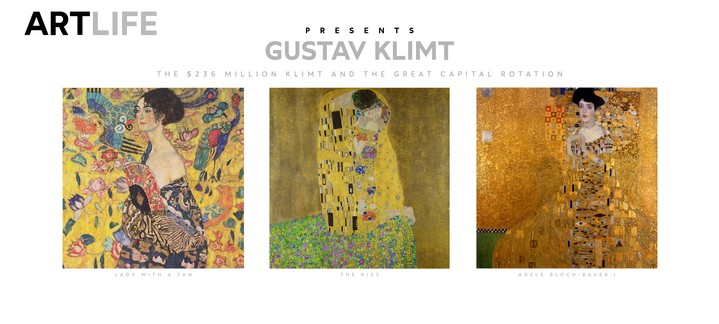
$236M Klimt Lederer Sale
Financial markets rarely present such a stark dichotomy in a single trading week. On one side of the ledger, digital market investors faced a brutal reality check. Bitcoin prices retraced approximately 30% from recent highs, erasing months of speculative gains in a matter of days.
Weighted heavily by the technology sector, the NASDAQ experienced notable volatility during the same week, with major tech stocks —including Nvidia— facing valuation pressure. The prevailing sentiment on the trading floors was one of caution, if not outright fear.
Yet, on Madison Avenue, inside the brutalist concrete structure that formerly housed the Whitney Museum, a very different financial reality played out. There was no panic selling here. Instead, the room witnessed a disciplined, high-stakes acquisition of history.
On the evening of November 18, 2025, Sotheby’s inaugurated its new flagship headquarters in the Breuer building —acquired for roughly $100 million— with a deal that will likely define the 2025 fiscal year. The headline event was the sale of Gustav Klimt’s Portrait of Elisabeth Lederer (1914–16). The hammer fell at a staggering $236.4 million.
This figure ranks as the second-highest price ever paid for a painting at auction, trailing only Leonardo da Vinci’s Salvator Mundi. However, focusing solely on the price tag misses the broader economic signal.
Occurring precisely as “paper” markets were bleeding, the sale confirms a thesis that ArtLife’s CEO, Avery Andon, has maintained for months: in a climate of digital instability, tangible, blue-chip holdings act as a necessary hedge for capital preservation.
Macro Context: Liquidity in Motion
The logic behind this quarter-billion-dollar acquisition lies in the shifting mechanics of global liquidity. For the past 24 months, the ‘risk-on’ trade dominated investment strategies. Capital flooded into high-growth technology stocks and decentralized finance projects, driven by low interest rates and speculative enthusiasm.
That tide has turned. The recent correction in Bitcoin and the cooling of the AI-driven tech boom suggest investors are re-evaluating their exposure to intangible instruments. High-net-worth individuals (HNWI) and institutional collectors are rotating out of volatility and into stability.
The logic behind that capital rotation becomes clearer when you compare the risk profiles side by side:
- Risk Profile Shift: Crypto assets can swing violently within hours due to macro headlines or regulatory pressure, a pattern that stands in sharp contrast to the slow-moving, historically anchored trajectory of blue-chip art.
- Tangibility: Physical possession of a unique object provides a level of psychological and financial security that a digital wallet simply cannot replicate.
- Inflation Hedging: Historically, blue-chip art outpaces inflation over long horizons. It protects capital precisely when fiat currency purchasing power fluctuates.
The buyer’s move marks a shift toward long-duration assets, prioritizing works whose value compounds through cultural relevance rather than short-term market cycles.
Inside the Breuer Building: A High-Stakes Debut
The venue itself raised the stakes for the evening. Sotheby’s recently purchased the Breuer building for $100 million, a bold real estate move designed to secure its top position in the New York market. Launching this landmark with the Leonard A. Lauder collection raised expectations —the sale needed to justify the investment.
The atmosphere in the salesroom was charged. The auction house had secured “irrevocable bids” (third-party guarantees) for many lots to mitigate risk, but the Lederer portrait tested the organic depth of the market.
Bidding for the Klimt stretched into a roughly 19–20 minute contest, with at least six bidders competing well past its $150 million pre-sale estimate. The identities of the participants were not disclosed.
When the price surpassed $200 million, the tension broke. The audience applauded, a reaction that signaled relief as much as celebration. Total sales for the evening reached approximately $706 million —a result that significantly outperformed comparable sales from the previous year—. This volume indicates that despite the contraction in the broader economy, the apex of the wealth pyramid remains liquid and willing to deploy capital for the right opportunity.
Provenance as the Ultimate Value Driver
In the high-stakes art market, the backstory often carries as much weight as the image itself. The Lederer portrait commands a premium because its provenance reads like a cinematic script, infusing the work with a unique form of ‘survivor equity’.
Painted between 1914 and 1916, during Klimt’s celebrated Golden Period, the masterpiece depicts Elisabeth Lederer, the 20-year-old daughter of Baron August and Serena Lederer.
The family was among the most important patrons of the Vienna Secession movement, amassing a collection that defined the era. However, the painting’s journey through the 20th century was perilous.
Following the Nazi annexation of Austria in 1938, the Gestapo seized the Lederer collection. Many of the works were transported to Schloss Immendorf for storage.
In the final days of World War II, retreating SS troops set fire to the castle to prevent the Allies from securing its contents. The blaze was a cultural tragedy, incinerating several of Klimt’s most important works, including his famous Faculty Paintings.
Portrait of Elisabeth Lederer miraculously escaped the flames. But the survival story extends to the subject herself, involving a desperate legal maneuver that saved her life:
- Aryanization Plea: As a Jewish woman in Nazi-occupied Vienna, Elisabeth Lederer faced deportation to a concentration camp.
- Legal Affidavit: Her mother, Serena, signed a sworn legal document claiming that Elisabeth was not the biological daughter of her Jewish husband, August.
- Klimt Connection: Serena claimed that Elisabeth was actually the illegitimate child of Gustav Klimt(who was considered “Aryan” by the regime.
- The Result: Nazi authorities accepted the claim, issuing a certificate of descent that spared Elisabeth from the Holocaust.
Owning this painting means becoming the custodian of this history. The buyer acquired a document of survival against the darkest chapter of modern times, a provenance that makes the work culturally —and financially— irreplaceable.
Lauder Collection Strategy: The Premium on Freshness
Another critical factor driving the aggressive bidding was the source of the painting. It came from the estate of Leonard A. Lauder, the billionaire heir to the Estée Lauder cosmetics empire. Lauder purchased the work nearly 40 years ago, and it remained in his private collection until this week.
In the current market ecosystem, “freshness” is a highly prized quality. Works that trade hands frequently at auction often suffer from "market burn"—collectors know the previous price and perceive the piece as shopped around. Conversely, a masterpiece that has been locked away in a legendary collection for four decades feels like a new discovery.
Lauder’s reputation as a discerning eye—he was a longtime trustee of the Whitney Museum and one of the world’s foremost collectors of Cubism—acted as a seal of quality. Buyers understood that the work was authentic, impeccably conserved, and curated with intelligence.
This demand for top-tier material extended beyond the Klimt. A drawing by Vincent van Gogh, The Sower in a Wheat Field at Sunset, sold for $11.2 million, setting a new auction record for a pen-and-ink work by the artist. Such results reinforce the trend: capital is available, but it is highly selective, targeting only the best-in-class examples.
Capital Rotation: Digital Volatility vs. Tangible Wealth
Moving $236.4 million into the Lederer portrait reveals something far more significant than a simple appetite for luxury. We are watching a structural ‘flight to quality’ play out in real time. As ArtLife analysts noted earlier this week, the timing is precise: the digital market correction and the sudden spike in blue-chip art values are directly linked.
For the past decade, the “wealth effect” was driven by intangible valuations. Speculative capital poured into cryptocurrencies and high-growth technology stocks, betting on future earnings and network effects. However, the current trading week exposed the fragility of that thesis.
The Market Divergence:
- Digital Asset Meltdown: Bitcoin prices have retraced nearly 30%, erasing billions in paper wealth. Selling pressure across the cryptocurrency sector reflects a broader risk-off sentiment, liquidating holdings with no underlying physical utility first.
- Tech Sector Volatility: Major technology indices, including the NASDAQ, are grappling with instability. High-flying stocks like Nvidia are seeing their multiples compressed as investors question whether the AI boom can sustain exponential growth.
- Tangible Stability: In direct contrast, the top 0.1% of the art market functions as a non-correlated investment. When equities bleed, masterpieces often hold or increase their value. The Lederer sale confirms that liquidity has consolidated exclusively at the market’s peak.
Smart money is repositioning—moving out of short-term speculative exposures and into assets that can anchor long-term wealth. A blue-chip canvas carries none of the systemic vulnerabilities embedded in digital instruments.
Strategies for the remainder of 2025 are shifting toward ‘real’ holdings —gold, prime real estate, and museum-quality art— at the expense of the digital speculation that defined the previous cycle. The Klimt sale is the clearest datapoint yet of where high-tier capital is migrating.
Ready to Start Your Collection?
Success in this market hinges on insight and access. ArtLife delivers both. We source investment-grade prints and blue-chip canvases that build real portfolio value. Contact ArtLife today to access our private inventory and acquire your next asset.