Banksy
Authentic Banksy Paintings and Limited Edition Prints
ArtLife provides access to the most liquid segment of the contemporary art market: Banksy. Our vetted inventory features investment-grade signed screenprints, accessible unsigned editions, and rare original canvases from the artist’s most iconic series. Browse our collection of authenticated Banksy artworks to secure a piece of art history.
Artwork
Sell Your Banksy with ArtLife
Sell your authenticated Banksy artwork or screenprint with ArtLife through a discreet, expert-led process connecting you with global collectors. Submission is free with no obligation to sell.
- FREE MARKET-LED VALUATION
- ACCESS TO SERIOUS COLLECTORS
- DISCREET PRIVATE SALES
- EXPERT HANDLING OF THE ARTWORKS
- STRATEGIC TIMING AND PLACEMENT
- GLOBAL REACH, PERSONAL APPROACH
Biography
Banksy’s anonymity means that we know very little about his origins. It is believed he was born in Bristol, South West England, around 1974. He started his career in the early ‘90s as a graffiti artist part of Bristol’s DryBreadZ Crew (DBZ), citing the work of 3D—who went on to found the band Massive Attack—as a source of inspiration. Critics have also highlighted similarities between Banksy and French graffiti artist Blek le Rat.
By the age of 18, Banksy started developing his stencil technique, which became his predominant method in the late ‘90s, and made his art more recognisable in Bristol and London. He decided to move to the capital around 2000, where he lived with his friend Jamie Eastman, who worked at Hombre, a record label. Eastman helped spread Banksy’s work around London, and used the artist’s work on the artwork of several of Hombre’s releases. Banksy rapidly gained a notorious reputation for his bold murals which often made challenging statements about war, the establishment and capitalism.
His newfound fame led to a series of exhibitions, like Existencilism at the 33 1⁄3 Gallery, Los Angeles in 2002, and Turf War, held in a London warehouse the following year. In 2005, Bansky travelled to Palestine, leaving nine paintings on the Israeli West Bank wall, including a dove holding an olive branch, and a little girl holding balloons and floating away. This broke major ground in his career, and led to a three-day exhibition called Barely Legal in Los Angeles in 2006. This featured an elephant painted pink—drawing complaints from animal activists—and graffiti symbolizing the world’s poverty—or the “elephant in the room”.
After several of his works sold for tens of thousands of pounds in 2006, journalist Max Foster referred to the transformation of street art to high art as “the Banksy effect”. There was further interest in the artist following the release of Exit Through the Gift Shop in 2010, a documentary about the artist which earned an Academy Award nomination.
In October 2013, Banksy undertook a residency in New York City called Better Out Than In, where he unveiled at least one new artwork every day, which he documented online. He also sold some of his canvases on the street for just $60, two of which went on to sell for $214,000 at auction. Back in the UK in 2015, he opened Dismaland in Weston-Super-Mare: a pop-up theme park exhibition, which featured work by 58 artists including Damien Hirst and Jenny Holzer.
Responsible for triggering a shift in the pop art movement originating from the streets, Banksy has attracted a significant cult following. He is considered a British cultural icon, who used his art to build a foundation supported by his peers, spreading bold statements through accessible work accessible.
There has been intense speculation over Banksy’s identity. A common belief is that he is Robin Gunningham, corroborated by many of Gunningham’s associates and former classmates. This was also the subject of a 2016 study, which showed that Gunningham’s known movements correlated with Banksy’s artworks.
Alternatively, it has been suggested that Banksy is 3D, Banksy’s former collaborator in the DbZ Crew, or comic book artist Jamie Hewlett. Another theory is that he is Damien Hirst’s alter-ego. However, to this day, none of these claims have ever been proven.
It’s important to remember that street art is illegal, which may partially explain why Banksy chooses to conceal who he really is. However, there’s no denying that this mystery is largely responsible for the buzz around his brand, with the intrigue around his identity serving to continually boost his profile.
Rats, apes, policemen and children feature heavily in Banksy’s art, with these striking images often combined with slogans to evoke satirical takes on political themes. Aside from his work on the streets, Banksy has also released original prints of his iconic pieces.
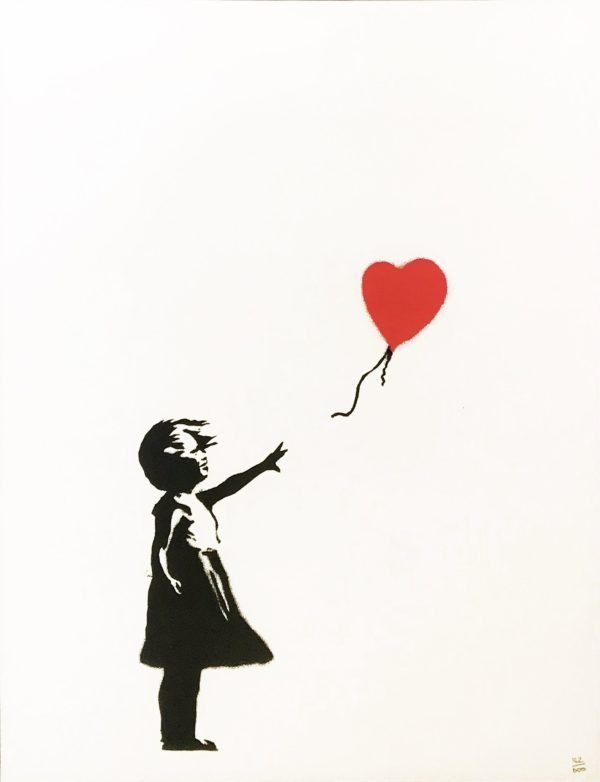
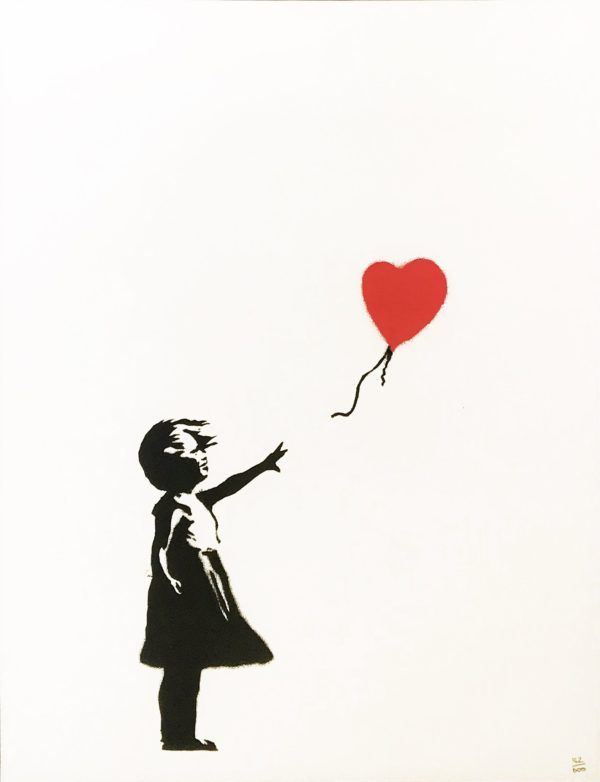
One of the most famous Banksy prints is Girl With Balloon, first painted in London in 2002, and once voted the UK’s favorite artwork. It also attracted significant attention in October 2018, when a framed copy shredded itself, moments after selling at auction for over $1.1 million.
The partially shredded piece was renamed Love is in the Bin, which Sotherby’s auction house called “the first artwork in history to have been created live during an auction”. On the same day, Banksy posted an image of the event to his Instagram page, captioned: “Going, going, gone…”.
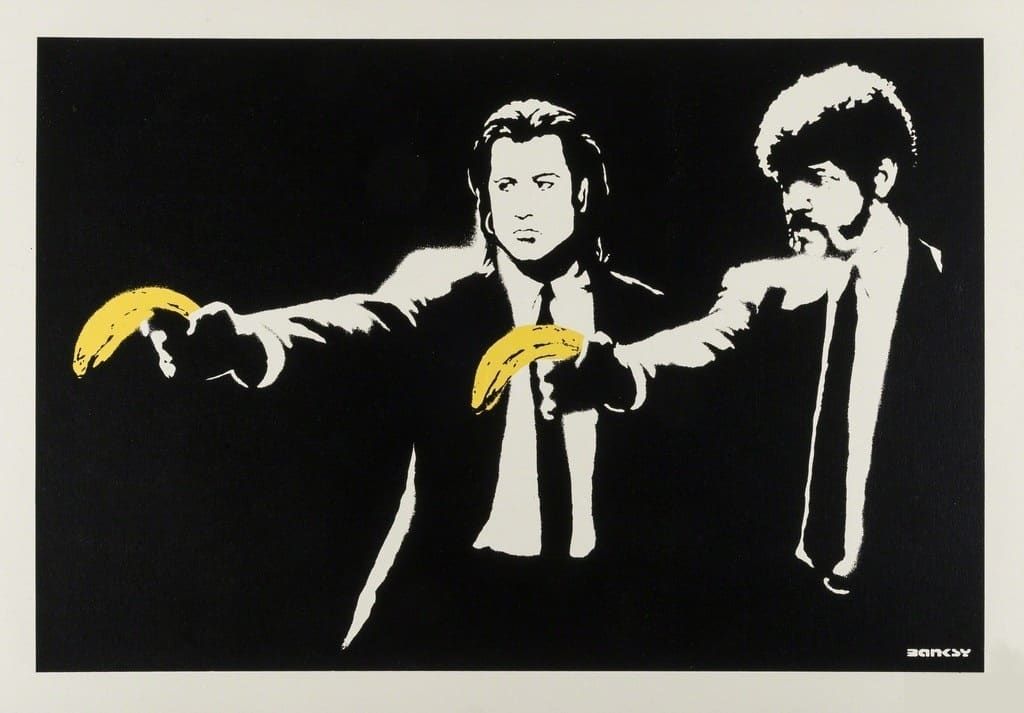
Other notable pieces include Love Is In The Air, which depicts a man dressed as a militant preparing to throw a bunch of flowers rather than a grenade, and Pulp Fiction, showing Samuel L. Jackson and John Travolta as their characters in the Quentin Tarantino movie, holding bananas instead of guns. When the latter was painted over by Transport for London in April 2007, Banksy replaced it with a new work, this time showing the two men now holding guns, but dressed in banana suits. Another famous Banksy artwork is Di Faced Tenner.
These fake banknotes, featuring the face of Princess Diana were first created in August 2004, and some people even tried to spend them after a large wad was thrown into the crowd at London’s Notting Hill Carnival. Here at ArtLife, a signed artist proof of this piece is also available for purchase.
It’s believed that there are approximately 30,000 authentic Banksy prints in existence, all of which are in extremely high demand. New releases are very rare, which means that those who wish to buy Banksy art will usually have to do so on the secondary market.
We have an exclusive collection of original pieces created by the internationally renowned artist available to collectors.
How to Buy Banksy Art with Confidence
Purchasing a Banksy is fundamentally different from buying primary market art. Since Banksy no longer sells directly to the public, the secondary market remains the sole channel for acquisition, making provenance, condition, and authenticity critical to long-term value. The secondary market is also saturated with sophisticated forgeries, which is why we filter out high-risk pieces and present only investment-grade works supported by verified history and secure documentation. Through trusted relationships with private collectors, ArtLife has access to off-market inventory that never appears publicly.
Our acquisition process is built around rigorous vetting at every stage. We analyze market data, edition sizes, and pricing to match works to your goals and budget. Each piece undergoes detailed digital inspection to assess paper quality, edges, and color integrity. We verify Pest Control certificates and ensure clear title transfer, and once purchased, your artwork is shipped using museum-standard packing and remains fully insured until delivery.
Smart Investing: What to Buy for Profit
For maximum appreciation, ArtLife recommends focusing on Iconic Imagery. Works that feature Banksy’s most recognizable motifs historically outperform obscure titles. If budget allows, a signed print is the gold standard. However, a pristine Unsigned copy of a top-tier image yields a better percentage return than a signed copy of a less popular image. Prioritize the popularity of the image and the condition of the paper.
Contact ArtLife today to view our available inventory of authentic, Pest Control-certified Banksy artworks.
Market Highlights: Value & Demand Insights
Investors are drawn to the Banksy paradox: anti-establishment imagery that delivers established blue-chip returns. His anonymity and limited output create a permanent supply shock against a global audience.
While other markets may soften, Banksy has historically shown low correlation with broader economic downturns, performing like a defensive asset. Acquiring his work via ArtLife gives you access to a cultural phenomenon that has outperformed the S&P 500 over the last decade.
Understanding Banksy Print Editions & Authentication
Banksy disrupts traditional collecting norms. Unlike most blue-chip artists, his unsigned prints are legitimate investment assets, and value is determined as much by documentation as by the artwork itself. Both signed and unsigned editions are original studio releases, but they serve different investment roles. Signed prints, hand-signed in pencil and released in smaller quantities, command the highest premiums and represent the highest level of scarcity. Unsigned prints are fully authorized, limited edition works that offer a more liquid entry point into the market and trade actively worldwide, provided they are in excellent condition and accompanied by proper documentation.
In the Banksy market, gallery certificates carry no authority. The only valid proof of authenticity is the certificate issued by Pest Control Office. Any work without this certificate is financially worthless on the secondary market, and we refuse to source or sell pieces lacking this documentation. Due to long processing times and administrative backlogs at Pest Control, we prioritize sourcing works that already have valid certificates, filtering out unauthorized reproductions and fake “gallery” COAs to ensure every purchase is secure and investment-grade.
Frequently Asked Questions
ArtLife offers immediate access to a verified supply of Banksy artworks. We connect buyers with vetted secondary market inventory, eliminating the risks associated with peer-to-peer platforms or unmanaged forums.
Yes. With ArtLife, you can buy securely from any location. We provide digital viewing rooms and comprehensive documentation, enabling you to make the best decisions without needing to visit a physical gallery.
Originals are unique creations—often spray-painted on canvas, steel, or found objects—and sit at the top of the pricing hierarchy. Prints are serigraphs produced in set quantities. ArtLife curates opportunities across both tiers.
Only prints released through official channels like Pictures on Walls (POW) or the GDP store are recognized. These must align with official edition counts. ArtLife strictly excludes exhibition posters or ‘merchandise’ that holds no intrinsic market value.
Verification begins and ends with Pest Control Office. This is the only body authorized to authenticate Banksy. Every piece sold on ArtLife is backed by this essential documentation or a guaranteed, trackable application.
Banksy remains the most traded artist in the Urban Art category. Data indicates strong historical appreciation and high liquidity. Unlike speculative digital assets, blue-chip signed editions have retained value even during broader art market corrections, proving their utility as a store of wealth. Building a position in Banksy through ArtLife adds a highly active, culturally relevant asset to your holdings.
Major auction houses and insurers will not recognize a Banksy without it. ArtLife confirms the paperwork accompanying your purchase meets this non-negotiable industry standard.
Yes. ArtLife actively seeks high-quality Banksy consignments. Use our “Sell Your Art” portal to submit your details; our team uses real-time market data to provide an accurate valuation and placement strategy.
Start Your Banksy Collection
Looking to acquire a Banksy? ArtLife Gallery provides curated access to investment-grade canvases, works on paper, and prints. Connect with our specialists to explore available works.