
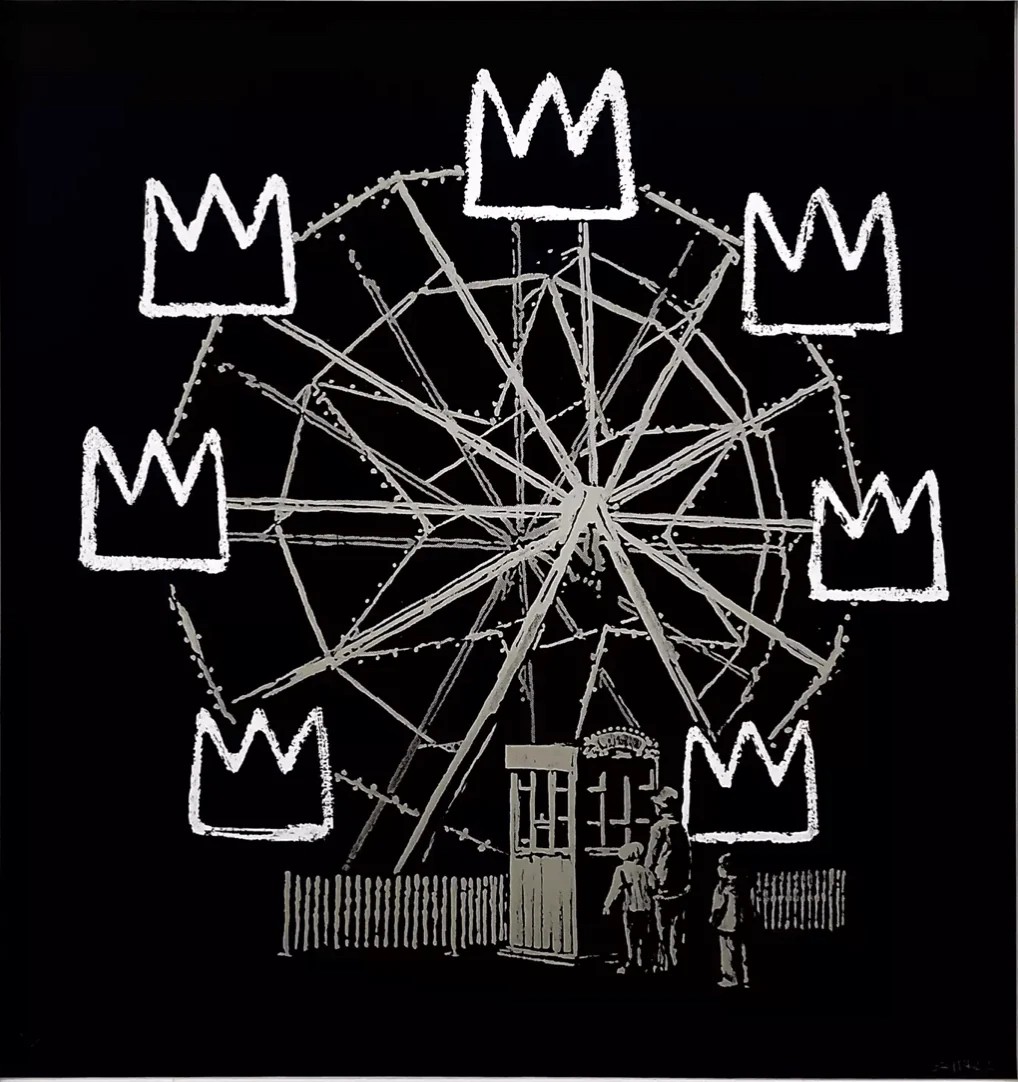
Banksquiat (Black)
by Banksy
Year: 2019
Medium: Screen print on black board
Size: 27 3/5 × 27 3/5″ in
Edition of 300
Signed and numbered in crayon
Banksy’s Banksquiat (Black) (2019) is a screenprint on black board measuring 27 3/5 × 27 3/5 inches, released in a limited edition of 300. Referencing the visual language of, the work merges neo-expressionist influence with Banksy’s incisive contemporary satire, reflecting on authorship and art-world mythology. Its restrained palette and rare edition enhance its collectability, while established provenance frameworks reinforce confidence among discerning contemporary art collectors. the work
Banksy’s Banksquiat first appeared as a screen print in the early 2000s, during a period when the artist was actively engaging with art history and reworking the language of neo-expressionism. The work is widely understood as a direct reference to Jean-Michel Basquiat, blending Banksy’s street-derived visual language with the raw, symbolic style associated with Basquiat’s paintings.
There is no known street graffiti version of Banksquiat, as the work was conceived specifically as a studio print. This format allowed Banksy to focus on appropriation and composition, using controlled production rather than public intervention to emphasize the dialogue between street art and the fine art market.
The imagery combines crown-like motifs, expressive mark-making, and simplified portrait elements, referencing themes of identity, artistic legacy, and cultural commodification. The work also reflects Banksy’s broader interest in how contemporary artists are absorbed into the market system they often critique.
For collectors, Banksquiat is highly sought after due to its strong art-historical reference, limited availability, and connection to two major contemporary art narratives—street art and neo-expressionism. Demand remains strong in the secondary market, with collectors valuing its rarity, cultural commentary, and museum-level visual significance. Today, it stands as a key example of Banksy’s dialogue with art history and his ability to reposition iconic styles within a contemporary context.
Banksy is a world-famous British street artist known for politically charged graffiti and an anonymous identity. Emerging from the Bristol underground scene in the 1990s, Banksy became a leading figure connecting street art, graffiti art, and contemporary art movements. His work combines satire, activism, and social commentary in ways that connect with both casual viewers and serious collectors.
Banksy’s iconic works, such as Girl with Balloon, Flower Thrower, and Love is in the Bin helped define his career and transformed street art into a respected part of the global art market. His visual style is instantly recognizable through stencil techniques, bold black-and-white contrasts, and sharp messages about war, consumerism, and inequality.
Banksy holds major market importance because his original works and authenticated prints regularly sell for millions at international auctions. Demand remains strong among collectors due to limited supply, global recognition, and cultural relevance.
Beyond the market, Banksy changed how people view public art. He brought graffiti into galleries, museums, and mainstream culture while keeping its rebellious spirit alive. From an investment perspective, Banksy is considered one of the strongest contemporary art names, with steady collector demand and long-term appeal across generations.
More Banksy Works to Explore





Banksquiat (Black)
by Banksy
Year: 2019
Medium: Screen print on black board
Size: 27 3/5 × 27 3/5″ in
Edition of 300
Banksy’s Banksquiat (Black) (2019) is a screenprint on black board measuring 27 3/5 × 27 3/5 inches, released in a limited edition of 300. Referencing the visual language of, the work merges neo-expressionist influence with Banksy’s incisive contemporary satire, reflecting on authorship and art-world mythology. Its restrained palette and rare edition enhance its collectability, while established provenance frameworks reinforce confidence among discerning contemporary art collectors. the work
Banksy’s Banksquiat first appeared as a screen print in the early 2000s, during a period when the artist was actively engaging with art history and reworking the language of neo-expressionism. The work is widely understood as a direct reference to Jean-Michel Basquiat, blending Banksy’s street-derived visual language with the raw, symbolic style associated with Basquiat’s paintings.
There is no known street graffiti version of Banksquiat, as the work was conceived specifically as a studio print. This format allowed Banksy to focus on appropriation and composition, using controlled production rather than public intervention to emphasize the dialogue between street art and the fine art market.
The imagery combines crown-like motifs, expressive mark-making, and simplified portrait elements, referencing themes of identity, artistic legacy, and cultural commodification. The work also reflects Banksy’s broader interest in how contemporary artists are absorbed into the market system they often critique.
For collectors, Banksquiat is highly sought after due to its strong art-historical reference, limited availability, and connection to two major contemporary art narratives—street art and neo-expressionism. Demand remains strong in the secondary market, with collectors valuing its rarity, cultural commentary, and museum-level visual significance. Today, it stands as a key example of Banksy’s dialogue with art history and his ability to reposition iconic styles within a contemporary context.
Banksy is a world-famous British street artist known for politically charged graffiti and an anonymous identity. Emerging from the Bristol underground scene in the 1990s, Banksy became a leading figure connecting street art, graffiti art, and contemporary art movements. His work combines satire, activism, and social commentary in ways that connect with both casual viewers and serious collectors.
Banksy’s iconic works, such as Girl with Balloon, Flower Thrower, and Love is in the Bin helped define his career and transformed street art into a respected part of the global art market. His visual style is instantly recognizable through stencil techniques, bold black-and-white contrasts, and sharp messages about war, consumerism, and inequality.
Banksy holds major market importance because his original works and authenticated prints regularly sell for millions at international auctions. Demand remains strong among collectors due to limited supply, global recognition, and cultural relevance.
Beyond the market, Banksy changed how people view public art. He brought graffiti into galleries, museums, and mainstream culture while keeping its rebellious spirit alive. From an investment perspective, Banksy is considered one of the strongest contemporary art names, with steady collector demand and long-term appeal across generations.