
Bomb Hugger
by Banksy
Year: 2003
Medium: Screenprint on paper
Size: 70 × 50 cm (27 3/5 × 19 7/10 in)
Edition of 600
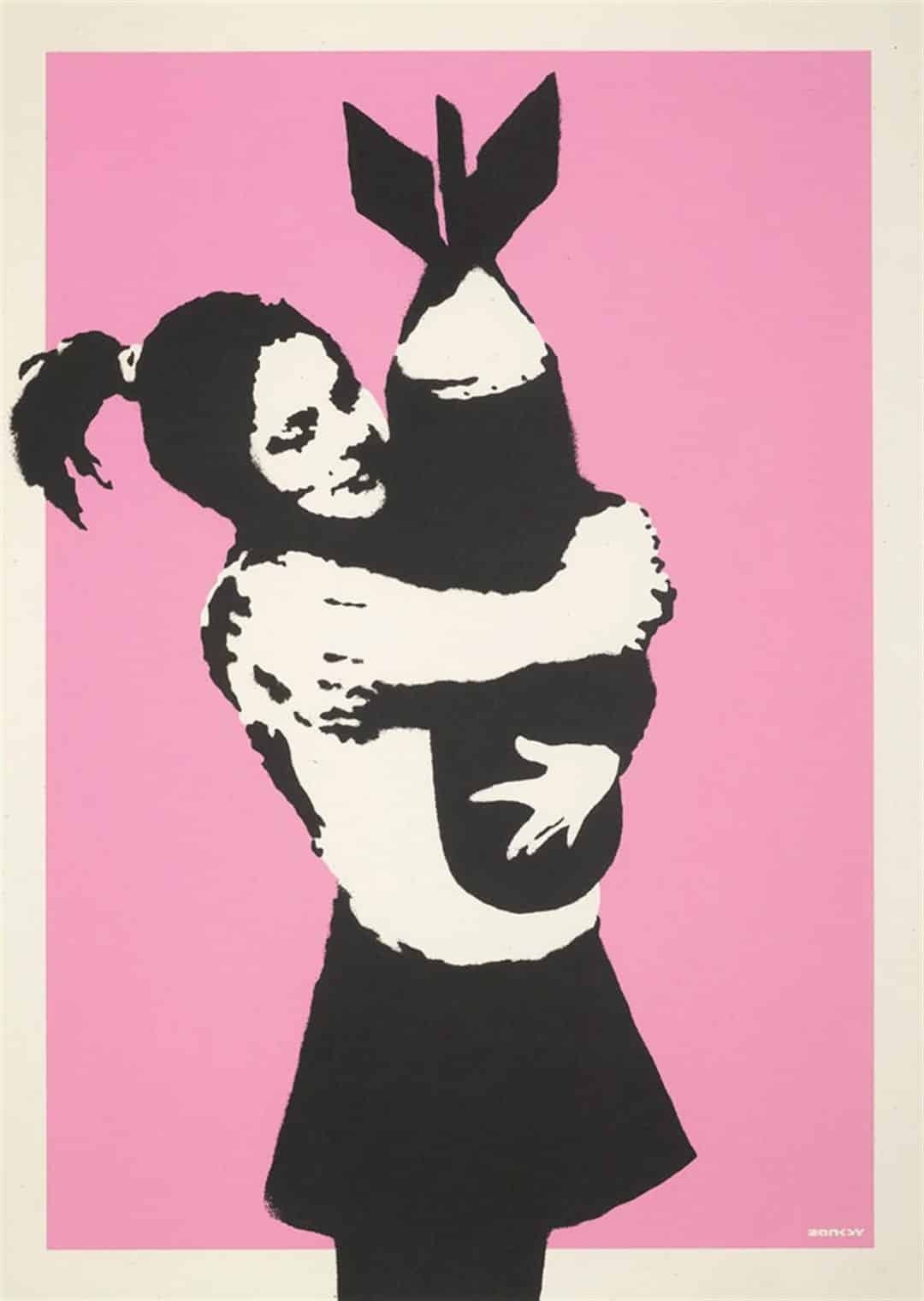
Banksy’s Bomb Hugger (2003) is an unsigned screenprint measuring 70 × 50 cm, released in an edition of 600. Among the artist’s most enduring anti-war images, it juxtaposes innocence and aggression through a deceptively simple composition that reflects the political tensions of the early twenty-first century. The work’s visual immediacy and cultural resonance have secured its place within Banksy’s most recognisable motifs, while its established edition history underpins strong collector confidence and market appeal.
Banksy’s Bomb Hugger is one of the artist’s most recognizable anti-war images, first released as a screen print in the early 2000s during a period marked by global debate surrounding military intervention and international conflict. While the image is closely associated with Banksy’s visual identity, it was created primarily as a print edition rather than a documented standalone street mural, allowing the artist to distribute its message widely through a collectible format.
The composition depicts a young girl embracing a large bomb as if it were a cherished toy. This striking contrast between innocence and destruction lies at the heart of the work’s meaning. Banksy uses the image to challenge the normalization of warfare and question how violence is presented within politics, media, and popular culture.
The symbolism is both immediate and powerful. The girl's gesture suggests affection, trust, and vulnerability, while the bomb represents fear and conflict. Together, these opposing elements create a visual critique of societies that become accustomed to militarization and perpetual war.
For collectors, Bomb Hugger remains one of the most sought-after Banksy editions. Its iconic imagery, strong political message, and limited availability have helped establish its enduring market appeal. Demand remains consistently high across the secondary market, making it an important work for collectors seeking one of Banksy’s clearest and most impactful statements on peace, conflict, and contemporary society.
Banksy is a world-famous British street artist known for politically charged graffiti and an anonymous identity. Emerging from the Bristol underground scene in the 1990s, Banksy became a leading figure connecting street art, graffiti art, and contemporary art movements. His work combines satire, activism, and social commentary in ways that connect with both casual viewers and serious collectors.
Banksy’s iconic works, such as Girl with Balloon, Flower Thrower, and Love is in the Bin helped define his career and transformed street art into a respected part of the global art market. His visual style is instantly recognizable through stencil techniques, bold black-and-white contrasts, and sharp messages about war, consumerism, and inequality.
Banksy holds major market importance because his original works and authenticated prints regularly sell for millions at international auctions. Demand remains strong among collectors due to limited supply, global recognition, and cultural relevance.
Beyond the market, Banksy changed how people view public art. He brought graffiti into galleries, museums, and mainstream culture while keeping its rebellious spirit alive. From an investment perspective, Banksy is considered one of the strongest contemporary art names, with steady collector demand and long-term appeal across generations.
More Banksy Works to Explore





Bomb Hugger
by Banksy
Year: 2003
Medium: Screenprint on paper
Size: 70 × 50 cm (27 3/5 × 19 7/10 in)
Edition of 600
Banksy’s Bomb Hugger (2003) is an unsigned screenprint measuring 70 × 50 cm, released in an edition of 600. Among the artist’s most enduring anti-war images, it juxtaposes innocence and aggression through a deceptively simple composition that reflects the political tensions of the early twenty-first century. The work’s visual immediacy and cultural resonance have secured its place within Banksy’s most recognisable motifs, while its established edition history underpins strong collector confidence and market appeal.
Banksy’s Bomb Hugger is one of the artist’s most recognizable anti-war images, first released as a screen print in the early 2000s during a period marked by global debate surrounding military intervention and international conflict. While the image is closely associated with Banksy’s visual identity, it was created primarily as a print edition rather than a documented standalone street mural, allowing the artist to distribute its message widely through a collectible format.
The composition depicts a young girl embracing a large bomb as if it were a cherished toy. This striking contrast between innocence and destruction lies at the heart of the work’s meaning. Banksy uses the image to challenge the normalization of warfare and question how violence is presented within politics, media, and popular culture.
The symbolism is both immediate and powerful. The girl's gesture suggests affection, trust, and vulnerability, while the bomb represents fear and conflict. Together, these opposing elements create a visual critique of societies that become accustomed to militarization and perpetual war.
For collectors, Bomb Hugger remains one of the most sought-after Banksy editions. Its iconic imagery, strong political message, and limited availability have helped establish its enduring market appeal. Demand remains consistently high across the secondary market, making it an important work for collectors seeking one of Banksy’s clearest and most impactful statements on peace, conflict, and contemporary society.
Banksy is a world-famous British street artist known for politically charged graffiti and an anonymous identity. Emerging from the Bristol underground scene in the 1990s, Banksy became a leading figure connecting street art, graffiti art, and contemporary art movements. His work combines satire, activism, and social commentary in ways that connect with both casual viewers and serious collectors.
Banksy’s iconic works, such as Girl with Balloon, Flower Thrower, and Love is in the Bin helped define his career and transformed street art into a respected part of the global art market. His visual style is instantly recognizable through stencil techniques, bold black-and-white contrasts, and sharp messages about war, consumerism, and inequality.
Banksy holds major market importance because his original works and authenticated prints regularly sell for millions at international auctions. Demand remains strong among collectors due to limited supply, global recognition, and cultural relevance.
Beyond the market, Banksy changed how people view public art. He brought graffiti into galleries, museums, and mainstream culture while keeping its rebellious spirit alive. From an investment perspective, Banksy is considered one of the strongest contemporary art names, with steady collector demand and long-term appeal across generations.