
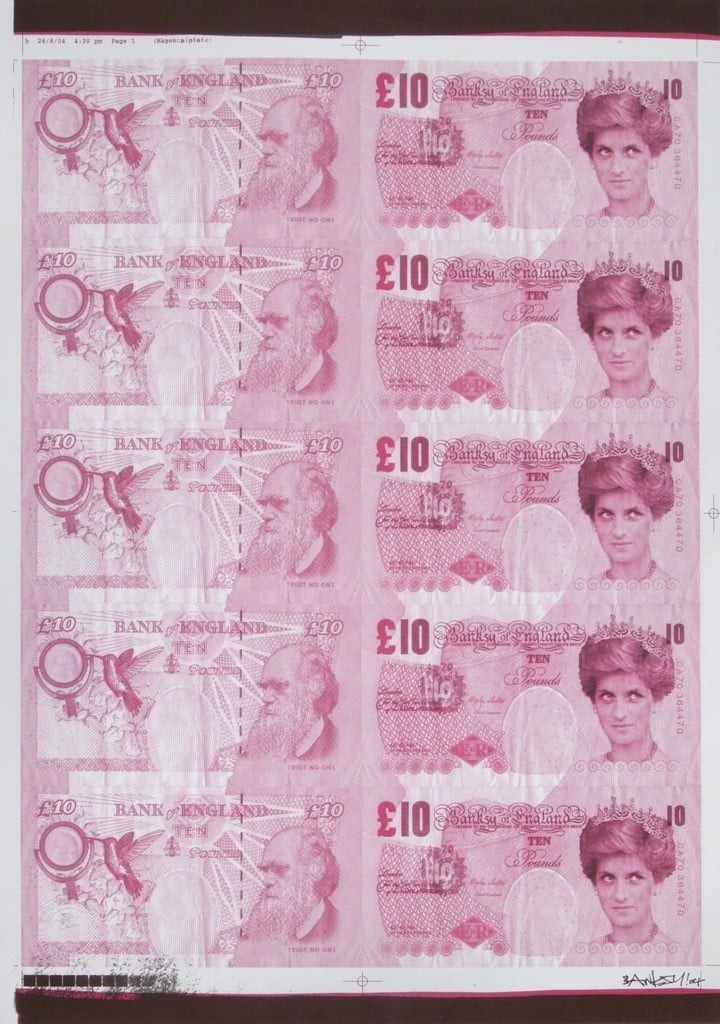
Di-Faced Tenner
by Banksy
Year: 2004
Medium: Screenprint on paper
Size: 30 x 42 cm
Signed artist proof
Edition of 34
Banksy’s Di-Faced Tenner (2004) is a rare print with signed artist’s proof measuring 30 × 42 cm, issued in an exceptionally limited edition of 34. Conceived as a subversive intervention into everyday currency, the work reflects the artist’s early exploration of value, authority, and institutional trust. Its radical scarcity, combined with the artist’s direct signature, elevates its status within Banksy’s printed oeuvre. With established authentication standards supporting provenance, it remains a highly coveted acquisition for discerning collectors of contemporary conceptual art.
Banksy’s Di-Faced Tenner first emerged in 2004 as a provocative fake banknote distributed as part of the artist’s broader critique of value, ownership, and trust in financial systems. Unlike Banksy’s street murals, this work was never intended as graffiti, but as a physical object designed to circulate in the real world, blurring the boundary between currency and art.
The design closely mimics a UK ten-pound note, but replaces the portrait of Queen Elizabeth II with Princess Diana. This single alteration shifts the meaning entirely, turning a symbol of state-backed monetary authority into a reflection on fame, cultural memory, and public emotion. The work plays on how easily authority can be reproduced, questioned, or undermined through subtle visual disruption.
At a deeper level, Di-Faced Tenner explores themes of economic belief, media construction, and the fragile systems that define value. By imitating official currency, Banksy highlights how money only functions through collective agreement, not intrinsic worth. The work also reflects his ongoing interest in satire as a tool for exposing institutional structures.
For collectors, Di-Faced Tenner is highly significant due to its rarity, conceptual originality, and crossover between art object and functional currency. Demand remains strong in the secondary market, driven by its unique format and historical importance. Today, it is considered one of Banksy’s most innovative works, expanding the definition of contemporary art beyond traditional mediums.
Banksy is a world-famous British street artist known for politically charged graffiti and an anonymous identity. Emerging from the Bristol underground scene in the 1990s, Banksy became a leading figure connecting street art, graffiti art, and contemporary art movements. His work combines satire, activism, and social commentary in ways that connect with both casual viewers and serious collectors.
Banksy’s iconic works, such as Girl with Balloon, Flower Thrower, and Love is in the Bin helped define his career and transformed street art into a respected part of the global art market. His visual style is instantly recognizable through stencil techniques, bold black-and-white contrasts, and sharp messages about war, consumerism, and inequality.
Banksy holds major market importance because his original works and authenticated prints regularly sell for millions at international auctions. Demand remains strong among collectors due to limited supply, global recognition, and cultural relevance.
Beyond the market, Banksy changed how people view public art. He brought graffiti into galleries, museums, and mainstream culture while keeping its rebellious spirit alive. From an investment perspective, Banksy is considered one of the strongest contemporary art names, with steady collector demand and long-term appeal across generations.
More Banksy Works to Explore





Di-Faced Tenner
by Banksy
Year: 2004
Medium: Screenprint on paper
Size: 30 x 42 cm
Signed artist proof
Banksy’s Di-Faced Tenner (2004) is a rare print with signed artist’s proof measuring 30 × 42 cm, issued in an exceptionally limited edition of 34. Conceived as a subversive intervention into everyday currency, the work reflects the artist’s early exploration of value, authority, and institutional trust. Its radical scarcity, combined with the artist’s direct signature, elevates its status within Banksy’s printed oeuvre. With established authentication standards supporting provenance, it remains a highly coveted acquisition for discerning collectors of contemporary conceptual art.
Banksy’s Di-Faced Tenner first emerged in 2004 as a provocative fake banknote distributed as part of the artist’s broader critique of value, ownership, and trust in financial systems. Unlike Banksy’s street murals, this work was never intended as graffiti, but as a physical object designed to circulate in the real world, blurring the boundary between currency and art.
The design closely mimics a UK ten-pound note, but replaces the portrait of Queen Elizabeth II with Princess Diana. This single alteration shifts the meaning entirely, turning a symbol of state-backed monetary authority into a reflection on fame, cultural memory, and public emotion. The work plays on how easily authority can be reproduced, questioned, or undermined through subtle visual disruption.
At a deeper level, Di-Faced Tenner explores themes of economic belief, media construction, and the fragile systems that define value. By imitating official currency, Banksy highlights how money only functions through collective agreement, not intrinsic worth. The work also reflects his ongoing interest in satire as a tool for exposing institutional structures.
For collectors, Di-Faced Tenner is highly significant due to its rarity, conceptual originality, and crossover between art object and functional currency. Demand remains strong in the secondary market, driven by its unique format and historical importance. Today, it is considered one of Banksy’s most innovative works, expanding the definition of contemporary art beyond traditional mediums.
Banksy is a world-famous British street artist known for politically charged graffiti and an anonymous identity. Emerging from the Bristol underground scene in the 1990s, Banksy became a leading figure connecting street art, graffiti art, and contemporary art movements. His work combines satire, activism, and social commentary in ways that connect with both casual viewers and serious collectors.
Banksy’s iconic works, such as Girl with Balloon, Flower Thrower, and Love is in the Bin helped define his career and transformed street art into a respected part of the global art market. His visual style is instantly recognizable through stencil techniques, bold black-and-white contrasts, and sharp messages about war, consumerism, and inequality.
Banksy holds major market importance because his original works and authenticated prints regularly sell for millions at international auctions. Demand remains strong among collectors due to limited supply, global recognition, and cultural relevance.
Beyond the market, Banksy changed how people view public art. He brought graffiti into galleries, museums, and mainstream culture while keeping its rebellious spirit alive. From an investment perspective, Banksy is considered one of the strongest contemporary art names, with steady collector demand and long-term appeal across generations.