
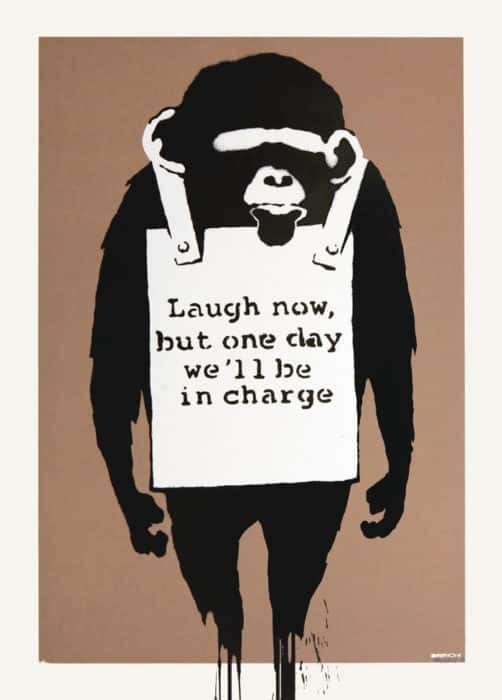
Laugh Now (Unsigned)
by Banksy
Year: 2003
Medium: Screenprint
Size: 70 x 50cm (27 3/5 × 19 7/10 in)
Edition of 600
Numbered by the artist
With a Pest Control Certificate
Banksy’s Laugh Now (2003) is a landmark screenprint measuring 70 × 50 cm, issued in an edition of 600 and numbered by the artist. Featuring the artist’s famous monkey motif, the work delivers a sharp commentary on power, conformity, and social hierarchy, themes that helped define Banksy’s early career. Accompanied by a Pest Control Certificate, this highly recognizable print combines cultural significance, strong provenance, and enduring appeal for contemporary art collectors.
Laugh Now is one of Banksy’s most famous and enduring images. The work first appeared as a large mural commissioned for a nightclub in Brighton in the early 2000s and later became one of the artist’s most sought-after print editions. Featuring a monkey wearing a sandwich board that reads, “Laugh now, but one day we’ll be in charge,” the image combines humor with a sharp critique of power, hierarchy, and human behavior.
The monkey is a recurring figure in Banksy’s work, often used to highlight the absurdities of modern society. In Laugh Now, the animal serves as a stand-in for the outsider, the underestimated, or those excluded from positions of influence. The message is both playful and unsettling, inviting viewers to question who truly holds power and how quickly social structures can change.
As one of Banksy’s most recognizable works, Laugh Now holds a significant place in contemporary street art history. Limited edition examples remain highly sought after by collectors worldwide, with strong demand driven by the work’s iconic imagery, cultural relevance, and broad appeal. Today, Laugh Now is considered a cornerstone of Banksy’s print market and a standout piece for collectors seeking one of the artist’s defining images.
Banksy is a world-famous British street artist known for politically charged graffiti and an anonymous identity. Emerging from the Bristol underground scene in the 1990s, Banksy became a leading figure connecting street art, graffiti art, and contemporary art movements. His work combines satire, activism, and social commentary in ways that connect with both casual viewers and serious collectors.
Banksy’s iconic works, such as Girl with Balloon, Flower Thrower, and Love is in the Bin helped define his career and transformed street art into a respected part of the global art market. His visual style is instantly recognizable through stencil techniques, bold black-and-white contrasts, and sharp messages about war, consumerism, and inequality.
Banksy holds major market importance because his original works and authenticated prints regularly sell for millions at international auctions. Demand remains strong among collectors due to limited supply, global recognition, and cultural relevance.
Beyond the market, Banksy changed how people view public art. He brought graffiti into galleries, museums, and mainstream culture while keeping its rebellious spirit alive. From an investment perspective, Banksy is considered one of the strongest contemporary art names, with steady collector demand and long-term appeal across generations.
More Banksy Works to Explore


Laugh Now (Unsigned)
by Banksy
Year: 2003
Medium: Screenprint
Size: 70 x 50cm (27 3/5 × 19 7/10 in)
Edition of 600
Banksy’s Laugh Now (2003) is a landmark screenprint measuring 70 × 50 cm, issued in an edition of 600 and numbered by the artist. Featuring the artist’s famous monkey motif, the work delivers a sharp commentary on power, conformity, and social hierarchy, themes that helped define Banksy’s early career. Accompanied by a Pest Control Certificate, this highly recognizable print combines cultural significance, strong provenance, and enduring appeal for contemporary art collectors.
Laugh Now is one of Banksy’s most famous and enduring images. The work first appeared as a large mural commissioned for a nightclub in Brighton in the early 2000s and later became one of the artist’s most sought-after print editions. Featuring a monkey wearing a sandwich board that reads, “Laugh now, but one day we’ll be in charge,” the image combines humor with a sharp critique of power, hierarchy, and human behavior.
The monkey is a recurring figure in Banksy’s work, often used to highlight the absurdities of modern society. In Laugh Now, the animal serves as a stand-in for the outsider, the underestimated, or those excluded from positions of influence. The message is both playful and unsettling, inviting viewers to question who truly holds power and how quickly social structures can change.
As one of Banksy’s most recognizable works, Laugh Now holds a significant place in contemporary street art history. Limited edition examples remain highly sought after by collectors worldwide, with strong demand driven by the work’s iconic imagery, cultural relevance, and broad appeal. Today, Laugh Now is considered a cornerstone of Banksy’s print market and a standout piece for collectors seeking one of the artist’s defining images.
Banksy is a world-famous British street artist known for politically charged graffiti and an anonymous identity. Emerging from the Bristol underground scene in the 1990s, Banksy became a leading figure connecting street art, graffiti art, and contemporary art movements. His work combines satire, activism, and social commentary in ways that connect with both casual viewers and serious collectors.
Banksy’s iconic works, such as Girl with Balloon, Flower Thrower, and Love is in the Bin helped define his career and transformed street art into a respected part of the global art market. His visual style is instantly recognizable through stencil techniques, bold black-and-white contrasts, and sharp messages about war, consumerism, and inequality.
Banksy holds major market importance because his original works and authenticated prints regularly sell for millions at international auctions. Demand remains strong among collectors due to limited supply, global recognition, and cultural relevance.
Beyond the market, Banksy changed how people view public art. He brought graffiti into galleries, museums, and mainstream culture while keeping its rebellious spirit alive. From an investment perspective, Banksy is considered one of the strongest contemporary art names, with steady collector demand and long-term appeal across generations.