
No Ball Games
by Banksy
Year: 2009
Medium: Screenprint in Colors
Size: 27 1/2 × 26 1/2 in (69.9 × 67.3 cm)
Edition of 250
Signed with Pest Control COA
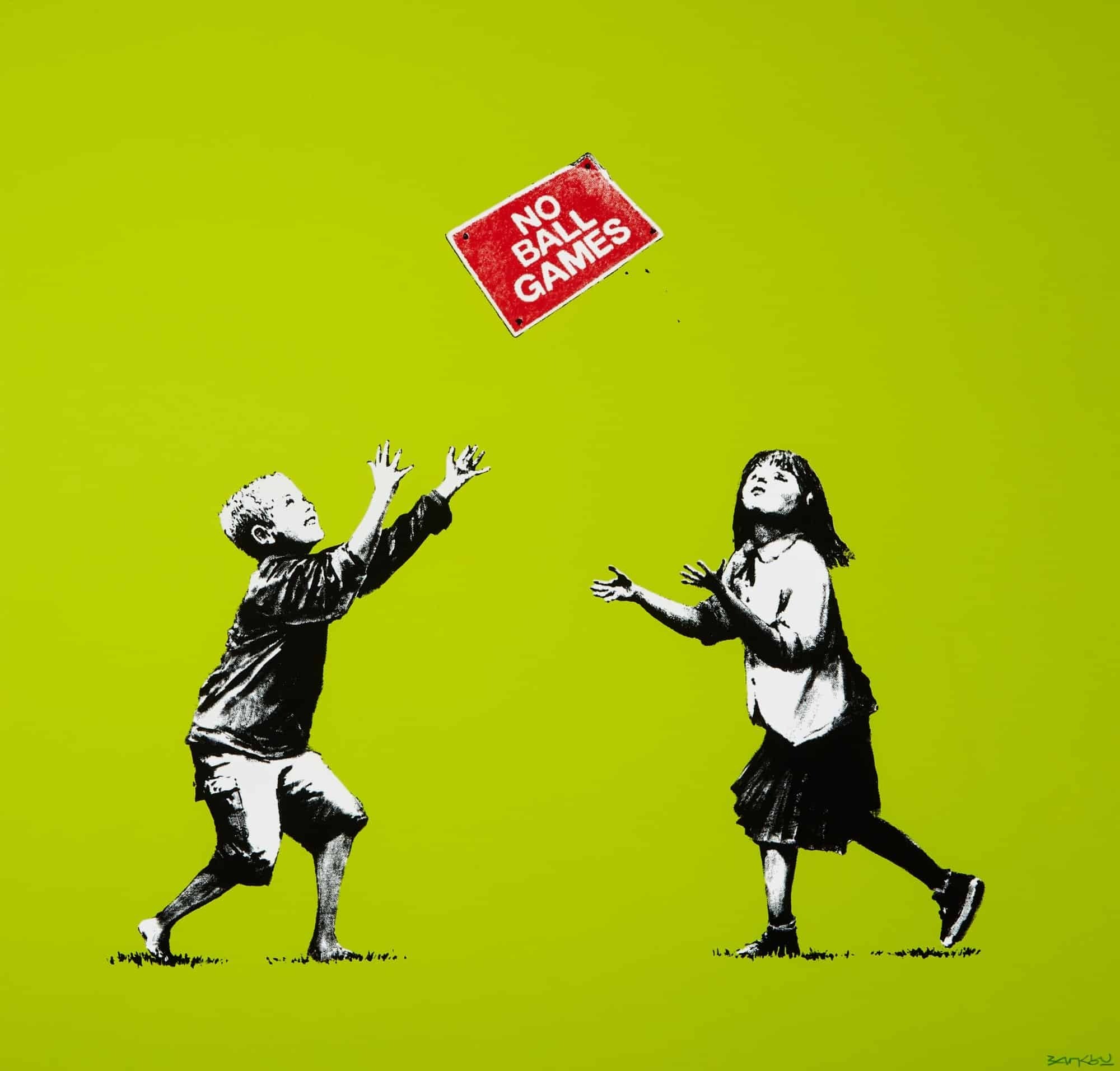
Banksy’s No Ball Games (2009) is a signed screenprint in colors, 69.9 × 67.3 cm, from a limited edition of 250. Referencing restricted play in urban spaces, it transforms a familiar street sign into a social commentary on childhood freedom and control. Its signed status, Pest Control Certificate of Authenticity, and low edition size reinforce strong provenance and enduring demand among contemporary street art collectors.
Banksy’s No Ball Games reflects the artist’s early focus on everyday urban life and the rules that shape public behavior. Created during the 2000s, a period when Banksy was actively transforming ordinary city spaces into platforms for social commentary, the work captures his interest in authority, control, and childhood freedom.
The image shows a classic “No Ball Games” sign that has been altered to include a child interacting with it, turning a simple public instruction into a moment of irony. This small intervention changes the meaning of the sign, questioning how rules are imposed and how they shape behavior in shared spaces. It also highlights Banksy’s recurring theme of reclaiming public space through subtle, subversive acts.
As a limited edition print, No Ball Games is highly regarded among collectors for its simplicity, clarity, and strong connection to Banksy’s street art roots. Works from this period continue to show strong demand in the secondary market due to their scarcity and cultural recognition. The piece is especially valued for its direct message and its ability to transform a familiar public symbol into a lasting commentary on control and freedom in modern society.
Banksy is a world-famous British street artist known for politically charged graffiti and an anonymous identity. Emerging from the Bristol underground scene in the 1990s, Banksy became a leading figure connecting street art, graffiti art, and contemporary art movements. His work combines satire, activism, and social commentary in ways that connect with both casual viewers and serious collectors.
Banksy’s iconic works, such as Girl with Balloon, Flower Thrower, and Love is in the Bin helped define his career and transformed street art into a respected part of the global art market. His visual style is instantly recognizable through stencil techniques, bold black-and-white contrasts, and sharp messages about war, consumerism, and inequality.
Banksy holds major market importance because his original works and authenticated prints regularly sell for millions at international auctions. Demand remains strong among collectors due to limited supply, global recognition, and cultural relevance.
Beyond the market, Banksy changed how people view public art. He brought graffiti into galleries, museums, and mainstream culture while keeping its rebellious spirit alive. From an investment perspective, Banksy is considered one of the strongest contemporary art names, with steady collector demand and long-term appeal across generations.
More Banksy Works to Explore




No Ball Games
by Banksy
Year: 2009
Medium: Screenprint in Colors
Size: 27 1/2 × 26 1/2 in (69.9 × 67.3 cm)
Edition of 250
Banksy’s No Ball Games (2009) is a signed screenprint in colors, 69.9 × 67.3 cm, from a limited edition of 250. Referencing restricted play in urban spaces, it transforms a familiar street sign into a social commentary on childhood freedom and control. Its signed status, Pest Control Certificate of Authenticity, and low edition size reinforce strong provenance and enduring demand among contemporary street art collectors.
Banksy’s No Ball Games reflects the artist’s early focus on everyday urban life and the rules that shape public behavior. Created during the 2000s, a period when Banksy was actively transforming ordinary city spaces into platforms for social commentary, the work captures his interest in authority, control, and childhood freedom.
The image shows a classic “No Ball Games” sign that has been altered to include a child interacting with it, turning a simple public instruction into a moment of irony. This small intervention changes the meaning of the sign, questioning how rules are imposed and how they shape behavior in shared spaces. It also highlights Banksy’s recurring theme of reclaiming public space through subtle, subversive acts.
As a limited edition print, No Ball Games is highly regarded among collectors for its simplicity, clarity, and strong connection to Banksy’s street art roots. Works from this period continue to show strong demand in the secondary market due to their scarcity and cultural recognition. The piece is especially valued for its direct message and its ability to transform a familiar public symbol into a lasting commentary on control and freedom in modern society.
Banksy is a world-famous British street artist known for politically charged graffiti and an anonymous identity. Emerging from the Bristol underground scene in the 1990s, Banksy became a leading figure connecting street art, graffiti art, and contemporary art movements. His work combines satire, activism, and social commentary in ways that connect with both casual viewers and serious collectors.
Banksy’s iconic works, such as Girl with Balloon, Flower Thrower, and Love is in the Bin helped define his career and transformed street art into a respected part of the global art market. His visual style is instantly recognizable through stencil techniques, bold black-and-white contrasts, and sharp messages about war, consumerism, and inequality.
Banksy holds major market importance because his original works and authenticated prints regularly sell for millions at international auctions. Demand remains strong among collectors due to limited supply, global recognition, and cultural relevance.
Beyond the market, Banksy changed how people view public art. He brought graffiti into galleries, museums, and mainstream culture while keeping its rebellious spirit alive. From an investment perspective, Banksy is considered one of the strongest contemporary art names, with steady collector demand and long-term appeal across generations.