
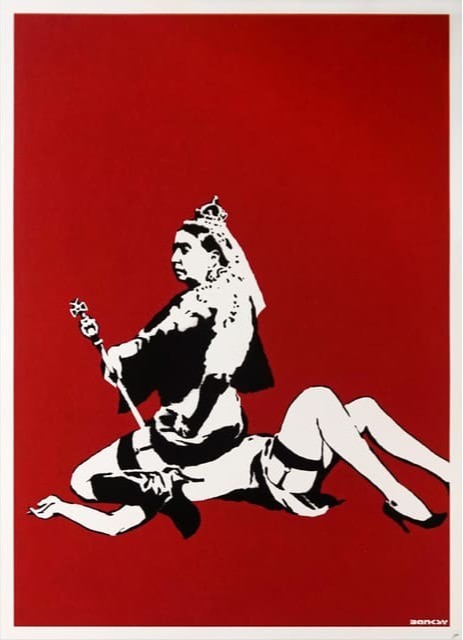
Queen Victoria (Unsigned)
by Banksy
Year: 2003
Medium: Screenprint on paper
Size: 70 × 50 cm (27 3/5 × 19 7/10 in)
Edition of 500
Pest Control Certificate Included
Banksy’s Queen Victoria (Unsigned) (2003) is a screenprint on paper measuring 70 × 50 cm, issued in a limited edition of 500. Recasting a symbol of British imperial heritage through a subversive contemporary lens, the work exemplifies the artist’s early critique of authority and historical narrative. Its restrained edition size, strong iconographic impact, and Pest Control Certificate of Authenticity provide secure provenance, reinforcing its appeal to discerning collectors of seminal Banksy prints.
Banksy’s Queen Victoria first appeared as a screen print in the early 2000s, during a period when the artist was actively questioning British identity, class structure, and historical power symbols. The work is best known as a studio-based edition rather than a confirmed street mural, as its composition relies on controlled portraiture and conceptual reinterpretation rather than site-specific graffiti intervention.
The image reimagines Queen Victoria in a subversive and unexpected way, transforming a traditional symbol of monarchy and empire into a critique of authority and inherited power. By distorting a figure deeply embedded in British history, Banksy draws attention to how national icons are constructed, preserved, and reinterpreted over time. The work engages with themes of imperial legacy, social hierarchy, and cultural memory.
Symbolically, Queen Victoria reflects Banksy’s broader use of historical figures to challenge institutional narratives. The contrast between reverence and irreverence is central to the piece, reinforcing the artist’s ability to disrupt familiar imagery with minimal but effective visual intervention.
For collectors, Queen Victoria is highly desirable due to its rarity, historical reference, and strong conceptual framing. Demand remains consistent in the secondary market, driven by its connection to British identity and its place within Banksy’s early print portfolio. Today, it stands as a key example of Banksy’s critique of monarchy and cultural symbolism, combining historical awareness with sharp contemporary commentary.
Banksy is a world-famous British street artist known for politically charged graffiti and an anonymous identity. Emerging from the Bristol underground scene in the 1990s, Banksy became a leading figure connecting street art, graffiti art, and contemporary art movements. His work combines satire, activism, and social commentary in ways that connect with both casual viewers and serious collectors.
Banksy’s iconic works, such as Girl with Balloon, Flower Thrower, and Love is in the Bin helped define his career and transformed street art into a respected part of the global art market. His visual style is instantly recognizable through stencil techniques, bold black-and-white contrasts, and sharp messages about war, consumerism, and inequality.
Banksy holds major market importance because his original works and authenticated prints regularly sell for millions at international auctions. Demand remains strong among collectors due to limited supply, global recognition, and cultural relevance.
Beyond the market, Banksy changed how people view public art. He brought graffiti into galleries, museums, and mainstream culture while keeping its rebellious spirit alive. From an investment perspective, Banksy is considered one of the strongest contemporary art names, with steady collector demand and long-term appeal across generations.
More Banksy Works to Explore





Queen Victoria (Unsigned)
by Banksy
Year: 2003
Medium: Screenprint on paper
Size: 70 × 50 cm (27 3/5 × 19 7/10 in)
Edition of 500
Banksy’s Queen Victoria (Unsigned) (2003) is a screenprint on paper measuring 70 × 50 cm, issued in a limited edition of 500. Recasting a symbol of British imperial heritage through a subversive contemporary lens, the work exemplifies the artist’s early critique of authority and historical narrative. Its restrained edition size, strong iconographic impact, and Pest Control Certificate of Authenticity provide secure provenance, reinforcing its appeal to discerning collectors of seminal Banksy prints.
Banksy’s Queen Victoria first appeared as a screen print in the early 2000s, during a period when the artist was actively questioning British identity, class structure, and historical power symbols. The work is best known as a studio-based edition rather than a confirmed street mural, as its composition relies on controlled portraiture and conceptual reinterpretation rather than site-specific graffiti intervention.
The image reimagines Queen Victoria in a subversive and unexpected way, transforming a traditional symbol of monarchy and empire into a critique of authority and inherited power. By distorting a figure deeply embedded in British history, Banksy draws attention to how national icons are constructed, preserved, and reinterpreted over time. The work engages with themes of imperial legacy, social hierarchy, and cultural memory.
Symbolically, Queen Victoria reflects Banksy’s broader use of historical figures to challenge institutional narratives. The contrast between reverence and irreverence is central to the piece, reinforcing the artist’s ability to disrupt familiar imagery with minimal but effective visual intervention.
For collectors, Queen Victoria is highly desirable due to its rarity, historical reference, and strong conceptual framing. Demand remains consistent in the secondary market, driven by its connection to British identity and its place within Banksy’s early print portfolio. Today, it stands as a key example of Banksy’s critique of monarchy and cultural symbolism, combining historical awareness with sharp contemporary commentary.
Banksy is a world-famous British street artist known for politically charged graffiti and an anonymous identity. Emerging from the Bristol underground scene in the 1990s, Banksy became a leading figure connecting street art, graffiti art, and contemporary art movements. His work combines satire, activism, and social commentary in ways that connect with both casual viewers and serious collectors.
Banksy’s iconic works, such as Girl with Balloon, Flower Thrower, and Love is in the Bin helped define his career and transformed street art into a respected part of the global art market. His visual style is instantly recognizable through stencil techniques, bold black-and-white contrasts, and sharp messages about war, consumerism, and inequality.
Banksy holds major market importance because his original works and authenticated prints regularly sell for millions at international auctions. Demand remains strong among collectors due to limited supply, global recognition, and cultural relevance.
Beyond the market, Banksy changed how people view public art. He brought graffiti into galleries, museums, and mainstream culture while keeping its rebellious spirit alive. From an investment perspective, Banksy is considered one of the strongest contemporary art names, with steady collector demand and long-term appeal across generations.