
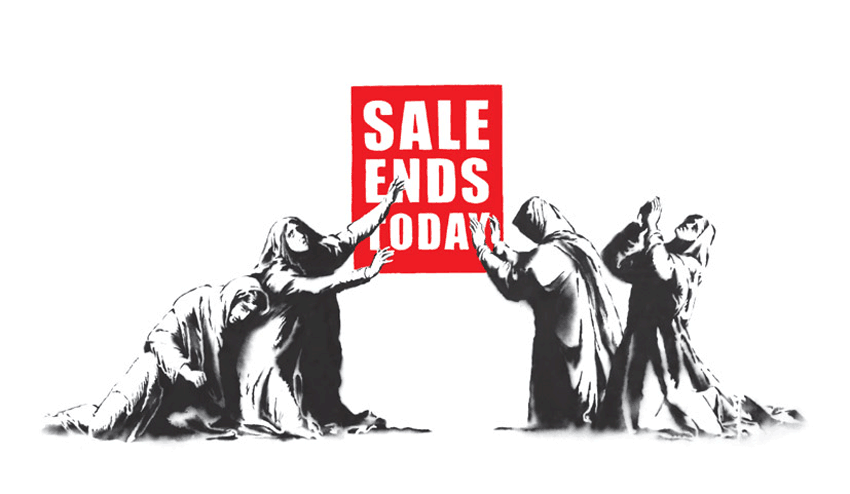
Sale Ends La Edition (Unsigned)
by Banksy
Year: 2006
Medium: Screen Print on Paper
Size: 76 x 56 cm
Edition of 500
Banksy’s Sale Ends La Edition (Unsigned) (2006) is a rare screen print on paper measuring 76 × 56 cm, released in a limited edition of 500. Reflecting the artist’s mid-2000s critique of consumerism and mass media culture, the work combines sharp visual satire with bold graphic composition. Its scarcity and strong market recognition enhance collector demand, while established provenance within Banksy’s print editions reinforces authenticity and long-term investment appeal.
Banksy’s Sale Ends reflects the artist’s ongoing critique of consumer culture and modern advertising. Created during the early to mid-2000s, a period when Banksy’s work was moving from underground street art into the global art market, the piece highlights the tension between public space, commercial messaging, and social behavior.
The work typically presents a bold visual warning tied to consumerism and urgency, echoing the language of retail advertising while turning it into satire. Through this reversal, Banksy exposes how modern society is shaped by constant promotion, persuasion, and the pressure to buy. The simplicity of the message strengthens its impact and makes it instantly readable in public space.
As a limited edition print, Sale Ends is highly regarded among collectors for its early place in Banksy’s print portfolio. Works from this period are increasingly scarce, which adds to their appeal in the secondary market. Demand remains steady, driven by strong recognition of Banksy’s early conceptual language and the work’s clear connection to his critique of capitalism and mass consumption.
Today, Sale Ends is valued for its rarity, direct message, and importance within Banksy’s broader body of socially driven works.
Banksy is a world-famous British street artist known for politically charged graffiti and an anonymous identity. Emerging from the Bristol underground scene in the 1990s, Banksy became a leading figure connecting street art, graffiti art, and contemporary art movements. His work combines satire, activism, and social commentary in ways that connect with both casual viewers and serious collectors.
Banksy’s iconic works, such as Girl with Balloon, Flower Thrower, and Love is in the Bin helped define his career and transformed street art into a respected part of the global art market. His visual style is instantly recognizable through stencil techniques, bold black-and-white contrasts, and sharp messages about war, consumerism, and inequality.
Banksy holds major market importance because his original works and authenticated prints regularly sell for millions at international auctions. Demand remains strong among collectors due to limited supply, global recognition, and cultural relevance.
Beyond the market, Banksy changed how people view public art. He brought graffiti into galleries, museums, and mainstream culture while keeping its rebellious spirit alive. From an investment perspective, Banksy is considered one of the strongest contemporary art names, with steady collector demand and long-term appeal across generations.
More Banksy Works to Explore





Sale Ends La Edition (Unsigned)
by Banksy
Year: 2006
Medium: Screen Print on Paper
Size: 76 x 56 cm
Edition of 500
Banksy’s Sale Ends La Edition (Unsigned) (2006) is a rare screen print on paper measuring 76 × 56 cm, released in a limited edition of 500. Reflecting the artist’s mid-2000s critique of consumerism and mass media culture, the work combines sharp visual satire with bold graphic composition. Its scarcity and strong market recognition enhance collector demand, while established provenance within Banksy’s print editions reinforces authenticity and long-term investment appeal.
Banksy’s Sale Ends reflects the artist’s ongoing critique of consumer culture and modern advertising. Created during the early to mid-2000s, a period when Banksy’s work was moving from underground street art into the global art market, the piece highlights the tension between public space, commercial messaging, and social behavior.
The work typically presents a bold visual warning tied to consumerism and urgency, echoing the language of retail advertising while turning it into satire. Through this reversal, Banksy exposes how modern society is shaped by constant promotion, persuasion, and the pressure to buy. The simplicity of the message strengthens its impact and makes it instantly readable in public space.
As a limited edition print, Sale Ends is highly regarded among collectors for its early place in Banksy’s print portfolio. Works from this period are increasingly scarce, which adds to their appeal in the secondary market. Demand remains steady, driven by strong recognition of Banksy’s early conceptual language and the work’s clear connection to his critique of capitalism and mass consumption.
Today, Sale Ends is valued for its rarity, direct message, and importance within Banksy’s broader body of socially driven works.
Banksy is a world-famous British street artist known for politically charged graffiti and an anonymous identity. Emerging from the Bristol underground scene in the 1990s, Banksy became a leading figure connecting street art, graffiti art, and contemporary art movements. His work combines satire, activism, and social commentary in ways that connect with both casual viewers and serious collectors.
Banksy’s iconic works, such as Girl with Balloon, Flower Thrower, and Love is in the Bin helped define his career and transformed street art into a respected part of the global art market. His visual style is instantly recognizable through stencil techniques, bold black-and-white contrasts, and sharp messages about war, consumerism, and inequality.
Banksy holds major market importance because his original works and authenticated prints regularly sell for millions at international auctions. Demand remains strong among collectors due to limited supply, global recognition, and cultural relevance.
Beyond the market, Banksy changed how people view public art. He brought graffiti into galleries, museums, and mainstream culture while keeping its rebellious spirit alive. From an investment perspective, Banksy is considered one of the strongest contemporary art names, with steady collector demand and long-term appeal across generations.