
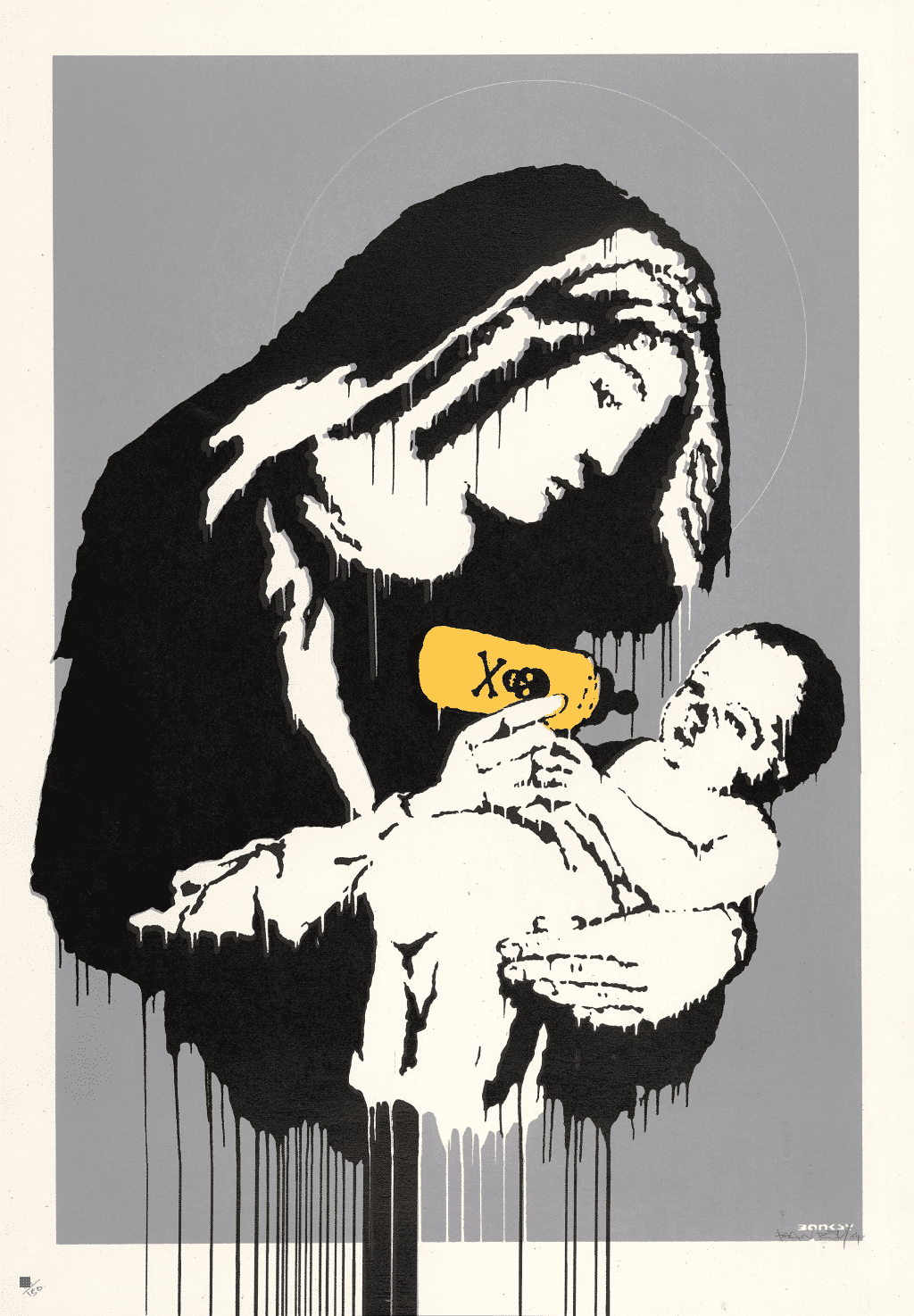
Toxic Mary (Signed)
by Banksy
Year: 2004
Medium: Screenprint on paper
Size: 50 × 70 cm (19 7/10 × 27 3/5 in)
Edition of 150
Signed and numbered by the artist
Pest Control Certificate Included
Banksy’s Toxic Mary (Signed) (2004) is a rare screenprint on paper measuring 50 × 70 cm, released in a limited edition of 150 and signed and numbered by the artist. Reimagining religious iconography through a provocative contemporary lens, the work reflects Banksy’s early 2000s critique of morality, environmental anxiety, and institutional influence. Its scarce signed edition, strong conceptual impact, and Pest Control Certificate ensure verified provenance and high collector desirability.
Discover Toxic Mary unsigned print version.
Banksy’s Toxic Mary is a provocative reworking of traditional religious imagery, first appearing as a street mural in the early 2000s. Created during a period when Banksy was actively confronting institutions through public art, the work reflects growing concerns around environmental damage, moral decline, and the impact of modern society on long-held beliefs.
The image shows the Virgin Mary holding the infant Jesus, surrounded by a sense of contamination and “toxic” disruption. By placing pollution and decay into a sacred scene, Banksy creates a direct clash between purity and corruption. The result is a powerful visual metaphor for how innocence and faith are affected by the world around them. The work also reflects Banksy’s broader themes of institutional critique and the tension between tradition and contemporary reality.
There is no wider graffiti series beyond the original mural, as Toxic Mary functions as a standalone intervention. Its impact relies on the shock of recognition and the immediate reinterpretation of a familiar religious scene within a public space.
For collectors, Toxic Mary is valued for its rarity, early date, and strong conceptual message. Demand remains steady in the secondary market, driven by its cultural relevance and its place within Banksy’s most politically and socially critical works. Today, it is considered a key example of how Banksy uses iconic imagery to challenge established belief systems.
Banksy is a world-famous British street artist known for politically charged graffiti and an anonymous identity. Emerging from the Bristol underground scene in the 1990s, Banksy became a leading figure connecting street art, graffiti art, and contemporary art movements. His work combines satire, activism, and social commentary in ways that connect with both casual viewers and serious collectors.
Banksy’s iconic works, such as Girl with Balloon, Flower Thrower, and Love is in the Bin helped define his career and transformed street art into a respected part of the global art market. His visual style is instantly recognizable through stencil techniques, bold black-and-white contrasts, and sharp messages about war, consumerism, and inequality.
Banksy holds major market importance because his original works and authenticated prints regularly sell for millions at international auctions. Demand remains strong among collectors due to limited supply, global recognition, and cultural relevance.
Beyond the market, Banksy changed how people view public art. He brought graffiti into galleries, museums, and mainstream culture while keeping its rebellious spirit alive. From an investment perspective, Banksy is considered one of the strongest contemporary art names, with steady collector demand and long-term appeal across generations.
More Banksy Works to Explore


Toxic Mary (Signed)
by Banksy
Year: 2004
Medium: Screenprint on paper
Size: 50 × 70 cm (19 7/10 × 27 3/5 in)
Edition of 150
Banksy’s Toxic Mary (Signed) (2004) is a rare screenprint on paper measuring 50 × 70 cm, released in a limited edition of 150 and signed and numbered by the artist. Reimagining religious iconography through a provocative contemporary lens, the work reflects Banksy’s early 2000s critique of morality, environmental anxiety, and institutional influence. Its scarce signed edition, strong conceptual impact, and Pest Control Certificate ensure verified provenance and high collector desirability.
Discover Toxic Mary unsigned print version.
Banksy’s Toxic Mary is a provocative reworking of traditional religious imagery, first appearing as a street mural in the early 2000s. Created during a period when Banksy was actively confronting institutions through public art, the work reflects growing concerns around environmental damage, moral decline, and the impact of modern society on long-held beliefs.
The image shows the Virgin Mary holding the infant Jesus, surrounded by a sense of contamination and “toxic” disruption. By placing pollution and decay into a sacred scene, Banksy creates a direct clash between purity and corruption. The result is a powerful visual metaphor for how innocence and faith are affected by the world around them. The work also reflects Banksy’s broader themes of institutional critique and the tension between tradition and contemporary reality.
There is no wider graffiti series beyond the original mural, as Toxic Mary functions as a standalone intervention. Its impact relies on the shock of recognition and the immediate reinterpretation of a familiar religious scene within a public space.
For collectors, Toxic Mary is valued for its rarity, early date, and strong conceptual message. Demand remains steady in the secondary market, driven by its cultural relevance and its place within Banksy’s most politically and socially critical works. Today, it is considered a key example of how Banksy uses iconic imagery to challenge established belief systems.
Banksy is a world-famous British street artist known for politically charged graffiti and an anonymous identity. Emerging from the Bristol underground scene in the 1990s, Banksy became a leading figure connecting street art, graffiti art, and contemporary art movements. His work combines satire, activism, and social commentary in ways that connect with both casual viewers and serious collectors.
Banksy’s iconic works, such as Girl with Balloon, Flower Thrower, and Love is in the Bin helped define his career and transformed street art into a respected part of the global art market. His visual style is instantly recognizable through stencil techniques, bold black-and-white contrasts, and sharp messages about war, consumerism, and inequality.
Banksy holds major market importance because his original works and authenticated prints regularly sell for millions at international auctions. Demand remains strong among collectors due to limited supply, global recognition, and cultural relevance.
Beyond the market, Banksy changed how people view public art. He brought graffiti into galleries, museums, and mainstream culture while keeping its rebellious spirit alive. From an investment perspective, Banksy is considered one of the strongest contemporary art names, with steady collector demand and long-term appeal across generations.