
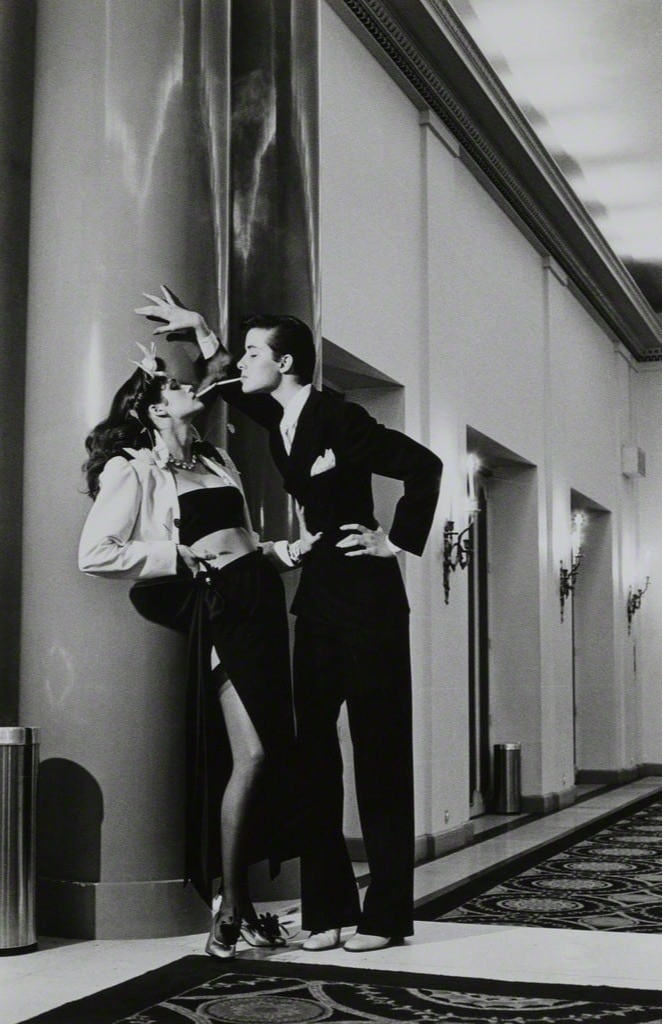
Woman Into Man
by Helmut Newton
Year: 1979
Medium: Silver Gelatin Print
Size: 20 × 16 in (50.8 × 40.6 cm)
Striking in its assured modernity, Helmut Newton’s Woman Into Man (1979) is a 20 × 16-inch (50.8 × 40.6 cm) silver gelatin print that explores identity, transformation, and the codes of fashion. Reflecting Newton’s provocative late-1970s aesthetic, the photograph balances elegance with psychological tension. Its iconic authorship, period significance, and distinctive subject make it an evocative acquisition for discerning collectors of fine photography.
Woman Into Man (Paris, 1979) first appeared in Vogue Paris in March 1979, created for Yves Saint Laurent and later included in Newton’s Private Property series. It is not a street-graffiti work; Newton’s medium was fashion photography, where he used controlled settings to explore identity, desire, and power.
The photograph presents a woman dressed in menswear, using androgyny as a deliberate visual challenge. Newton’s mirror-like composition blurs masculine and feminine roles, while the formal setting adds tension between public image and private identity. His interest was not simply fashion—it was the power of transformation and the freedom to challenge convention.
The image is especially desirable in documented vintage and early edition prints. The Private Property edition was limited to 75, with no more than 25 complete sets released. Sotheby’s has offered an editioned example at a $15,000–$25,000 estimate, underscoring its market importance.
We see Woman Into Man as Newton at his most intelligent: fashion becomes a stage for power, identity, and controlled ambiguity.
It is central to Newton’s late-1970s Le Smoking and Private Property language, alongside his iconic Yves Saint Laurent portraits. For collectors, it remains a defining Newton image with lasting cultural and market appeal.
More Helmut Newton Works to Explore
Woman Into Man
by Helmut Newton
Year: 1979
Medium: Silver Gelatin Print
Size: 20 × 16 in (50.8 × 40.6 cm)
Striking in its assured modernity, Helmut Newton’s Woman Into Man (1979) is a 20 × 16-inch (50.8 × 40.6 cm) silver gelatin print that explores identity, transformation, and the codes of fashion. Reflecting Newton’s provocative late-1970s aesthetic, the photograph balances elegance with psychological tension. Its iconic authorship, period significance, and distinctive subject make it an evocative acquisition for discerning collectors of fine photography.
Woman Into Man (Paris, 1979) first appeared in Vogue Paris in March 1979, created for Yves Saint Laurent and later included in Newton’s Private Property series. It is not a street-graffiti work; Newton’s medium was fashion photography, where he used controlled settings to explore identity, desire, and power.
The photograph presents a woman dressed in menswear, using androgyny as a deliberate visual challenge. Newton’s mirror-like composition blurs masculine and feminine roles, while the formal setting adds tension between public image and private identity. His interest was not simply fashion—it was the power of transformation and the freedom to challenge convention.
The image is especially desirable in documented vintage and early edition prints. The Private Property edition was limited to 75, with no more than 25 complete sets released. Sotheby’s has offered an editioned example at a $15,000–$25,000 estimate, underscoring its market importance.
We see Woman Into Man as Newton at his most intelligent: fashion becomes a stage for power, identity, and controlled ambiguity.
It is central to Newton’s late-1970s Le Smoking and Private Property language, alongside his iconic Yves Saint Laurent portraits. For collectors, it remains a defining Newton image with lasting cultural and market appeal.