
4 Pop Shop Iii
by Keith Haring
Year: 1989
Medium: Silkscreen
Size: 13 × 16 in (33.02 x 40.64 cm)
Edition: 200
Distinctive in its graphic clarity, 4 Pop Shop III (1989) captures Keith Haring’s celebrated Pop Shop period through a 13 × 16-inch (33.02 × 40.64 cm) silkscreen, issued in an edition of 200. Its dynamic visual language reflects Haring’s fusion of street culture, Pop art, and public expression. A compelling period example, the work offers collectors enduring cultural relevance, strong visual presence, and a clear edition history.
4 Pop Shop III (1989) is the fourth plate from Keith Haring’s Pop Shop III portfolio, created during the artist’s mature Pop Shop period. It does not have a known street-graffiti version: unlike Haring’s subway drawings, this image was conceived as a signed screenprint, extending his street-born visual language into the collectible art market.
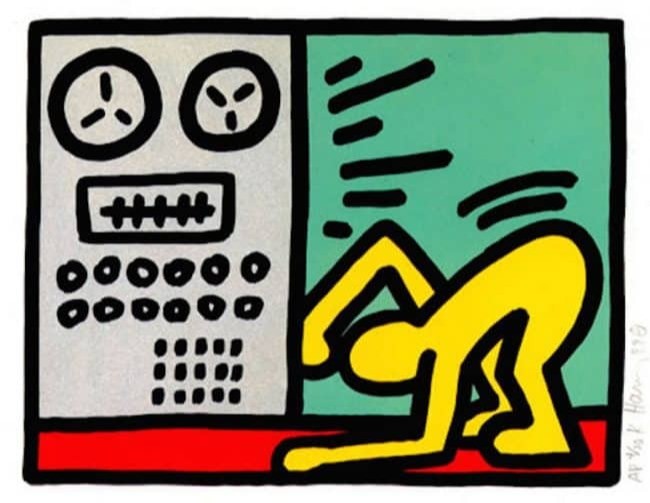
A yellow Haring figure bends toward a mechanical form, listening to the sound it produces. The simple scene becomes a playful study of curiosity, communication, movement, and human interaction. The bold colors and animated lines show why Haring’s imagery remains so powerful decades later.
Signed and numbered from an edition of 200, this work offers a strong entry into Haring’s important Pop Shop III series. A single Pop Shop III print sold for $38,100 at Phillips, confirming continued demand for the portfolio.
We see this plate as a fine example of Haring’s ability to turn an everyday action into a universal visual symbol.
It belongs to Haring’s late-1980s printmaking practice and connects directly to the Pop Shop project, bridging his subway roots with the broader worlds of Pop art, design, and contemporary collecting. The complete four-print portfolio is especially desirable for serious Haring collectors.
Keith Haring (1958–1990) was an influential American artist known for his bold lines, vivid colors, and instantly recognizable figures that helped define the New York art scene of the 1980s. Combining elements of Pop Art, graffiti, and street culture, Haring created energetic artworks featuring dancing figures, barking dogs, radiant babies, and symbolic imagery exploring humanity, love, social justice, and political activism.
Born in Reading, Pennsylvania, Haring moved to New York City in 1978 to study at the School of Visual Arts. He gained public attention through his chalk drawings on unused subway advertising panels, transforming everyday urban spaces into accessible public art. His distinctive visual language soon attracted international recognition and led to exhibitions, collaborations, and large-scale murals.
In 1986, Haring opened the Pop Shop in Manhattan, offering prints, clothing, and other products featuring his designs. The shop reflected his belief that art should reach people beyond traditional galleries and museums. Throughout his career, he addressed important social issues, including racism, apartheid, drug abuse, and the AIDS epidemic.
After being diagnosed with AIDS in 1988, Haring continued creating art and established the Keith Haring Foundation in 1989 to support AIDS-related organizations and children's programs. He died in 1990, aged 31, leaving a lasting legacy in contemporary art.
Today, Keith Haring art prints and original artworks remain sought after by collectors worldwide. Understanding an artwork's edition, condition, provenance, and market history is essential when evaluating its value. Explore our guide to Keith Haring print valuation and learn more about the investment potential of Keith Haring art.
More Keith Haring Works to Explore


4 Pop Shop Iii
by Keith Haring
Year: 1989
Medium: Silkscreen
Size: 13 × 16 in (33.02 x 40.64 cm)
Edition: 200
Distinctive in its graphic clarity, 4 Pop Shop III (1989) captures Keith Haring’s celebrated Pop Shop period through a 13 × 16-inch (33.02 × 40.64 cm) silkscreen, issued in an edition of 200. Its dynamic visual language reflects Haring’s fusion of street culture, Pop art, and public expression. A compelling period example, the work offers collectors enduring cultural relevance, strong visual presence, and a clear edition history.
4 Pop Shop III (1989) is the fourth plate from Keith Haring’s Pop Shop III portfolio, created during the artist’s mature Pop Shop period. It does not have a known street-graffiti version: unlike Haring’s subway drawings, this image was conceived as a signed screenprint, extending his street-born visual language into the collectible art market.
A yellow Haring figure bends toward a mechanical form, listening to the sound it produces. The simple scene becomes a playful study of curiosity, communication, movement, and human interaction. The bold colors and animated lines show why Haring’s imagery remains so powerful decades later.
Signed and numbered from an edition of 200, this work offers a strong entry into Haring’s important Pop Shop III series. A single Pop Shop III print sold for $38,100 at Phillips, confirming continued demand for the portfolio.
We see this plate as a fine example of Haring’s ability to turn an everyday action into a universal visual symbol.
It belongs to Haring’s late-1980s printmaking practice and connects directly to the Pop Shop project, bridging his subway roots with the broader worlds of Pop art, design, and contemporary collecting. The complete four-print portfolio is especially desirable for serious Haring collectors.
Keith Haring (1958–1990) was an influential American artist known for his bold lines, vivid colors, and instantly recognizable figures that helped define the New York art scene of the 1980s. Combining elements of Pop Art, graffiti, and street culture, Haring created energetic artworks featuring dancing figures, barking dogs, radiant babies, and symbolic imagery exploring humanity, love, social justice, and political activism.
Born in Reading, Pennsylvania, Haring moved to New York City in 1978 to study at the School of Visual Arts. He gained public attention through his chalk drawings on unused subway advertising panels, transforming everyday urban spaces into accessible public art. His distinctive visual language soon attracted international recognition and led to exhibitions, collaborations, and large-scale murals.
In 1986, Haring opened the Pop Shop in Manhattan, offering prints, clothing, and other products featuring his designs. The shop reflected his belief that art should reach people beyond traditional galleries and museums. Throughout his career, he addressed important social issues, including racism, apartheid, drug abuse, and the AIDS epidemic.
After being diagnosed with AIDS in 1988, Haring continued creating art and established the Keith Haring Foundation in 1989 to support AIDS-related organizations and children's programs. He died in 1990, aged 31, leaving a lasting legacy in contemporary art.
Today, Keith Haring art prints and original artworks remain sought after by collectors worldwide. Understanding an artwork's edition, condition, provenance, and market history is essential when evaluating its value. Explore our guide to Keith Haring print valuation and learn more about the investment potential of Keith Haring art.