
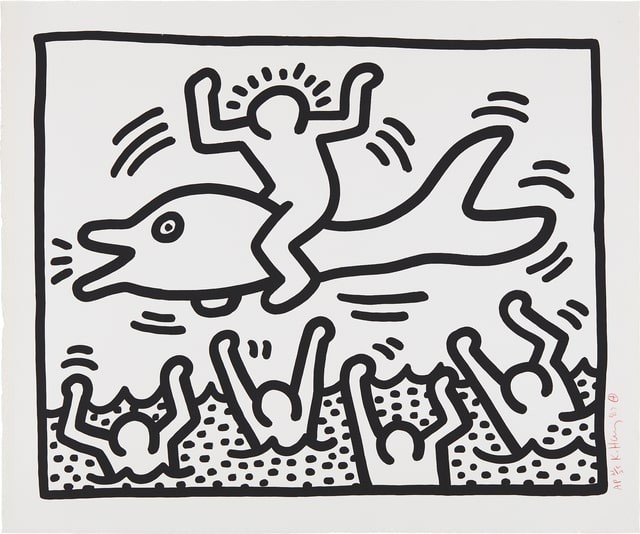
Untitled (Man On Dolphin)
by Keith Haring
Year: 1987
Medium: Lithograph
Size: 29 2/5 × 35 2/5″ in (74.8 × 90 cm)
Lithograph on wove paper, with full margins
Edition of 170 + 25AP
Capturing Keith Haring’s exuberant 1980s visual language, Untitled (Man on Dolphin) (1987) is a lithograph on wove paper with full margins, measuring 29 2/5 × 35 2/5 inches (74.8 × 90 cm). Issued in an edition of 170 plus 25 artist’s proofs, the work unites movement, play, and symbolic freedom. Its strong period relevance and limited edition make it a compelling acquisition for discerning collectors.
First appearing in Haring’s late-1980s body of work, Untitled (Man on Dolphin) brings together two recurring ideas: the human figure and the animal as a vehicle for movement. The rider’s dynamic pose and the dolphin’s sweeping form create a sense of freedom, play, and shared energy. Like much of Haring’s work, the image is simple on the surface but open to readings about harmony, motion, sexuality, and human connection.
There is no documented street-graffiti version of this exact composition. Its visual language, however, comes directly from Haring’s subway drawings, where bold contours and instantly readable figures made complex ideas accessible in public space.
For collectors, the work is appealing for its rarity and strong recognition value. Haring’s dolphin imagery is less ubiquitous than his radiant baby, barking dog, and dancing figures, giving this composition added distinction. Its market importance also reflects Haring’s enduring position among the defining artists of the 1980s.
From a gallery perspective, the work feels unusually lyrical. The dolphin becomes more than an animal; it carries the figure forward, turning movement into a metaphor for freedom.
It belongs to Haring’s mature period and connects naturally to his recurring animal and human motifs. For collectors seeking a less predictable but unmistakably Haring image, this is a particularly engaging choice.
More Keith Haring Works to Explore
Untitled (Man On Dolphin)
by Keith Haring
Year: 1987
Medium: Lithograph
Size: 29 2/5 × 35 2/5″ in (74.8 × 90 cm)
Lithograph on wove paper, with full margins
Capturing Keith Haring’s exuberant 1980s visual language, Untitled (Man on Dolphin) (1987) is a lithograph on wove paper with full margins, measuring 29 2/5 × 35 2/5 inches (74.8 × 90 cm). Issued in an edition of 170 plus 25 artist’s proofs, the work unites movement, play, and symbolic freedom. Its strong period relevance and limited edition make it a compelling acquisition for discerning collectors.
First appearing in Haring’s late-1980s body of work, Untitled (Man on Dolphin) brings together two recurring ideas: the human figure and the animal as a vehicle for movement. The rider’s dynamic pose and the dolphin’s sweeping form create a sense of freedom, play, and shared energy. Like much of Haring’s work, the image is simple on the surface but open to readings about harmony, motion, sexuality, and human connection.
There is no documented street-graffiti version of this exact composition. Its visual language, however, comes directly from Haring’s subway drawings, where bold contours and instantly readable figures made complex ideas accessible in public space.
For collectors, the work is appealing for its rarity and strong recognition value. Haring’s dolphin imagery is less ubiquitous than his radiant baby, barking dog, and dancing figures, giving this composition added distinction. Its market importance also reflects Haring’s enduring position among the defining artists of the 1980s.
From a gallery perspective, the work feels unusually lyrical. The dolphin becomes more than an animal; it carries the figure forward, turning movement into a metaphor for freedom.
It belongs to Haring’s mature period and connects naturally to his recurring animal and human motifs. For collectors seeking a less predictable but unmistakably Haring image, this is a particularly engaging choice.