
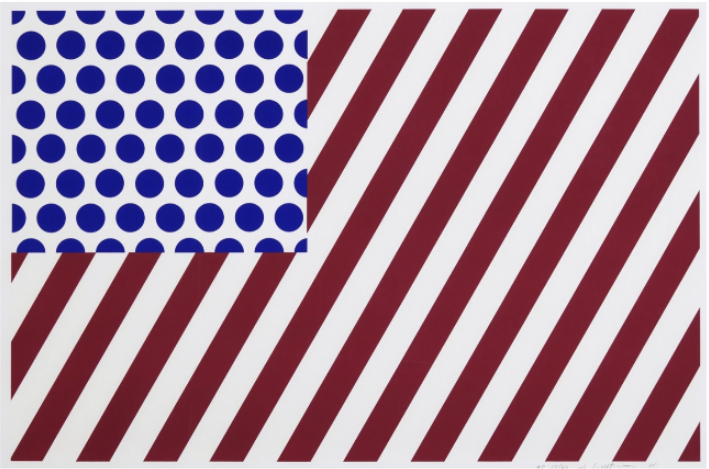
Forms In Space
by Roy Lichtenstein
Year: 1985
Medium: Screenprint on BFK Rives paper
Size: 35 3/4″ x 52″ (90.8 x 132 cm)
Forms in Space by Roy Lichtenstein, available on ArtLife.com. Roy Lichtenstein is preeminently identified with Pop Art, a movement he helped originate.
A bold exploration of geometry and visual rhythm, Roy Lichtenstein’s Forms in Space (1985) reflects his later engagement with abstraction and modernist design. This large-scale screenprint on BFK Rives paper measures 35 3/4 × 52 inches, giving its graphic forms room to command attention. Combining refined printmaking with Lichtenstein’s unmistakable Pop Art language, the work offers a compelling addition to a collection of important postwar prints.
Forms In Space by Roy Lichtenstein is a striking 1985 Pop Art screenprint created for a fundraising benefit at the Institute of Contemporary Art, University of Pennsylvania. Inspired by the American flag, its bold colors, geometric shapes, and graphic patterns explore national identity, visual rhythm, and modern culture.
Unlike street graffiti, Forms In Space belongs to the fine-art print tradition. No established graffiti version is documented. The work reflects Lichtenstein’s ability to transform familiar symbols into bold, visually engaging compositions.
Issued in an edition of 125 prints, plus 20 artist’s proofs, Forms In Space holds appeal for collectors of postwar American art. Lichtenstein’s international reputation and lasting influence on Pop Art support continued interest in his prints. Edition, condition, provenance, and authenticity remain key factors in assessing market value.
From a curatorial perspective, the work stands out for its balance of structure and movement. Lichtenstein turns a familiar national symbol into a study of shape, space, and visual impact.
Created during his mature career, Forms In Space connects with his broader explorations of abstraction, graphic design, and popular imagery. For collectors, it offers a distinctive opportunity to explore Lichtenstein beyond his iconic comic-book works.
More Roy Lichtenstein Works to Explore
Forms In Space
by Roy Lichtenstein
Year: 1985
Medium: Screenprint on BFK Rives paper
Size: 35 3/4″ x 52″ (90.8 x 132 cm)
Forms in Space by Roy Lichtenstein, available on ArtLife.com. Roy Lichtenstein is preeminently identified with Pop Art, a movement he helped originate.
A bold exploration of geometry and visual rhythm, Roy Lichtenstein’s Forms in Space (1985) reflects his later engagement with abstraction and modernist design. This large-scale screenprint on BFK Rives paper measures 35 3/4 × 52 inches, giving its graphic forms room to command attention. Combining refined printmaking with Lichtenstein’s unmistakable Pop Art language, the work offers a compelling addition to a collection of important postwar prints.
Forms In Space by Roy Lichtenstein is a striking 1985 Pop Art screenprint created for a fundraising benefit at the Institute of Contemporary Art, University of Pennsylvania. Inspired by the American flag, its bold colors, geometric shapes, and graphic patterns explore national identity, visual rhythm, and modern culture.
Unlike street graffiti, Forms In Space belongs to the fine-art print tradition. No established graffiti version is documented. The work reflects Lichtenstein’s ability to transform familiar symbols into bold, visually engaging compositions.
Issued in an edition of 125 prints, plus 20 artist’s proofs, Forms In Space holds appeal for collectors of postwar American art. Lichtenstein’s international reputation and lasting influence on Pop Art support continued interest in his prints. Edition, condition, provenance, and authenticity remain key factors in assessing market value.
From a curatorial perspective, the work stands out for its balance of structure and movement. Lichtenstein turns a familiar national symbol into a study of shape, space, and visual impact.
Created during his mature career, Forms In Space connects with his broader explorations of abstraction, graphic design, and popular imagery. For collectors, it offers a distinctive opportunity to explore Lichtenstein beyond his iconic comic-book works.