Top 6 Emerging Artists to Watch and Invest In for 2027
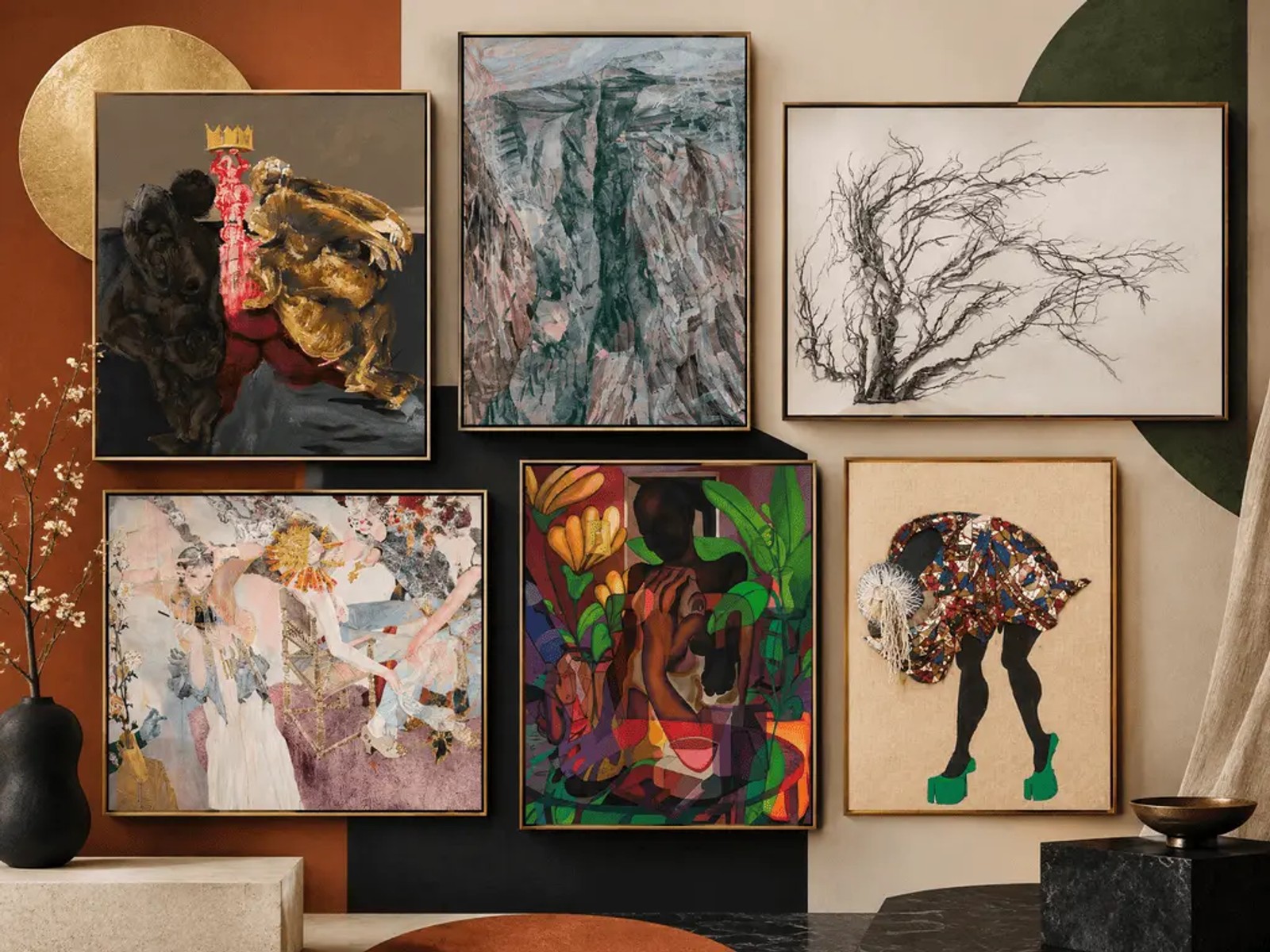
Top 6 emerging artists and their works
On the opening day of Art Basel 2026, Gypsum Gallery sold nine works by Hana El-Sagini from its booth in Statements, the fair’s sector for solo presentations by emerging artists.
A strong first day in Basel is a real result. It still leaves open who bought, whether those prices will hold at her next show and whether anyone will want the works back in five years. At this stage you pay the gallery’s price with little public history to check it against, so the case for each artist rests on career evidence you can verify yourself.
What Actually Counts as an Emerging Artist?
An emerging artist is early in a professional career, sells mainly through a gallery on the primary market and has little or no auction history. Age plays almost no part. Three of the six artists on this list were born between 1980 and 1985. The two youngest were born in 1998.
Established artists, often called mid-career, add museum exhibitions, works in public collections and a record at auction. Blue-chip names trade in volume at the big auction houses, as our guide to Top 10 Blue-Chip Artists to Collect and Invest in 2027 shows. Between two emerging artists, the difference lies in how quickly outside recognition arrives: a second gallery, a museum group show, a first public acquisition.
Why Are Collectors Watching Emerging Art in 2026?
Collectors are buying more at fairs, visiting studios more often and finding new names online. Primary-market galleries now represent as many women as men. Spending has not moved at the same speed, since contemporary art dealers reported flat sales in 2025 while Old Master specialists grew 9% and Modern dealers 11%.
The Art Basel and UBS Art Market Report 2026 puts art fairs at 35% of dealer sales, their highest share since 2022. Online sales fell to $9.2 billion, the lowest figure since 2019. In primary-market galleries, women generated 44% of sales by value.
In the Art Basel and UBS Survey of Global Collecting, 51% of high-net-worth collectors said they had bought through Instagram. Studio visits rose more than every other type of art event, from five a year in 2019 to seven in 2024. Caution remains, as 52% of the same collectors see work by unknown artists as a high-risk purchase.
For Avery Andon, chief executive of ArtLife Gallery, the biggest change since 2021 is in who is buying: “During the boom, a lot of the money at this level came from people who planned to resell within a year or two. The buyers at fairs now ask about museum shows and a gallery’s track record before they ask about price. That’s a slower market, but it’s a much better base for an artist’s career than fast bidding ever was.”
How We Selected the Artists for This 2027 Watchlist
Every artist here had to show several independent signals from the past 12 months, each one checkable in a public source. A single viral moment or one strong auction result was not enough. We also left out artists whose prices have already moved past an early-stage level.
We applied these criteria to each name:
- Institutional recognition: a museum show, a biennial or a public collection.
- Gallery representation: a gallery with a regular program and a fair presence.
- Exhibition history: solo shows building on each other.
- Critical attention: serious writing about a consistent body of work.
- Collector demand: sales reported by the gallery or the fair.
- Secondary evidence: auction results, read with caution when few.
- Price and access: work a private buyer can still acquire.
These signals show a career moving forward. None of them guarantees a price rise.
Yu Nishimura shows where the list stops. Now with David Zwirner, the Japanese painter saw Leaves carpet climb to $998,400 in a May 2026 Sotheby’s sale, more than eight times its low estimate. At that level a buyer pays for a market already formed.
The Emerging Artists to Watch in 2026
The six artists below come from six countries and work in painting, ceramics, bronze, wood and rubber. Where a gallery does not publish prices, the table says so.
| Artist | Born | Based in | Medium | Gallery | Primary price | 2026 milestone |
|---|---|---|---|---|---|---|
| Hana El-Sagini | 1980, Cairo | Dubai | Sculpture, ceramics, installation | Gypsum Gallery | €3,000 to €10,000 at Art Basel | Solo booth in Art Basel’s Statements sector |
| Reika Takebayashi | 1998, Osaka | Kyoto | Painting, ceramics | Taka Ishii Gallery, Public Gallery | Price on request | Sold-out presentation at Frieze New York |
| Márcia Falcão | 1985, Rio de Janeiro | Rio de Janeiro | Painting | Fortes D’Aloia & Gabriel, Contemporary Fine Arts, Night Gallery | $27,000 for a 2026 painting at Art Basel | 36th Bienal de São Paulo (2025–26) |
| Ding Shilun | 1998, Guangzhou | Guangzhou and London | Painting | Bernheim | Price on request | Solo exhibition at Song Art Museum, Beijing |
| Woody De Othello | 1991, Miami | Oakland | Ceramics, bronze, wood | Jessica Silverman, Karma | Price on request | Public Art Fund exhibition in Brooklyn Bridge Park |
| Patrick Bongoy | 1980, Kinshasa | Cape Town | Rubber and mixed-media sculpture | Southern Guild | $20,000 to $38,000 per piece for the gallery’s whole Frieze New York booth | Congo pavilion, Venice Biennale |
Hana El-Sagini
El-Sagini comes from a family of Egyptian artists that includes her grandfather, the sculptor Gamal El-Sagini. She spent 12 years in corporate jobs before turning to art full time, completed a Master of Fine Arts in Basel in 2022 and lives and teaches in Dubai. Her best-known project, Counting Fingers, filled 421 Arts Campus in Abu Dhabi with more than 200 ceramic objects recreating hospital waiting rooms and corridors. The Fenix Museum in Rotterdam holds one of her installations.
- Risks: Her exhibition record is still mostly regional, with little public data on how her prices have changed. Her next two or three shows will say more about demand than one good fair.
- Check before buying: Ask Gypsum how her prices have moved since her first shows and whether any work has appeared at auction.
Reika Takebayashi
Takebayashi paints landscapes in thin, diluted layers of oil and acrylic and makes ceramics combining clay with water-based resin. After an MFA at Kyoto City University of Arts in 2022, her second solo show at Taka Ishii Gallery opened in Tokyo in April 2026. At Frieze New York in May, Public Gallery sold out its Focus presentation of her work. The Baltimore Museum of Art acquired Both Banks I (2026) from the booth.
- Risks: Her professional record covers barely four years. A sold-out booth usually brings a waiting list, which limits what a new buyer can get and puts pressure on output.
- Check before buying: Ask how each gallery allocates new work and how many pieces she completes in a year.
Márcia Falcão
Falcão paints large figures of women’s bodies in heavy layers of oil, acrylic, oil pastel and charcoal, drawing on life in the suburbs of Rio de Janeiro. Her solo shows moved from Rio in 2021 to São Paulo, Los Angeles and, in 2025, Contemporary Fine Arts in Berlin. A group of her paintings hung in the 36th Bienal de São Paulo. Artnet lists no auction results for her, so every known price is a gallery price.
- Risks: She exhibits with galleries in Brazil, Germany, the United States and the United Kingdom. Several galleries can push output up and make prices harder to hold steady from one city to the next.
- Check before buying: Compare price lists from her different galleries for works of a similar size.
Ding Shilun
Ding paints large, crowded scenes built from Chinese folklore, ghost stories, manga and European history painting. He finished an MA at the Royal College of Art in 2022 and has shown with Bernheim since that year. The Song Art Museum in Beijing hosted his first comprehensive exhibition in China from May 20 to June 28, 2026.
His auction market is very new. In May, Three Princes (2022) reached $358,400 at Sotheby’s, more than seven times its low estimate. Two months earlier a smaller painting sold at Phillips Hong Kong for just over $5,000. Only five of his works have appeared at auction.
- Risks: Three Princes came from his first Bernheim show and went to auction four years later. With so few lots, one high result says little about the rest of his work. A buyer entering at auction may also pay well above gallery prices.
- Check before buying: Ask Bernheim whether its sales contracts limit resale and for how long.
Woody De Othello
De Othello makes glazed ceramics, bronzes and wood sculptures based on household objects such as clocks, phones and fans. A participant in the 2022 Whitney Biennial, he has work in the collections of the Whitney, SFMOMA and LACMA, among others. The Public Art Fund is showing his bronzes and redwood sculptures in Brooklyn Bridge Park until March 2027. In May, a 2018 ceramic nightstand sold for $54,180 at Phillips, a new record for him.
- Risks: Of the six, De Othello is the furthest along, so much of the early discovery has already happened. His auction market lags his museum record. Large bronzes also cost more to ship, install and insure.
- Check before buying: For a bronze, ask for the edition size and how many casts already exist.
Patrick Bongoy
He studied at the Academy of Fine Arts in Kinshasa and moved to South Africa in 2013. Bongoy cuts and weaves rubber from old inner tubes with hessian sacking, packaging and textiles into dense sculptures and wall reliefs about mineral extraction and forced migration in Congo. He is one of nine artists in Simba Moto! Seize the Fire!, the first national pavilion of the Democratic Republic of the Congo at the Venice Biennale.
- Risks: A group pavilion gives less individual exposure than a solo show. His commercial record also runs through a single gallery.
- Check before buying: Ask Southern Guild how the rubber should be displayed and cared for.
Which Signals Suggest an Emerging Artist Is Gaining Momentum?
Momentum shows when several signals arrive from different directions over two or three years. A stronger gallery, a museum show, a public acquisition, serious reviews and buyers who come back. One viral post or one auction spike can come from a handful of people and fade within a season.
A museum acquisition carries the most weight, because a curator and a committee chose the work. A sold-out fair booth says less, since galleries tend to place work with clients before the fair opens. Prizes depend on sponsors. Art Basel dropped the Baloise Art Prize in 2026, an award which since 1999 had given two Statements artists a cash prize and a museum acquisition.
What Does It Really Cost to Buy Emerging Art?
Galleries set primary prices mostly by size and medium, then raise them in steps after strong shows. Reported sales at the 2026 fairs often landed in the low to mid five figures for younger artists. Framing, shipping, insurance and storage come on top of the label price.
At Frieze New York, P420 sold works by Francis Offman and Adelaide Cioni for $20,000 each. Nara Roesler placed five works by Jonathas de Andrade at $12,000 to $22,000. Prints and photographs in editions cost less than unique works, though they add little to an artist’s market record.
Extra costs include conservation framing for works on paper, crates and specialist shipping for large canvases and insurance updated as the artist’s prices change.
Andon thinks most first-time buyers underestimate this part: “People plan for the price of the work and forget the cost of owning it. On a large canvas, framing, crating, shipping and insurance add up to money you’ll never get back. My view is that nobody should put a first budget into a single emerging artist. Three smaller works by three different artists teach you more and protect you better.”
Where Do You Find and Buy Emerging Artists?
Most emerging art sells through galleries, at their own shows and at fairs. The most sought-after works are often reserved through waiting lists before they are hung. Fair sections for younger galleries, open studios, residency shows and online showcases are the other main routes.
Art Basel has Statements and Frieze runs Focus for emerging galleries. In New York, NADA and Independent concentrate on newer programs. Online, Artsy’s Foundations 2026 brought together more than 1,200 works from over 85 galleries in 20 countries.
Nico Hayes, senior director at ArtLife, reads a waiting list as a good sign for the artist: “A gallery that sells to whoever pays first is usually the gallery whose artists turn up at auction a year later. The serious ones choose buyers carefully because that’s how they keep prices stable. A dealer who asks about your collection before selling to you is doing the artist’s market a favor.”
What Should You Check About the Artist Before You Buy?
Start with the artist’s career and market history. Find out who represents them and for how long, where they have exhibited, which museums or institutions hold their work, and whether their practice shows a consistent direction. Check how gallery prices have changed over time and whether any works have appeared at auction. These are essential considerations helping you assess an artist’s progress, market potential and the risks of buying early.
More expert tips you can find in our complete guide to collecting and investing in art for beginners and experienced collectors.
The Risks Nobody Talks About Enough
The biggest risk is that no secondary market ever forms. Many emerging artists never reach auction. When they do, a few early records can mislead. Gallery changes or closures can also cut the value of work you already own.
At auction, the ultra-contemporary segment, meaning artists born after 1974, has cooled for four straight years. Its sales fell 26.5% in 2025 to $229.9 million. The average price per work dropped to $15,629, down 72.4% from the 2021 peak.
Joseph Yaeger’s There is a light and it always goes out (2021) sold for $477,300 at Phillips in May against an estimate of $60,000 to $80,000. More than 25 of his works have gone to auction since 2024. Project Native Informant, the London gallery behind the first sale of this one, has since closed. Resales at that pace show demand from a small group of bidders more than a settled price level.
Followers on social media measure attention, which can move to another artist within a season.
Hayes ranks a gallery closure above most other risks: “For an emerging artist, losing the gallery does more damage to prices than a bad review ever could. Once the dealer is gone, nobody manages supply or steps in when work comes up at auction. Pieces tend to appear in clusters with lower estimates. I’d judge the gallery as carefully as the artist before buying.”
Emerging vs. Established: What Actually Differs
The difference comes down to evidence. An established artist has public prices, museum support and a resale route you can check before you buy. An emerging artist has a gallery price, a short exhibition record and an open question about resale.
| Emerging | Established | |
|---|---|---|
| Price history available | Gallery prices only, few or no auction results | Years of gallery and auction results |
| Who sets the price | The gallery, with the artist | The gallery, tested at auction |
| Time to resell | Uncertain, possibly years | Usually one or two auction seasons |
| Evidence you can check | CV, exhibitions, sales reported by galleries and fairs | Museum collections, catalogues, public auction records |
| What can go wrong | No secondary market forms, the artist changes gallery | Prices soften in a weak market, too much supply at auction |
If you already own work by a younger artist and want to know what it could fetch today, request a free valuation from ArtLife with no obligation to sell.
Frequently Asked Questions
What is an emerging artist?
Emerging describes a career stage. The artist usually has a short CV, a few solo shows, one or two galleries setting the prices and few or no auction results. Birth year says little because many artists start late. Read the exhibition record to judge where someone stands.
Is emerging art worth buying as an investment in 2026?
It can be for buyers who accept high risk and years of waiting. Auction prices for the youngest generation of artists fell again in 2025, though gallery sales at fairs held up better. Buy work you want to live with, spread your budget across several names and do not count on a price rise.
How much does emerging art cost?
Small works on paper can cost under $5,000 at the gallery. Paintings by artists with some institutional support can reach the low to mid five figures, with large canvases and sculpture costing more. Budget for framing, shipping and insurance on top of the gallery price.
Where can I buy work by emerging artists?
Start with primary galleries that run dedicated programs for emerging talent, alongside specialized fair sectors like Statements at Art Basel and Focus at Frieze. Established galleries provide provenance, transparent primary pricing, and direct access to an artist’s market. Buying through a gallery also establishes the relationship needed for competitive waiting lists.
How do I know if an emerging artist is gaining momentum?
Look for recognition from different sources over two or three years: a museum acquisition, a biennial, a move to a bigger gallery, serious reviews and collectors who buy again. A sold-out booth or a single high auction result proves much less, because a few buyers can produce either one.
What are the biggest risks of buying emerging art?
The main danger is an artist who never develops a secondary market, leaving the work without a clear resale price. Other risks include early auction spikes setting unrealistic expectations, a gallery closing or the artist leaving it, rising supply as demand grows and the cost of caring for unusual materials.
How easy is it to resell emerging artist art?
Reselling emerging art can take time, as buyers and auction houses often look for an established market record. If you’re considering selling, ArtLife Gallery can help assess your artwork, advise on its resale potential and explore opportunities to connect it with interested collectors. Contact our team to discuss selling your piece.
Looking to Buy Emerging Art?
Discover exciting works by emerging artists with ArtLife Gallery. Whether you’re starting your collection or seeking your next acquisition, our team can help you find original art that reflects your taste and interests. Get in touch to explore available works.