
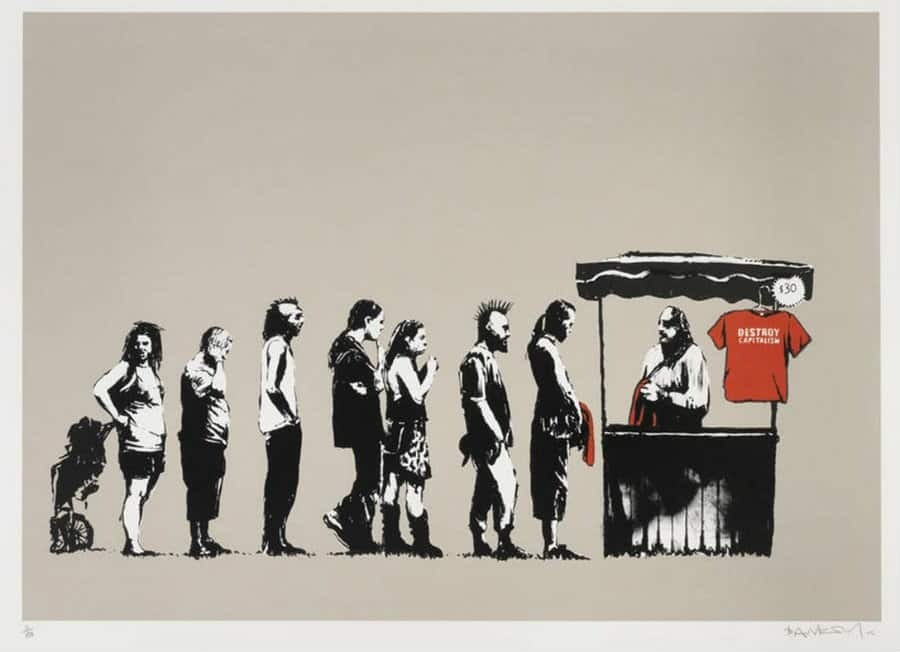
Festival (Destroy Capitalism) (Signed)
by Banksy
Year: 2006
Medium: Screen print on paper
Size: 56 x 76cm
Signed and numbered by the artist
Pest Control Certificate Included
Banksy’s Festival (Destroy Capitalism) (2006) is a screen print on paper measuring 56 × 76 cm, signed and numbered by the artist. Conceived during a period of growing global debate around consumerism and corporate power, the work juxtaposes protest culture with commercial spectacle, a hallmark of Banksy’s visual rhetoric. Its bold political message, signed status, and accompanying Pest Control Certificate establish strong provenance, securing its position as a compelling acquisition within the artist’s celebrated print oeuvre.
Discover the unsigned version of the Festival (Destroy Capitalism) screen print.
Banksy’s Festival (Destroy Capitalism) is one of the artist’s most direct examinations of protest culture and the commercialization of dissent. Created in the early 2000s, when anti-globalization movements and large-scale political demonstrations were attracting worldwide attention, the work reflects Banksy’s fascination with the relationship between activism, consumer culture, and public spectacle.
Unlike many of his iconic images, Festival (Destroy Capitalism) is not known to originate from a specific street mural. Instead, it is primarily associated with Banksy’s print output, where the artist could explore political messaging through carefully controlled imagery and text. This format reinforces the work’s central irony: even anti-capitalist messages can be packaged, marketed, and consumed.
The composition typically depicts festival-goers or protesters carrying a banner with the slogan “Destroy Capitalism,” highlighting the contradiction between genuine resistance and commercialized counterculture. The work explores themes of political identity, mass movements, branding, and the absorption of rebellion into mainstream culture. Like many of Banksy’s strongest concepts, the message is humorous on the surface but deeply critical underneath.
For collectors, Festival (Destroy Capitalism) is valued for its rarity, cultural relevance, and clear connection to Banksy’s anti-establishment philosophy. Demand remains strong among collectors seeking politically charged works that capture the spirit of early 21st-century protest culture. Today, it stands as a significant example of Banksy’s ability to expose contradictions within modern society through simple but unforgettable imagery.
Banksy is a world-famous British street artist known for politically charged graffiti and an anonymous identity. Emerging from the Bristol underground scene in the 1990s, Banksy became a leading figure connecting street art, graffiti art, and contemporary art movements. His work combines satire, activism, and social commentary in ways that connect with both casual viewers and serious collectors.
Banksy’s iconic works, such as Girl with Balloon, Flower Thrower, and Love is in the Bin helped define his career and transformed street art into a respected part of the global art market. His visual style is instantly recognizable through stencil techniques, bold black-and-white contrasts, and sharp messages about war, consumerism, and inequality.
Banksy holds major market importance because his original works and authenticated prints regularly sell for millions at international auctions. Demand remains strong among collectors due to limited supply, global recognition, and cultural relevance.
Beyond the market, Banksy changed how people view public art. He brought graffiti into galleries, museums, and mainstream culture while keeping its rebellious spirit alive. From an investment perspective, Banksy is considered one of the strongest contemporary art names, with steady collector demand and long-term appeal across generations.
More Banksy Works to Explore





Festival (Destroy Capitalism) (Signed)
by Banksy
Year: 2006
Medium: Screen print on paper
Size: 56 x 76cm
Signed and numbered by the artist
Banksy’s Festival (Destroy Capitalism) (2006) is a screen print on paper measuring 56 × 76 cm, signed and numbered by the artist. Conceived during a period of growing global debate around consumerism and corporate power, the work juxtaposes protest culture with commercial spectacle, a hallmark of Banksy’s visual rhetoric. Its bold political message, signed status, and accompanying Pest Control Certificate establish strong provenance, securing its position as a compelling acquisition within the artist’s celebrated print oeuvre.
Discover the unsigned version of the Festival (Destroy Capitalism) screen print.
Banksy’s Festival (Destroy Capitalism) is one of the artist’s most direct examinations of protest culture and the commercialization of dissent. Created in the early 2000s, when anti-globalization movements and large-scale political demonstrations were attracting worldwide attention, the work reflects Banksy’s fascination with the relationship between activism, consumer culture, and public spectacle.
Unlike many of his iconic images, Festival (Destroy Capitalism) is not known to originate from a specific street mural. Instead, it is primarily associated with Banksy’s print output, where the artist could explore political messaging through carefully controlled imagery and text. This format reinforces the work’s central irony: even anti-capitalist messages can be packaged, marketed, and consumed.
The composition typically depicts festival-goers or protesters carrying a banner with the slogan “Destroy Capitalism,” highlighting the contradiction between genuine resistance and commercialized counterculture. The work explores themes of political identity, mass movements, branding, and the absorption of rebellion into mainstream culture. Like many of Banksy’s strongest concepts, the message is humorous on the surface but deeply critical underneath.
For collectors, Festival (Destroy Capitalism) is valued for its rarity, cultural relevance, and clear connection to Banksy’s anti-establishment philosophy. Demand remains strong among collectors seeking politically charged works that capture the spirit of early 21st-century protest culture. Today, it stands as a significant example of Banksy’s ability to expose contradictions within modern society through simple but unforgettable imagery.
Banksy is a world-famous British street artist known for politically charged graffiti and an anonymous identity. Emerging from the Bristol underground scene in the 1990s, Banksy became a leading figure connecting street art, graffiti art, and contemporary art movements. His work combines satire, activism, and social commentary in ways that connect with both casual viewers and serious collectors.
Banksy’s iconic works, such as Girl with Balloon, Flower Thrower, and Love is in the Bin helped define his career and transformed street art into a respected part of the global art market. His visual style is instantly recognizable through stencil techniques, bold black-and-white contrasts, and sharp messages about war, consumerism, and inequality.
Banksy holds major market importance because his original works and authenticated prints regularly sell for millions at international auctions. Demand remains strong among collectors due to limited supply, global recognition, and cultural relevance.
Beyond the market, Banksy changed how people view public art. He brought graffiti into galleries, museums, and mainstream culture while keeping its rebellious spirit alive. From an investment perspective, Banksy is considered one of the strongest contemporary art names, with steady collector demand and long-term appeal across generations.