
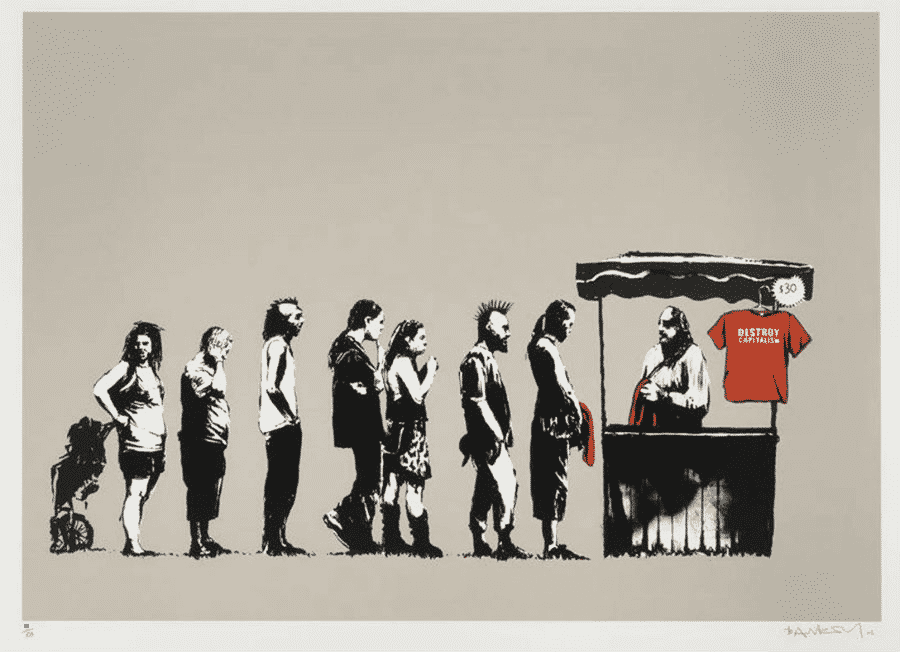
Festival (Destroy Capitalism) (Unsigned)
by Banksy
Year: 2006
Medium: Screenprint
Size: 56 x 76cm
Edition of 100
Pest Control Certificate Included
Banksy’s Festival (Destroy Capitalism) (2006) is a rare unsigned screenprint on paper measuring 56 × 76 cm, issued in a notably scarce edition of 100. Blending the imagery of music festivals with anti-establishment messaging, the work captures the tension between protest culture and commercial consumption that defines much of Banksy’s practice. Its low edition size, cultural relevance, and Pest Control Certificate of Authenticity provide exceptional provenance and enduring appeal within the contemporary print market.
Discover the signed version of the Festival (Destroy Capitalism) screen print.
Banksy’s Festival (Destroy Capitalism) captures one of the central contradictions in modern culture: the commercialization of rebellion. Released during the early 2000s, when anti-corporate protests and alternative festivals were becoming increasingly visible across Europe and North America, the work reflects Banksy’s interest in how political movements can be absorbed by the very systems they oppose.
Unlike many of the artist’s best-known images, Festival (Destroy Capitalism) was conceived as a print rather than a documented street mural. The controlled edition format reinforces the irony at the heart of the work—a critique of capitalism presented as a collectible art object within the market itself.
The composition depicts a crowd gathered around a large banner reading “Destroy Capitalism,” evoking the atmosphere of a music festival, demonstration, or public gathering. Banksy uses this scene to explore themes of activism, consumer culture, conformity, and the commodification of dissent. The work asks whether genuine resistance can survive once it becomes fashionable, marketable, or socially accepted.
For collectors, Festival (Destroy Capitalism) is valued for its cultural relevance, sharp conceptual message, and connection to Banksy’s anti-establishment philosophy. Demand remains strong among buyers seeking works that combine humor with political critique. Today, it is regarded as one of Banksy’s most effective commentaries on the relationship between protest culture and commercial society.
Banksy is a world-famous British street artist known for politically charged graffiti and an anonymous identity. Emerging from the Bristol underground scene in the 1990s, Banksy became a leading figure connecting street art, graffiti art, and contemporary art movements. His work combines satire, activism, and social commentary in ways that connect with both casual viewers and serious collectors.
Banksy’s iconic works, such as Girl with Balloon, Flower Thrower, and Love is in the Bin helped define his career and transformed street art into a respected part of the global art market. His visual style is instantly recognizable through stencil techniques, bold black-and-white contrasts, and sharp messages about war, consumerism, and inequality.
Banksy holds major market importance because his original works and authenticated prints regularly sell for millions at international auctions. Demand remains strong among collectors due to limited supply, global recognition, and cultural relevance.
Beyond the market, Banksy changed how people view public art. He brought graffiti into galleries, museums, and mainstream culture while keeping its rebellious spirit alive. From an investment perspective, Banksy is considered one of the strongest contemporary art names, with steady collector demand and long-term appeal across generations.
More Banksy Works to Explore





Festival (Destroy Capitalism) (Unsigned)
by Banksy
Year: 2006
Medium: Screenprint
Size: 56 x 76cm
Edition of 100
Banksy’s Festival (Destroy Capitalism) (2006) is a rare unsigned screenprint on paper measuring 56 × 76 cm, issued in a notably scarce edition of 100. Blending the imagery of music festivals with anti-establishment messaging, the work captures the tension between protest culture and commercial consumption that defines much of Banksy’s practice. Its low edition size, cultural relevance, and Pest Control Certificate of Authenticity provide exceptional provenance and enduring appeal within the contemporary print market.
Discover the signed version of the Festival (Destroy Capitalism) screen print.
Banksy’s Festival (Destroy Capitalism) captures one of the central contradictions in modern culture: the commercialization of rebellion. Released during the early 2000s, when anti-corporate protests and alternative festivals were becoming increasingly visible across Europe and North America, the work reflects Banksy’s interest in how political movements can be absorbed by the very systems they oppose.
Unlike many of the artist’s best-known images, Festival (Destroy Capitalism) was conceived as a print rather than a documented street mural. The controlled edition format reinforces the irony at the heart of the work—a critique of capitalism presented as a collectible art object within the market itself.
The composition depicts a crowd gathered around a large banner reading “Destroy Capitalism,” evoking the atmosphere of a music festival, demonstration, or public gathering. Banksy uses this scene to explore themes of activism, consumer culture, conformity, and the commodification of dissent. The work asks whether genuine resistance can survive once it becomes fashionable, marketable, or socially accepted.
For collectors, Festival (Destroy Capitalism) is valued for its cultural relevance, sharp conceptual message, and connection to Banksy’s anti-establishment philosophy. Demand remains strong among buyers seeking works that combine humor with political critique. Today, it is regarded as one of Banksy’s most effective commentaries on the relationship between protest culture and commercial society.
Banksy is a world-famous British street artist known for politically charged graffiti and an anonymous identity. Emerging from the Bristol underground scene in the 1990s, Banksy became a leading figure connecting street art, graffiti art, and contemporary art movements. His work combines satire, activism, and social commentary in ways that connect with both casual viewers and serious collectors.
Banksy’s iconic works, such as Girl with Balloon, Flower Thrower, and Love is in the Bin helped define his career and transformed street art into a respected part of the global art market. His visual style is instantly recognizable through stencil techniques, bold black-and-white contrasts, and sharp messages about war, consumerism, and inequality.
Banksy holds major market importance because his original works and authenticated prints regularly sell for millions at international auctions. Demand remains strong among collectors due to limited supply, global recognition, and cultural relevance.
Beyond the market, Banksy changed how people view public art. He brought graffiti into galleries, museums, and mainstream culture while keeping its rebellious spirit alive. From an investment perspective, Banksy is considered one of the strongest contemporary art names, with steady collector demand and long-term appeal across generations.