Why Graffiti Is Art And Not Vandalism: 5 Reasons That Prove It
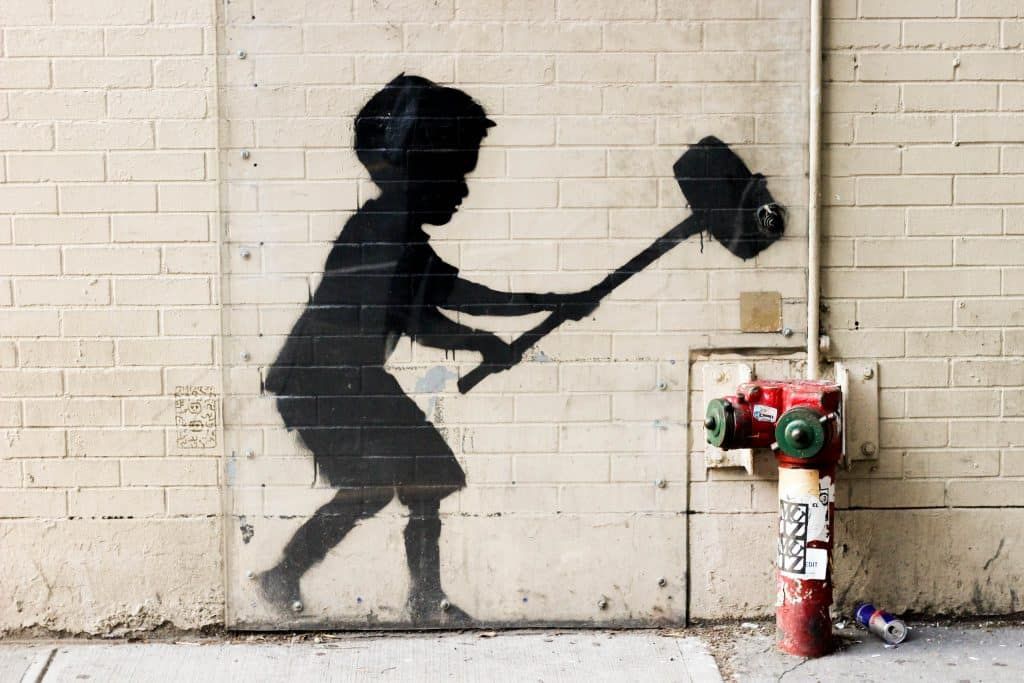
Hammer Boy graffiti in New York by Banksy
Key Takeaways: Why Graffiti Is Art
Graffiti can be both art and vandalism depending on context. In our gallery experience, the distinction between graffiti and vandalism often comes down to intent, context, and artistic execution.
- Graffiti requires skill – Talented street artists like Retna showcase mastery in color, composition, and large-scale execution.
- It’s pure freedom of expression – Artists work outside galleries, free from commercial or institutional constraints.
- It speaks to society – Iconic works by Banksy and Keith Haring highlight urgent political and social issues.
- It transforms spaces – Bold colors and imaginative designs turn dull walls into vibrant urban landmarks.
- The art market values it – High auction prices for pieces by Basquiat, Banksy, and others affirm its artistic legitimacy.
What Is Graffiti?
Graffiti is a form of visual expression created in public spaces using spray paint, markers, stencils, stickers, or murals. The term originates from the Italian word graffio, meaning "to scratch." Modern graffiti emerged in the late 1960s and 1970s as part of urban culture, allowing artists to share ideas, identities, and social messages through public art.
While graffiti often focuses on tags and lettering, it can also include large-scale murals and intricate designs. Depending on the context, graffiti may be viewed as either artistic expression or vandalism, making it one of the most debated forms of contemporary art.
Graffiti vs. Street Art: What Sets Them Apart?
Although the terms graffiti and street art are often used interchangeably, they have distinct characteristics. Graffiti traditionally focuses on tags, lettering, and personal expression, often created without permission in public spaces. Street art typically includes murals, stencils, posters, and large-scale installations designed to engage a wider audience.
The main difference lies in intent and context. Graffiti is often rooted in identity and subculture, while street art frequently aims to communicate a message or beautify an environment. Today, many artists move between both forms, blurring the boundaries between urban art, public art, and contemporary culture.
Is Graffiti Art or Vandalism? Understanding the Difference
The debate over whether graffiti is art or vandalism often depends on one key factor: context. Unauthorized markings on private or public property may be considered vandalism under the law. However, commissioned murals and thoughtfully executed works that demonstrate creativity, technical skill, and cultural significance are increasingly recognized as legitimate forms of art.
According to Avery Andon, founder and owner of ArtLife Gallery, "Graffiti should be judged by the same standards as any other artistic medium. Intent, execution, originality, and context all matter. While illegal tagging can be vandalism, meaningful works that inspire dialogue and reflect cultural experiences deserve recognition as art."
As cities, galleries, and collectors continue to embrace urban art, the line between graffiti and vandalism is becoming more nuanced than ever.
5 Reasons That Prove Graffiti Is Art
The debate over whether graffiti constitutes art or vandalism is incredibly complex, and depends on many factors, such as the location of a particular piece, and the quality and message of the design. There is no clear answer, and it’s easy to see both sides of the debate — after all, not everyone would be happy to have their property painted without their consent. On the flip side, it could also be argued that graffiti is an artist’s right to freedom of expression, and a way to ensure their work can be appreciated by those beyond the artistic elite.
However, we champion plenty of graffiti artists here at ArtLife, and even though there will always be exceptions, we stand firm that graffiti is deserving of its status as art for the following reasons:
1. Graffiti Takes Technical Skill
A great deal of talent is required to create brilliant artwork, and graffiti is no exception. In fact, there are plenty of street artists whose work clearly displays an immense level of technical ability. Take Retna, for example, who has gone beyond painting walls to cover entire buildings with his distinct calligraphic style, such as the 21-story Cuauhtemoc building in Mexico City.
This unbelievably complex achievement required a great deal of strategic planning and real imagination to pull off, as well as a clear understanding of color and composition. This may not be true of all graffiti creations — many critics would argue that you don’t need talent to paint a scruffy tag. However, art is subjective, and there will always be ‘good’ and ‘bad’ artists within every movement. Those like Retna prove that, as in any art form, graffiti can be exceptional when created by someone with impressive skill.
"When evaluating street art submissions, I look for mastery of scale, composition, and visual storytelling. Executing a mural on a 30-foot wall requires technical precision that rivals traditional studio painting." — Nico Hayes, Senior Director at ArtLife Gallery
2. It Exemplifies Freedom Of Expression
Art ceases to be art without freedom of expression, and perhaps graffiti exercises this right more than any other medium. Taking creativity to the streets means that the artists don’t need to worry about gallery curators, critics or potential buyers, and can therefore be completely unrestrained, and even anonymous if they so choose.
Status doesn’t matter, and the lack of limitations allow graffiti artists to break conventions and push boundaries to create even more exciting — and arguably more authentic — works of art.
3. Political And Social Themes Are Powerfully Represented
Many of the most renowned artworks make a powerful comment on the social and political issues of their time, and graffiti can make a huge impact in this respect. Just look at Banksy, who has become world-famous for his humorous and subversive commentaries like Love is in the Air, first painted on Jerusalem’s West Bank barrier in 2003 as a statement in favor of Palestinian rights. Similarly, Keith Haring was able to bring mass attention to the crack epidemic through his Crack is Wack mural, as well as homosexuality and the AIDS crisis.
Plenty of aficionados would argue that it’s art’s duty to shed light on such topics, and given that these themes relate to ordinary people, perhaps it’s unsurprising that the most iconic examples were created on the streets the target audience live on.
4. Impressive Works Bring Drab Spaces To Life
As well as having meaning, art is also valued for its beauty, and there’s no denying how beautiful some graffiti can look, which is why street art tours are now so popular all over the world. Even though graffiti is generally free to access, more and more people are willing to pay to see some of the most magnificent works in the city of choice.
Bold colours, shapes and patterns are key features of this art form, and when artists let their imaginations run wild, their creations instantly transform drab spaces into places people are excited to be. Seeing as art is used to decorate the walls of our homes, couldn’t it be argued that graffiti does the same to the walls outside?
5. Huge Sales Demonstrate Its Artistic Value
Anyone arguing that graffiti isn’t art may struggle to explain why people have paid so much for it in recent years. For example, Untitled by Jean-Michel Basquiat sold for a huge $110.5 million in 2017, the most expensive American painting ever to sell at auction at the time, while Banksy’s Girl with Balloon sold for $1.37 million.
Other expensive pieces include Retna’s Untitled ($38,000) and Charlie Chaplin by Mr. Brainwash ($100,000). Not everyone would agree that an artwork’s value is determined by its price tag, however the fact that graffiti can sell for such high sums proves the respect and prestige it has generated within the art community, and it would therefore be entirely reductive to claim all graffiti is mere vandalism.
At ArtLife Gallery, we've seen growing collector interest in urban art over the last five years, particularly among first-time buyers.
"We've seen growing interest in urban art among collectors who value its cultural relevance and social commentary," said veteran art dealer and artist manager Avery Andon.
Why Do Some People View Graffiti as Vandalism?
The debate over graffiti often centers on issues of property rights and public responsibility. Many people consider graffiti vandalism when it is created without the property owner's consent, regardless of its artistic quality.
Unauthorized tagging can damage buildings, public infrastructure, and private property, leaving owners responsible for expensive cleanup and restoration costs. Cities and local governments also invest significant resources each year to remove graffiti from streets, parks, transit systems, and public spaces.
Community concerns play an important role as well. Some residents believe excessive graffiti contributes to a sense of neglect, negatively affects neighborhood appearance, and may impact local businesses or property values. While commissioned murals are often welcomed as public art, unauthorized graffiti continues to raise questions about ownership, consent, and the appropriate use of shared spaces.
From City Walls to Galleries: Famous Graffiti Artists Who Changed the Art World
The growing recognition of graffiti as a legitimate art form is closely tied to the influence of pioneering artists who transformed urban expression into a global cultural movement. Banksy is perhaps the most recognizable name, known for his politically charged stencils and anonymous identity. Jean-Michel Basquiat began as a graffiti writer in New York before becoming one of the most celebrated contemporary artists of his generation.
Other influential figures include Keith Haring, whose bold public murals brought street art into mainstream culture, and RETNA, known for his distinctive calligraphic style. Artists such as Shepard Fairey and Lady Pink have also helped bridge the gap between public spaces and galleries.
Their success demonstrates that graffiti can extend far beyond unauthorized markings, influencing contemporary art, design, fashion, and popular culture worldwide.
Frequently Asked Questions
Why do people consider graffiti a form of art?
Graffiti is often considered art because it combines creativity, technical skill, visual storytelling, and cultural influence. Many artists use walls and public spaces as canvases to communicate ideas, emotions, and social commentary. Over time, graffiti has evolved from underground expression into a respected movement within contemporary art and design.
What is the difference between street art and graffiti?
Although the terms are frequently grouped together, graffiti usually focuses on lettering, tags, and spray-painted styles, while street art often includes murals, stencils, posters, and larger visual concepts. Both forms share urban roots, but street art is generally created for broader public engagement and visual storytelling.
Why has graffiti become popular worldwide?
Graffiti gained global popularity because it speaks directly to public audiences outside traditional galleries and museums. Its bold visuals, accessibility, and connection to music, fashion, and youth culture helped it spread across major cities worldwide. Social media has also amplified graffiti artists and urban art movements internationally.
Can graffiti have cultural or historical significance?
Many graffiti works reflect important cultural moments, political movements, and social struggles tied to specific communities or cities. Certain murals and street pieces become historical landmarks over time because they capture public emotions, local identity, or major events in a visually memorable and accessible way.
Why do galleries and collectors invest in graffiti art?
Collectors are increasingly drawn to graffiti art because of its originality, cultural relevance, and growing influence within the contemporary art market. Works by major street artists have achieved strong auction results and museum recognition, turning graffiti from an underground practice into a respected and highly collectible art category.
How does graffiti influence modern design and fashion?
Graffiti has heavily influenced graphic design, advertising, fashion, music visuals, and sneaker culture through its bold typography, vibrant colors, and rebellious aesthetic. Many luxury brands and global companies now collaborate with street artists, proving graffiti’s lasting impact on mainstream visual culture and creative industries.
Why do cities preserve certain graffiti murals?
Cities sometimes protect graffiti murals because they attract tourism, strengthen cultural identity, and contribute to urban revitalization. Famous works can become local landmarks that represent creativity and community pride. In some cases, preserved murals also honor influential artists or document important social and historical themes.
Can graffiti artists become successful contemporary artists?
Many graffiti artists have transitioned into successful contemporary art careers through gallery exhibitions, international commissions, and museum collaborations. Artists like Banksy, Jean-Michel Basquiat, and Keith Haring helped bridge the gap between street culture and fine art, inspiring a new generation of collectors and urban creatives.
Ready to Start Your Collection?
Success in this market hinges on insight and access. ArtLife delivers both. We source investment-grade prints and blue-chip canvases that build real portfolio value. Contact ArtLife today to access our private inventory and acquire your next asset.