Banksy Investment Guide 2026: Smart Collector’s Playbook
Banksy investment guide
In March 2026, a Reuters investigation did what twenty years of rumor could not. It put a name to Banksy, identifying the Bristol street artist as a man born there in 1973. The claim reignited global debate and the leading theories behind who Banksy is. Two months later, the market answered. A previously unseen painting, Girl With Balloon on Found Landscape, sold for nearly $18 million at a New York auction, the third-highest price ever paid for his art.
That sequence reframes the question for anyone buying in 2026. Banksy now holds undisputed blue-chip status. His record-setting work, Love Is In The Bin, fetched $25.4 million at Sotheby’s in 2021, and his prints change hands in London and New York at every price level.
Let’s look at the actual numbers to see where the market floor sits today, which prints are changing hands, and how to secure an airtight acquisition.
Why Investors Still Care About Banksy in 2026
The decades-long debate over who Banksy is no longer dictates his market value. With his identity revealed and the market exiting a 2022 to 2024 correction, collectors are buying based on hard data. Fixed print supplies, institutional backing, and a recent $18 million sale confirm that blue-chip demand for his work has comfortably survived the loss of his anonymity.
After the sharp correction of the last few years, buyers are asking one question: do today’s lower prices mark a buying opportunity or a value trap? The answer comes down to three market mechanics.
First, global demand. Banksy’s imagery commands a level of cultural recognition that translates directly into secondary-market liquidity.
Second, supply is severely restricted. His primary publisher, Pictures on Walls, closed in 2017. Apart from a limited release through his Gross Domestic Product shop in 2019 and a 50-print charity run for Ukraine in 2022, he has stopped issuing new commercial print editions. The pool of authentic prints is capped.
Third, institutional validation. His art anchors major museum exhibitions and private collections, and the $18 million Manhattan sale in May 2026 showed his market behaves like classic blue-chip territory, insulating his top-tier prints from short-term contemporary trends.
What’s Happening in the Banksy Market Right Now?
The 2021 boom that produced the $25.4 million record has cooled, and 2026’s real story is the identity reveal and its first market test. A recovering auction market, plus a sale near $18 million in May, suggest that demand for top-tier Banksy art has held even though the initial speculative wave has ended.
The comedown after the 2021 peak
The peak saw extreme valuations. Love Is In The Bin set the artist’s record at Sotheby’s on 14 October 2021, and a Love Is In The Air canvas had already sold for $12.9 million in New York that May, paid in cryptocurrency. Those results marked the top, and the speculative wave receded afterward.
The recovery has been slow and selective. According to the Bank of America 2026 U.S. Art Market Report, United States auction sales across the major houses rose 23 percent in 2025 to $3.17 billion, the first annual increase since 2022, with the second half up 54 percent year on year. Established names led that rebound, which is where Banksy now sits.
The reveal that changed the story
A Reuters investigation in March identified Banksy as a Bristol man born in 1973, drawing on court records and corporate filings. His lawyer disputed parts of the account, and Pest Control, his authentication office, declined to confirm or deny it.
For investors, the reveal cuts two ways. A named artist can read as a more stable and collectible asset, easier for institutions to underwrite. A lost mystery can also reduce the cultural momentum that drove the brand. The market had not weighed in until May.
Is Banksy actually a good investment?
Banksy has delivered enormous gains and brutal corrections inside the same decade. His art is an alternative asset with low correlation to equities. Buyers use his work for portfolio diversification. The upside is scarcity and recognition. The risks are liquidity, authenticity, and now an artist whose anonymity is gone.
How Banksy compares with stocks, gold, and fine art
Art tends to move on its own cycle, with weak ties to stock indexes. Within art, Banksy is unusually liquid, because his print editions run into the hundreds, so an owner can usually find a buyer instead of waiting years for a single match.
The trade-offs are real. There are no dividends, auction fees are steep, and a buyer who enters near a peak can wait a long time to recover. Gold and index funds give liquidity without forgery risk. Banksy offers cultural weight and capped supply that financial assets cannot.
Historical returns: boom, bust, and recovery
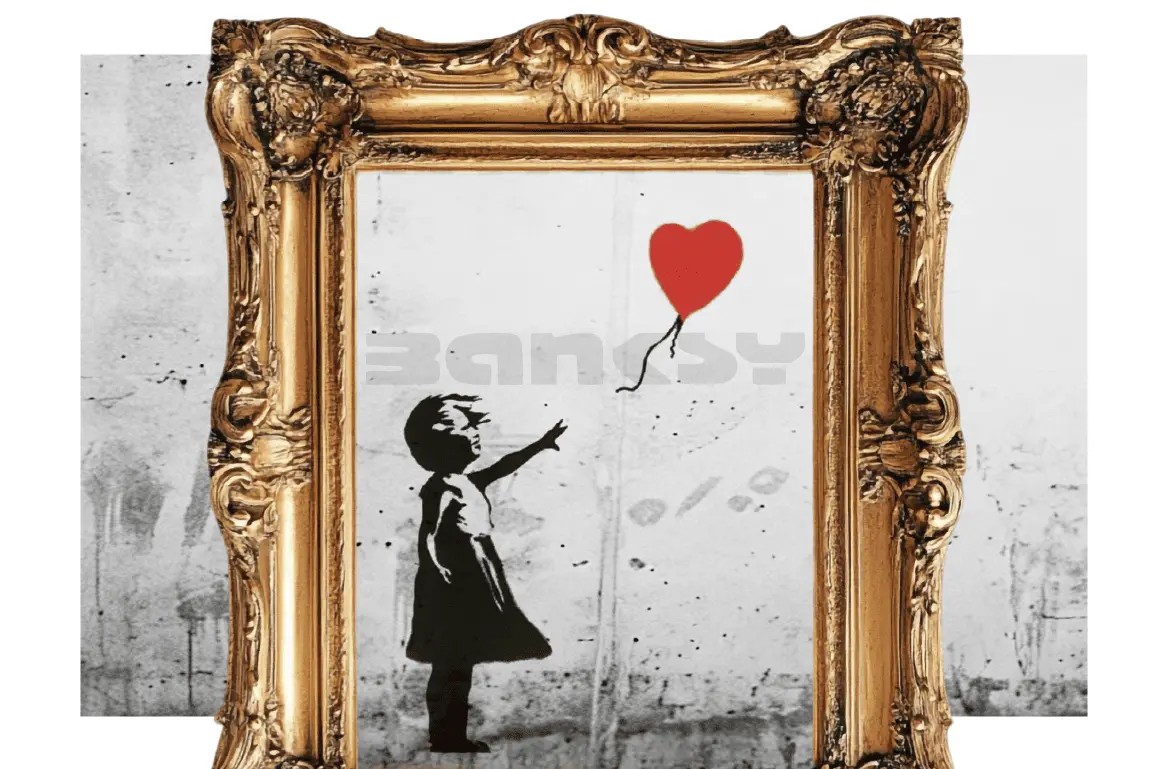
Historical data shows long-term growth interrupted by a severe market correction. A framed Girl With Balloon sold for about $1.4 million at Sotheby’s in 2018, then shredded itself live, and the wreck resold as Love Is In The Bin for $25.4 million in 2021. A Gold artist’s proof of the same image reached $1.5 million that March.
Then the speculation cooled and many 2021 buyers sat on paper losses. By 2025 the broader market had returned to growth, and the 2026 reveal failed to break demand. Buyers who held images bought before the frenzy have generally come out ahead.
Risk vs reward explained
The upside is anchored in capped supply and durable recognition. The danger, however, lies in wild price swings, a high volume of fakes, and the untested variable of his unmasking.
Which Banksy Prints Have the Strongest Investment Potential?
A close look at the top 15 Banksy prints to buy right now shows that actual demand concentrates on a handful of core images. Signatures command a steep premium over standard editions, while the scarcest artist’s proofs have reached seven figures. The three images below carry the deepest and best-documented auction records in the entire market.
The blue-chip Banksy prints
These are the images with the longest sale histories and the widest buyer base. They trade often, recover fastest after a dip, and tend to anchor a serious collection. Demand for them is global and consistent, which is what an investor wants when the ability to sell matters as much as the ability to buy.
- Girl With Balloon (2004): His signature image, a girl reaching toward a red heart-shaped balloon. Pictures on Walls published an unsigned edition of 600 and a signed edition of 150. A Gold proof set the print record at $1.5 million (£1,104,000) at Sotheby’s in March 2021. The shredded canvas of this image, renamed Love Is In The Bin, holds Banksy’s overall record at $25.4 million.
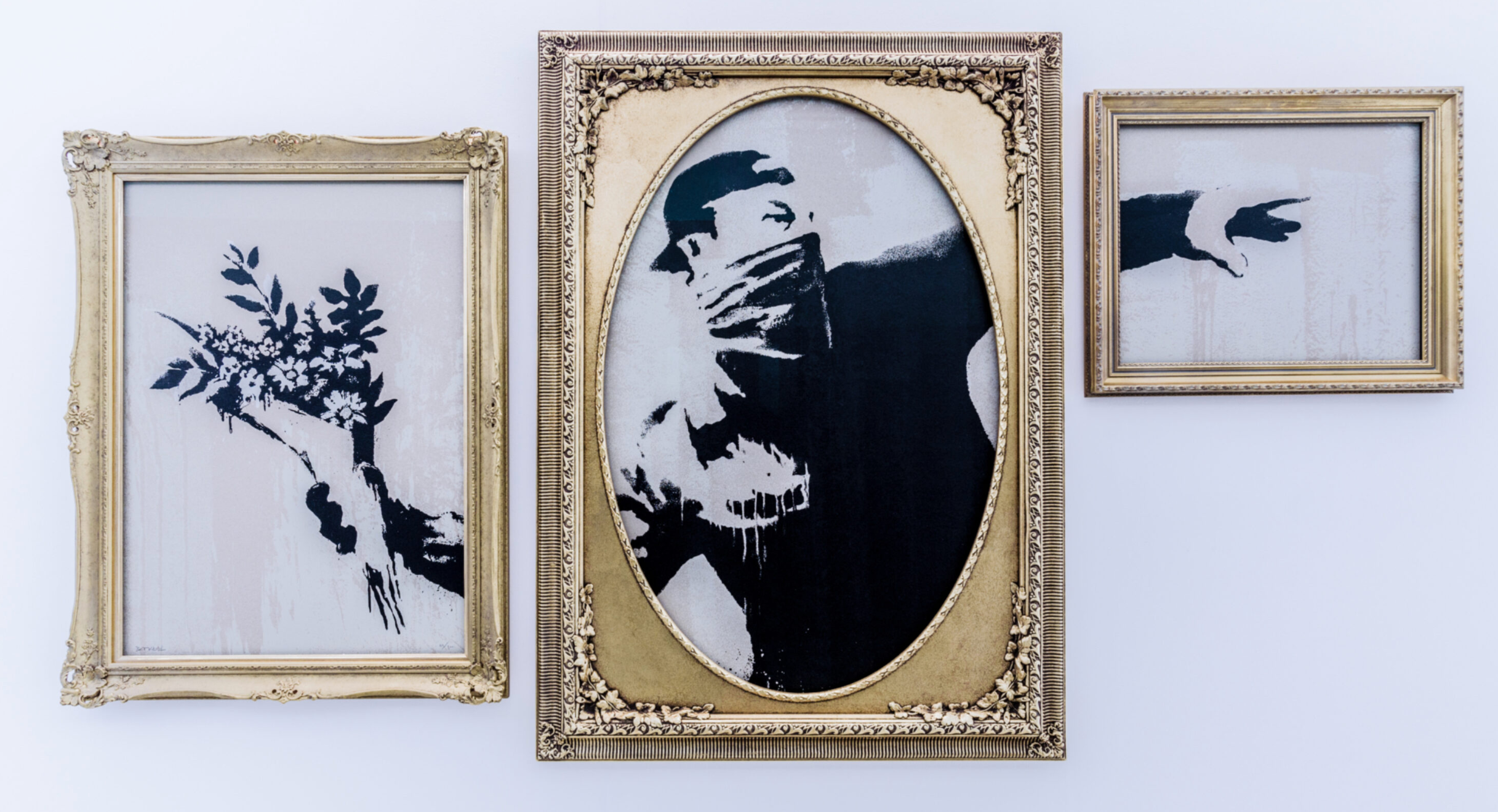
- Love Is In The Air, also called Flower Thrower (2003): A masked protester hurling a bouquet, first painted near the West Bank wall and chosen for the cover of Banksy’s book Wall and Piece. An original canvas sold for $12.9 million at Sotheby’s in New York in May 2021, the first physical artwork the house allowed a buyer to pay for in cryptocurrency.
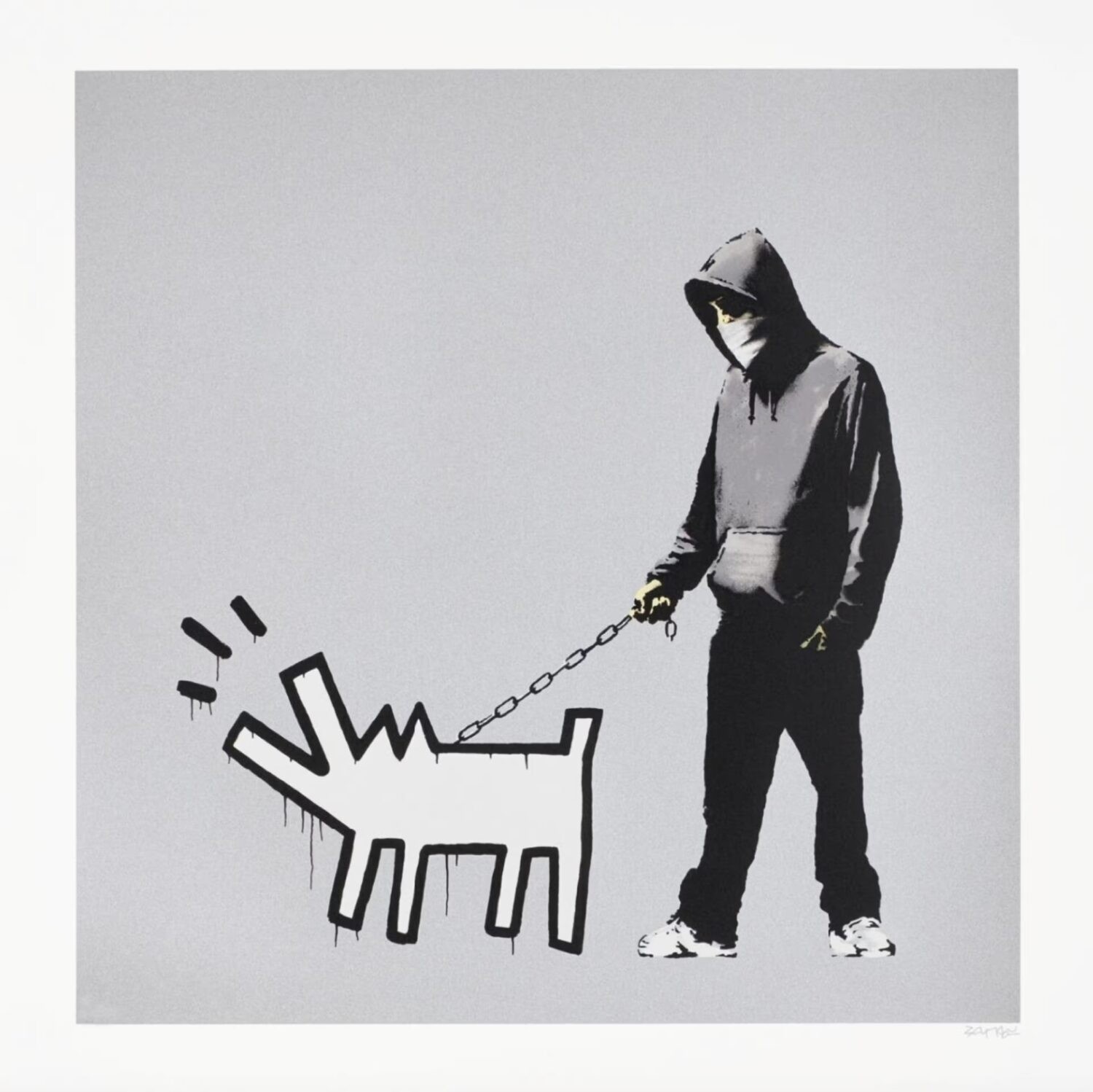
- Choose Your Weapon (2010): A hooded figure walking the barking dog drawn from Keith Haring, and the last print Banksy issued through Pictures on Walls before it closed. A rare Fluoro Green example set the image’s auction record at $420,336 (£302,400) at Sotheby’s in March 2021.
Emerging opportunities investors are watching
A second tier sells well below the blue-chips and offers room to grow as the top images get scarcer. These prints have shorter or thinner sale records, so they carry more uncertainty, but they let a buyer hold a strong image without seven-figure exposure. Both houses that lead the market now run dedicated Banksy print sales.
Two names draw steady interest. Kate Moss (2005) maps the supermodel onto Andy Warhol’s Marilyn silkscreen, a pop-art homage issued in multiple colorways.
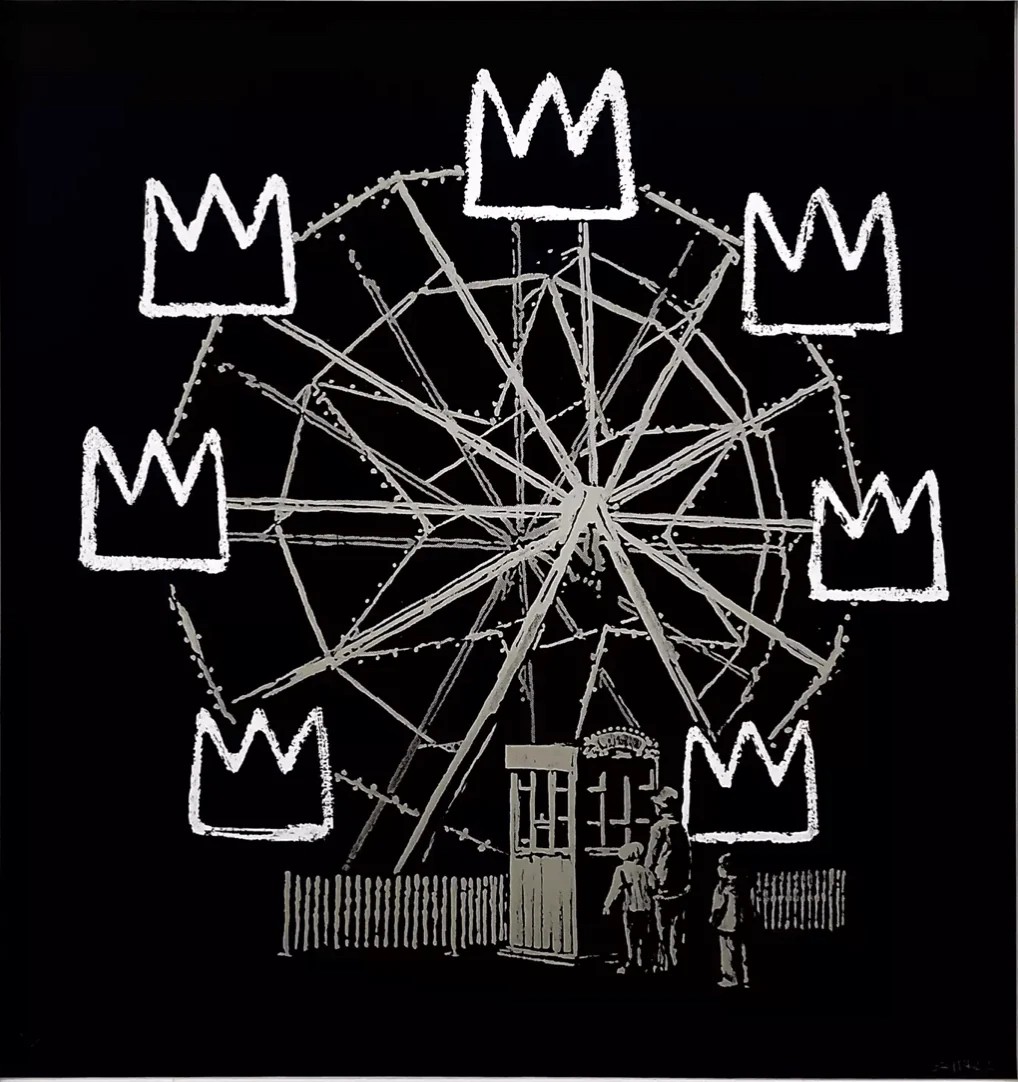
Banksquiat (2019), a signed edition of 300 released through his Gross Domestic Product project, replaces the carriages of a Ferris wheel with Jean-Michel Basquiat’s crown motif, a comment on how the market commodified Basquiat. Both appear regularly at Sotheby’s and Christie’s, at price points far under the record-setters above, which is what makes them an entry route worth watching.
Signed vs unsigned: which offers better value?
The financial divide between signed vs unsigned Banksy prints is stark. Signatures command a massive premium and climb faster, but they also took the hardest hit during the correction. Unsigned editions trade more frequently at lower entry points, suiting a cautious or first-time buyer. The right answer comes down to budget, time horizon, and tolerance for volatility.
Girl With Balloon shows the spread cleanly. Its unsigned edition of 600 is the accessible end of the market, while its 88 artist’s proofs are the rarest tier and produced the $1.5 million record. Signatures and proofs are scarce by design, and in a thinner market that scarcity protects value, while unsigned editions reward a lower cost of entry.
How Much Money Do You Need to Invest in Banksy?
The amount depends on the tier you buy into. Unsigned prints start around $6,500, while a unique original canvas can exceed $10 million. Most buyers set a budget first, then divide it among several works rather than spending it all on one print. Values shift with each auction cycle, so a clear budget limits the risk.
Entry-level collectors ($6,500 - $32,000)
A budget of $6,500 to $32,000 buys unsigned prints, the busiest and most liquid corner of the market, where works change hands far more often than unique canvases. Most newcomers start right here, with images like Applause or Morons.
Everything depends on the Pest Control certificate. Without it, a print is very hard to resell at a fair price, so confirm it no matter how low the cost.
Serious investors ($32,000 - $130,000)
This tier reaches Banksy’s best-known works without the sharp price swings of the most expensive lots. Demand is deep, so you can usually sell when you choose to, and prices tend to stay stable over a long holding period.
Patience matters most here. Wait for the right price and require documented provenance. Do not spend the whole budget on one in-demand image. Dividing it among two or three stable prints reduces the risk if a single print falls in value.
Premium collectors ($130,000+)
Past the $130,000 mark, the market shifts to rare artist proofs, original canvases, and top-tier signed prints. These pieces drive auction records, but they also carry high transaction fees and major price swings.
At this level you bid against museums and experienced dealers, which leaves little room for error on a six-figure purchase.
An independent condition report and a documented chain of ownership are essential. You also need a clear plan for when and how you would sell, because an expensive purchase without an exit plan can become a costly mistake.
Example Banksy portfolio allocations
One way to picture it, purely as an example, is a three-way split. Around 60 percent goes to a stable signed blue-chip print, 25 percent to an undervalued image with room to grow, and the last 15 percent to an unsigned edition you can sell quickly for cash.
Every buyer works with different timelines and budgets. You must adapt this exact breakdown to your own reality. The best collections belong to people who buy what they can comfortably hold for a decade, with no pressure to sell quickly.
How to Spot a Winning Banksy Before Everyone Else?
Winners share a pattern. They pair a scarce edition with an iconic image, show a deep record of public sales, and hold demand through a downturn. Reading those signals in the auction data beats reacting to headlines, and it is how a disciplined buyer gets ahead of the crowd instead of arriving late.
The scarcity formula
Scarcity drives Banksy pricing more than any other factor. Smaller editions, signed examples, and rare colorways command the steepest premiums, and the supply freeze since Pictures on Walls closed in 2017 means authentic editions only grow scarcer over time. A buyer should always weigh edition size against demand.
The sharpest opportunities pair a small edition with a famous image. A common image in a large unsigned edition rarely outperforms a scarce signed version of the same motif, however tempting the cheaper option looks on price alone.
Why artist’s proofs often outperform
Artist’s proofs exist in tiny batches set aside from the main production run. This makes them the rarest tier of any composition and a frequent source of auction records. The market holds only 88 signed Girl With Balloon proofs in all color variations combined.
One Gold proof reached $1.5 million, far above standard signed prints. The reason is simple. Fewer available items meet identical demand. The main drawback is liquidity. Because proofs trade so rarely, sellers must wait patiently for the right buyer. Rarity cuts both ways.
Reading auction data like a pro
Numbers tell more than headlines. Watch the hammer price against the estimate, how often an image comes to market, and the dedicated Banksy sales now held by Sotheby’s and Christie’s. A result that meets or beats its high estimate, as the May 2026 sale did, confirms real demand rather than a lack of buyers.
The aim is to know an image’s normal range before bidding. Once a buyer understands where an image usually lands, both an inflated estimate and a genuine bargain become easy to spot.
Supply vs demand signals to watch
Supply and demand leave clear fingerprints on an artist’s market, and a handful of them reward close attention. Shrinking lot counts, results that beat estimates, fresh cultural attention, and deeper online bidding all point to strengthening demand, while the opposite pattern warns that an image is cooling. The signals below are the ones to track:
- Falling lot counts with steady prices. When fewer examples come to market but values hold, supply is tightening, which supports long-term value.
- Estimates being met or beaten. Results that clear the high estimate, point to genuine competition rather than forced selling.
- Fresh cultural attention. A new museum retrospective, a major street mural, or sustained press coverage pushes bids higher for the entire catalog.
- Depth of online bidding. Active competition for affordable unsigned prints proves the buyer base is expanding and driving the market.
Don’t Buy a Fake: The Authentication Checklist
Authentication decides both value and resale. Pest Control, the artist’s own office, is the only body that authenticates Banksy, and a print without its certificate is hard to sell at any price. A 2026 federal forgery case showed just how convincingly fakes can reach the market.
Why Pest Control matters
To understand how the market filters out fakes, our Pest Control authentication guide covers the absolute basics. This private office is the exclusive body recognized to verify Banksy art. An owner submits images, edition details, and provenance, then receives or is refused a Certificate of Authenticity.
The certificate is built to resist forgery. Each one carries half of a torn “Di-Faced Tenner,” Banksy’s spoof £10 note bearing Princess Diana, with the matching half and a handwritten code held by Pest Control. When a print changes hands, the new owner files a change-of-ownership request, and the office confirms with the recorded owner before updating its files.
Provenance verification step by step
A clean chain of evidence protects the buyer. Confirm the Certificate of Authenticity first, then match the torn Di-Faced Tenner half and its handwritten code against the record. Check the edition number and the Pictures on Walls blindstamp on the print, and keep the certificate stored separately from the art during any sale.
Then verify ownership directly. A genuine seller can support a change-of-ownership request through Pest Control, which contacts the listed owner. If a seller resists that step or cannot produce a certificate, treat the deal as unproven no matter how convincing the print appears.
Warning signs every buyer should know
A short list of red flags recurs in nearly every Banksy fraud, and any single one is reason enough to walk away from a deal. Missing paperwork, a price that looks too good, provenance that cannot be checked, and pressure to move quickly are the patterns that frequently expose a fake. Watch for these specific warning signs.
- No Pest Control certificate.
- A price far below market.
- Vague provenance. Histories that trace to galleries or collections that no longer exist are difficult to check and easy to fabricate.
- Pressure and secrecy. Forged stamps on aged paper, a rushed timeline, or a refusal to allow independent verification all point the same way.
Lessons from recent forgery cases
Fakes reach even reputable rooms. In April 2026, a father and daughter pleaded guilty in a United States federal court to a counterfeiting scheme that slipped more than 200 fakes, including bogus Banksy prints, into American galleries and auction houses between 2020 and 2025, defrauding buyers of at least $2 million.
The operation, confirmed by the U.S. Department of the Interior, leaned on antique paper, forged stamps, and fabricated histories, and one fake Banksy protest print sold for about $2,000.
Where should you buy Banksy in 2026?
Buyers navigate four main channels, each balancing fees, transparency, and safety differently. Auction houses guarantee authenticity but charge steep buyer premiums. Specialist brokers provide discrete access to rare prints. Direct private deals allow price negotiation but increase provenance risks. Finally, open online platforms offer massive inventory alongside a severe risk of fakes.
- Auction houses: Sotheby’s, Christie’s, and Phillips offer transparent pricing and strong vetting, but charge steep buyer’s premiums and invite bidding that can push prices up.
- Specialist galleries and brokers: A reputable dealer such as ArtLife can source authenticated prints privately, with documentation and guidance, away from a live saleroom.
- Private sales: Direct deals offer discretion and negotiation, but shift more of the provenance and authentication burden onto the buyer.
- Online marketplaces: They widen access and lower entry costs, yet carry the highest forgery risk, so a Pest Control certificate is essential.
Match the route to your experience, and never let a low price excuse missing paperwork.
When is the Best Time to Buy Banksy?
The ideal moment to buy is during the quiet stretches between major seasonal auctions. Smart collectors acquire pieces when general market sentiment feels soft, deliberately avoiding the crowded bidding wars of spring and autumn. Since 2026 data shows returning strength, waiting for a lower bottom risks missing current opportunities.
Major auction houses concentrate their marquee sales during spring and autumn in London and New York. Bidding during the off-season generates far less competition. Acquiring art during these quiet summer and winter months allows a buyer to negotiate better private deals and secure prints at lower hammer prices.
The 2026 market is clearly recovering. Banksy’s first post-reveal painting met its high estimate in May. Major collectors have returned. Disciplined buyers are acting today instead of waiting for impossible discounts.
The Biggest Risks Every Banksy Investor Should Know
Banksy is blue-chip, yet he carries risks that index funds do not. Prices swing hard, the market can thin out quickly, fakes are common, and the 2026 identity reveal added a variable nobody has fully priced.
- Volatility: Values ran up sharply into 2021 and then corrected for years, so entering near a peak can mean a long wait to break even.
- Liquidity: A thin segment can freeze when sentiment turns, and a seller may have to wait for the right sale.
- Authentication: Fakes reach reputable rooms, so a Pest Control certificate is the line between an asset and a loss.
- Legal and regulatory: Resale royalties under United Kingdom law, anti-money-laundering checks, and import rules all affect net returns.
- The identity variable: With the artist named, demand could steady or cool, and the long-term effect is untested despite the strong May sale.
What Could Drive Banksy Prices Higher Over the Next Decade?
Prices will climb because a shrinking pool of available art is meeting an expanding buyer base. With zero new commercial editions entering the market, scarcity is absolute. Simultaneously, major museums, international collectors, and heavy institutional capital are aggressively competing for the remaining fixed supply.
- Restricted supply: Pictures on Walls closed in 2017, ending his era of large-scale print runs. Rare releases like the 2019 Gross Domestic Product drop still happen, but his overall commercial output remains heavily restricted. The available pool of classic editions shrinks permanently as private owners lock away their assets.
- Institutional demand: Museums and elite private collections actively hunt his best canvases. Vaulting an image removes it from public circulation, forcing private buyers to compete fiercely for whatever remains on the secondary market.
- A widening collector base: New international buyers use these editions as a direct entry point into fine art. This steady influx of fresh capital establishes a hard floor for prices.
- Cultural relevance: Fresh murals, steady press coverage, and the ongoing search for Banksy locations in the US and beyond keep his imagery in public view
- A named artist: The reveal removes a long-standing uncertainty, which could make his market easier to value over time.
Banksy investment outlook for 2026 to 2030
Performance over the next five years depends on macroeconomics and collector demand. A strong recovery will push premium assets significantly higher, while current patterns suggest iconic compositions will simply retain steady values. An economic contraction represents the only major downside risk, though strict supply limits prevent a severe market collapse.
Acquisition discipline remains constant regardless of these conditions. Buyers must secure Pest Control paperwork, study historical auction data, and refuse inflated entry prices. ArtLife Gallery directly sources Banksy prints with complete authentication, helping collectors execute secure acquisitions and build structured portfolios tailored to their specific holding timelines.
Frequently Asked Questions
Is Banksy a good investment in 2026?
Yes, as a long-term alternative asset. Iconic prints offer absolute scarcity, though the market remains volatile. Smart buyers treat these pieces exactly like holding real estate or precious metals. You are parking capital in a culturally significant object that anchors a diversified portfolio against traditional stock market swings.
Which Banksy print is the best investment?
Girl With Balloon has the deepest auction record and the widest demand, making it the safest blue-chip choice. Choose Your Weapon and Love Is In The Air also hold well-documented markets. These specific images transcend the art world, guaranteeing extreme global liquidity whenever you decide to cash out.
Do Banksy prints increase in value over time?
Many have over the long run, though not in a straight line. Prices peaked in 2021, corrected for three years, and began recovering in 2025. This history proves street art requires patience. Flipping prints quickly is a dangerous game, but holding premium sheets for a decade historically yields serious returns.
How much money do you need to invest in Banksy?
Entry runs from a few thousand dollars for a common unsigned print to eight figures for a unique canvas. New buyers tend to start with those standard unsigned editions. It is the smartest way to enter the market, learn how the auction cycles operate, and secure an authentic piece without locking up heavy capital.
Are signed Banksy prints worth more than unsigned prints?
Yes, by a wide margin. Signed editions are far scarcer, and artist’s proofs scarcer still, which is exactly why a gold proof of Girl With Balloon reached $1.5 million. You are essentially paying a massive premium for the guarantee that the studio will never produce another autographed copy.
How can you tell if a Banksy print is authentic?
It must carry a Certificate of Authenticity from Pest Control, the artist’s only authentication body. Without it, a print is very hard to resell. Ignore letters of provenance, old purchase receipts, or a gallery's word. The secondary market requires this exact document to clear any high-level transaction.
Where is the safest place to buy Banksy art?
Established auction houses and reputable specialist galleries, like ArtLife, are the most trusted sources to buy Baksy prints. They give the strongest security and documentation. Wherever you buy, insist on Pest Control paperwork. Serious dealers verify the chain of ownership long before a sale happens, to make sure you do not waste capital on a piece that the secondary market will reject.
Will Banksy still be valuable in 2030?
Most likely. A fixed print supply and steady institutional demand support prices over the long term, though no asset is guaranteed. The 2026 identity reveal did not reduce secondary market prices at all. That alone proves the catalog is permanently locked into modern art history.
Ready to Invest in Banksy?
Building a valuable art portfolio requires more than capital—it requires access to the right opportunities. ArtLife specializes in sourcing authentic, investment-grade Banksy prints and blue-chip artworks sought after by collectors worldwide. Our experts can help you identify high-potential acquisitions and navigate the market with confidence. Contact ArtLife today to gain access to our private inventory and take the next step in your collecting journey.