Warhol and Basquiat: Collaboration That Changed 1980s Art
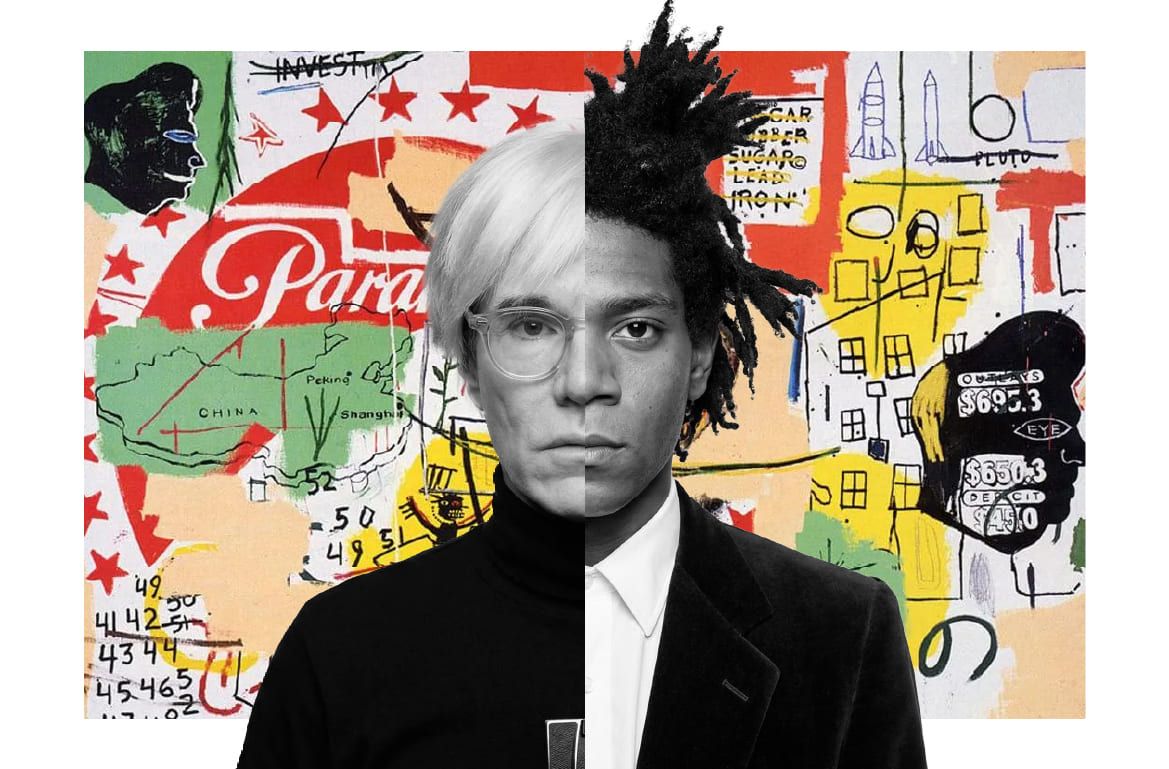
Andy Warhol and Jean-Michel Basquiat collaboration
Andy Warhol and Jean-Michel Basquiat were not an obvious pairing. One was a 54-year-old Pop Art institution, celebrated and scrutinized in equal measure. The other was a 21-year-old who had been sleeping on friends’ floors in Lower Manhattan a few years earlier. What brought them together in 1982 was equal parts coincidence, commercial calculation, and genuine creative chemistry.
The roughly 160 paintings they produced over two years are still among the most discussed pieces in postwar American art, first dismissed, then reappraised, now commanding record prices at auction. The partnership raised questions about race, authorship, commerce, and artistic legacy that the art world is still working through today.
How Andy Warhol and Jean-Michel Basquiat First Met
Andy Warhol and Jean-Michel Basquiat first met on October 4, 1982, when Zurich-based gallerist Bruno Bischofberger arranged a formal introduction at Warhol’s Factory.
What happened in the hours after that introduction set the tone for everything that followed:
- Warhol photographed Basquiat with a Polaroid camera—a standard ritual at the Factory.
- Basquiat asked Bischofberger to photograph the two of them together.
- Basquiat left the Factory shortly after lunch.
- Within two hours, his assistant Stephen Torton arrived at the Factory carrying a finished double portrait: Dos Cabezas (1982).
Warhol was caught off guard. A complete, signed painting delivered that afternoon signaled the kind of instinctive speed Warhol had not seen in his immediate circle for years.
Why Did Warhol and Basquiat Collaborate?
Warhol and Basquiat began collaborating formally in late 1983, at the suggestion of Bruno Bischofberger, their shared dealer, who proposed that each artist work on canvases independently before passing them to the others. Most of that happened at Warhol’s Studio on Broadway, where both artists spent long sessions building the series.
The resulting framework, structured spontaneity, no preliminary discussion about imagery or technique, became the engine of the whole enterprise. Several forces made the partnership make sense for both artists at that specific moment.
Warhol’s position
By the early 1980s, critics had written Warhol off as a commercial force past his peak. The Oxidation paintings, Rorschach blots, and Shadow paintings showed a restless private practice, but nothing that pulled critical attention back to him as a painter. Basquiat changed that, and so did the physical act of working on large canvases by hand again.
Basquiat’s position
Jean-Michel Basquiat’s rise was fast. Samo graffiti tags on downtown walls, then solo shows with gallerist Mary Boone in quick succession. But Warhol’s social network opened doors that his own circle could not. For anyone researching why Basquiat is so famous, that access matters—it was, in practical terms, entry to a different tier of the art world.
Mutual admiration
Basquiat admired Warhol long before they met, seeing him as the architect of a new visual language for American popular culture. Warhol, in turn, found Basquiat’s instinctive compositional speed and the constant flow of new ideas genuinely surprising.
Andy Warhol’s assistant Ronnie Cutrone described it as a relationship built on mutual need: Basquiat wanted the institutional credibility that Warhol’s name unlocked; Warhol wanted the raw creative energy that Basquiat’s presence brought back into the Factory.
How Warhol and Basquiat Created Their Collaborative Paintings
Warhol and Basquiat produced around 160 paintings together between late 1983 and 1985, working primarily at the Factory on Broadway. The process was structured but not scripted: Warhol laid down a first layer; Basquiat responded; layers accumulated until neither artist could cleanly separate his contribution from the other’s.
The specific mechanics varied by canvas, but a consistent pattern emerges across the series:
- Warhol typically opened the canvas, using his overhead projector to trace recognizable source material (corporate logos, brand names, newspaper headlines) onto large-scale surfaces drawn from consumer culture and mass media.
- Basquiat entered the canvas in reaction. He painted over, around, and through Warhol’s imagery, adding his Neo-Expressionist figures, text fragments, crossed-out words, totemic heads, and references to African American history and identity. He “defaced” what Warhol had established—the word Basquiat himself used— and then pushed for Warhol to return and work on it again.
- The process repeated. Each artist added layers without narrating their intentions to the other. The result belonged to neither man independently. Keith Haring, who watched them in action during this period, wrote that the output was something genuinely new, a product that neither could have reached on his own.
This extended to 15 six-handed compositions made with Italian artist Francesco Clemente, organized by Bischofberger and completed by mail across three studios rather than in the same room.
If you are new to Warhol’s work, ArtLife’s guide on how to buy your first Warhol print is a good place to start.
5 Most Famous Warhol and Basquiat Collaboration Paintings
The Warhol and Basquiat collaboration is best represented by Arm and Hammer II, Ten Punching Bags (Last Supper), Untitled (1984), and the Olympic Rings and Paramount series.
- Arm and Hammer II (1984–85): Warhol opened with the Arm & Hammer baking soda logo on a gold background. Basquiat responded by adding a portrait of jazz musician Charlie Parker, marked by the year of his death and his saxophone, and crossed out the brand name in broad black brushstrokes. A consumer logo turned monument.
- Ten Punching Bags (Last Supper) (1985–86): A monumental sculpture consisting of ten actual punching bags stenciled with references to the Last Supper and the AIDS crisis. Featured at the Fondation Louis Vuitton’s 2023 retrospective as one of the centerpieces. It connects Basquiat’s interest in bodily violence and Catholic iconography to one of the decade’s defining tragedies.
- African Mask: An 8-meter canvas, also included in the Louis Vuitton retrospective, one of the largest compositions the two ever produced together.
- Olympic Rings and Paramount series: Works in which Warhol silkscreened entertainment and sports corporate logos (the Paramount mountain, the Olympic rings) onto which Basquiat added text and figures that recontextualize the icons. The visual tension between institutional symbols and Basquiat’s interventions is direct and legible.
- Untitled (1984): The current auction record for any piece produced by two artists in tandem. It features baseball mitts, tennis rackets, sneakers, and the Zenith electronics logo alongside Basquiat’s totemic heads and color fields. It sold at Sotheby’s in May 2024 for $19.4 million, nearly seven times what it realized at auction in 2010.
The 1985 Exhibition That Divided Critics
The 1985 Warhol–Basquiat exhibition at Tony Shafrazi Gallery in New York was the first and only major public showing of their shared output during their lifetimes. It was met with some of the harshest reviews either artist had received, and it effectively brought everything to a close.
The bare facts of the reception:
- The show opened in September 1985 at Tony Shafrazi Gallery in SoHo. Shafrazi organized the event and designed the iconic promotional poster: both artists photographed in boxing gloves, ready to spar, nodding to Basquiat’s lifelong connection to the sport.
- The New York Times review, published September 20, 1985, hit hardest. Critic Vivien Raynor concluded the show served Warhol at Basquiat’s expense, framing it as a manipulation by the older artist leaving Basquiat in a supporting role rather than as an equal partner.
- Art world gossip sharpened the reading further, with commentary suggesting Warhol had come out ahead on points, a boxing metaphor hitting harder given the promotional imagery.
- Not a single painting was sold before the Basquiat Warhol exhibition closed.
The two artists absorbed the failure differently. Warhol, accustomed to critical hostility and practiced at detaching himself from it, moved on. Basquiat had staked considerably more in the joint project, and it showed. The closeness cooled.
History reversed the verdict completely. In 2023, the Fondation Louis Vuitton assembled more than 80 canvases for its retrospective, the largest gathering ever staged, and positioned the series alongside the great artistic achievements of the 20th century.
The same pieces no one bought in 1985 now sell for eight figures. A shift that makes more sense when you look at the top 10 Warhol’s works and how his market moved over the same decades.
How Andy Warhol-Basquiat Friendship Influenced Their Art
What happened between Warhol and Basquiat is not fully captured by the auction records or the retrospectives. One a Pittsburgh-born son of immigrants who had become an American institution, the other a young Black artist navigating an art world not built to accommodate him. What they made together suggests the chemistry was real.
Beyond the Canvas
Off the canvas, they said as much about each other as the art did:
Basquiat gave Warhol a football helmet and asked him to wear it for a full day, a gesture designed to make Warhol feel, in some small way, what it meant to move through the world as a Black man under constant observation. Warhol held onto it.
On a porcelain plate, Basquiat drew a portrait of Warhol and labeled him “BOY GENIUS,” a designation critics typically reserved for Basquiat himself. The full range of that irreverence is visible across Jean-Michel Basquiat's artworks from every period of his career.
Keith Haring, who spent time in both studios, described the back-and-forth as an ongoing dialogue: two distinct sensibilities answering each other on the same surface, producing something neither would have made alone.
What each artist took from the other went beyond technique. The exchange was not just personal. It changed how both men worked. Basquiat pulled Warhol back toward the large-scale hand-painting he had largely set aside. Warhol sharpened Basquiat’s already sophisticated engagement with consumer imagery and appropriation. The influence ran in both directions.
The End of the Warhol–Basquiat Collaboration
The Andy Warhol - Basquiat art collaboration ended in the wake of the 1985 Shafrazi show. The two artists moved apart cordially, but with less of the daily proximity that defined the dynamic at its peak.
The timeline of what followed:
- 1985: The Shafrazi show closes without a single sale. The critical damage proves irreversible.
- 1987: Andy Warhol dies on February 22 from cardiac arrhythmia following complications from a gallbladder operation. He was 58. The death was sudden and unexpected.
- 1987: Basquiat creates Gravestone, a three-panel assemblage made in direct response to Warhol’s death. The left panel carries a skull-like face half-buried under paint; the center holds an oversized black tulip and the word “PERISHABLE” stamped twice in block capitals; yellow crosses throughout the triptych echo motifs from Warhol’s own earlier work. Few pieces in Basquiat’s entire catalog express grief as directly.
- 1988: Jean-Michel Basquiat dies on August 12 of a heroin overdose. He was 27. His estate comprises approximately 1,000 paintings and 2,000 drawings.
Both artists died within 18 months of each other, three years after the peak of what they made together. Neither got the chance to revisit or rehabilitate the joint output publicly.
That task fell to later curators, collectors, and critics, who spent the four decades since making the case the 1985 critics refused to make—and to those who chose to invest in Basquiat art when the market had not yet caught up with the vision.
4 Reasons Why Warhol & Basquiat Collaborations Are So Valuable Today
Are Warhol Basquiat collaborations valuable? The auction results answer that directly: the same canvases no one bought in 1985 now sell for eight figures. Scarcity, the individual stature of both artists, and a sustained critical reappraisal combine to make these creations among the hardest to acquire in the contemporary art market.
1. Scarcity
Approximately 160 collaborative works exist. Most sit in private collections and rarely reach the market. Each auction appearance is, by definition, an event with no deep secondary supply to absorb demand.
2. Double provenance
Acquiring a Warhol–Basquiat collaboration means buying into the documented history of two of the highest-valued American artists simultaneously. That dual attribution is unique in the market.
3. Auction trajectory
In 2010, Untitled (1984) sold at Sotheby’s for $2.65 million. In May 2024, the same canvas sold for $19.4 million, the new auction record for any artistic partnership. The previous record, Zenith (1985) at Phillips in 2014, stood at $11.4 million. The direction is unambiguous.
4. Institutional validation
In 2023, the Fondation Louis Vuitton assembled more than 80 canvases for its retrospective, the largest public presentation of the art ever staged. The Brant Foundation showing in New York (November 2023–January 2024) brought the exhibition to the American market. Institutional attention of this scale consistently precedes revaluation in the secondary market.
For collectors considering Basquiat’s market more broadly, the full picture of celebrity owners of Basquiat art tells a story about taste, speculation, and long-term value worth understanding before any acquisition decision.
Legacy of the Warhol–Basquiat Partnership
Few artistic pairings of the 20th century generated as much market impact, institutional presence, and cultural debate as this one. The questions it put into circulation about race, authorship, and commerce remain unresolved.
Here is what the legacy looks like today.
- Market: Individual auction records stand at $195 million for Warhol and $110.5 million for Basquiat. Andy Warhol prints represent the lowest entry point into that market, while the series now constitute their own tracked category with a clear upward trajectory.
- Theatre and film: The Collaboration, a play by Anthony McCarten covering the years Warhol and Basquiat worked together, ran at London's Young Vic in 2022 and transferred to Broadway. A feature film adaptation is in development.
- Ongoing exhibition: The Downtown/Uptown: New York in the Eighties show at Lévy Gorvy Dayan in New York (through December 2025) places Basquiat and Warhol relationship at the center of an argument about the 1980s as the decade that defined contemporary art’s connection to celebrity, money, and politics.
- Institutional presence: Art from the series is held at the Andy Warhol Museum in Pittsburgh, The Broad in Los Angeles, and the Brooklyn Museum, among other major collections, though not always on permanent display.
- Critical reappraisal: The consensus that the 1985 critics got it wrong is now effectively universal. Their legacy appears in university courses, major retrospectives, and collector research as a body of art that anticipated conversations about race, visibility, and commodification still active today.
Frequently Asked Questions
How did Basquiat meet Andy Warhol?
Bruno Bischofberger, the Zurich-based gallerist who represented both, arranged the meeting on October 4, 1982, at Warhol’s Factory. The two had crossed paths before: Basquiat once sold Warhol a postcard at a SoHo restaurant. The Factory meeting started everything.
How many paintings did Warhol and Basquiat make together?
Around 160 between late 1983 and 1985, plus 15 six-handed canvases completed by mail alongside Italian artist Francesco Clemente.
What are the most famous Basquiat Warhol paintings?
Curators consistently point to Arm and Hammer II (1984–85) as the clearest demonstration of how both artists worked together. Untitled (1984) holds the auction record.
Why did Basquiat and Warhol stop collaborating?
The 1985 Shafrazi show drew damaging reviews and sold nothing. The fallout hit Basquiat harder than Warhol. Warhol’s death in February 1987 closed the door permanently.
Did Basquiat admire Andy Warhol?
Yes. He admired Warhol long before they met and made that clear throughout the collaboration, above all in Gravestone (1987), the three-panel assemblage he created after Warhol’s death.
How much are Warhol-Basquiat collaboration paintings worth?
The record is $19.4 million for Untitled (1984) at Sotheby's in May 2024, up from $2.65 million for the same canvas in 2010.
What was the relationship between Warhol and Basquiat?
Mentorship, creative partnership, and genuine friendship simultaneously. Warhol opened institutional doors; Basquiat pulled Warhol back toward painting. The football helmet Basquiat gave Warhol and the elegy Gravestone he made after Warhol’s death says a lot about their relationship.
Where can you see Warhol and Basquiat's collaborative works?
Many are in private collections. The Andy Warhol Museum in Pittsburgh holds several, including Ten Punching Bags (Last Supper). Both the Broad in Los Angeles and the Brooklyn Museum hold art from each artist independently. The largest public presentations to date were the 2023 Fondation Louis Vuitton retrospective in Paris and the Brant Foundation showing in New York (November 2023 to January 2024).
Ready to Start Your Collection?
Success in this market hinges on insight and access. ArtLife delivers both. We source investment-grade prints and blue-chip canvases that build real portfolio value. Contact ArtLife today to access our private inventory and acquire your next asset.