A Collector’s Guide to Keith Haring Prints and Their Value
Keith Haring prints
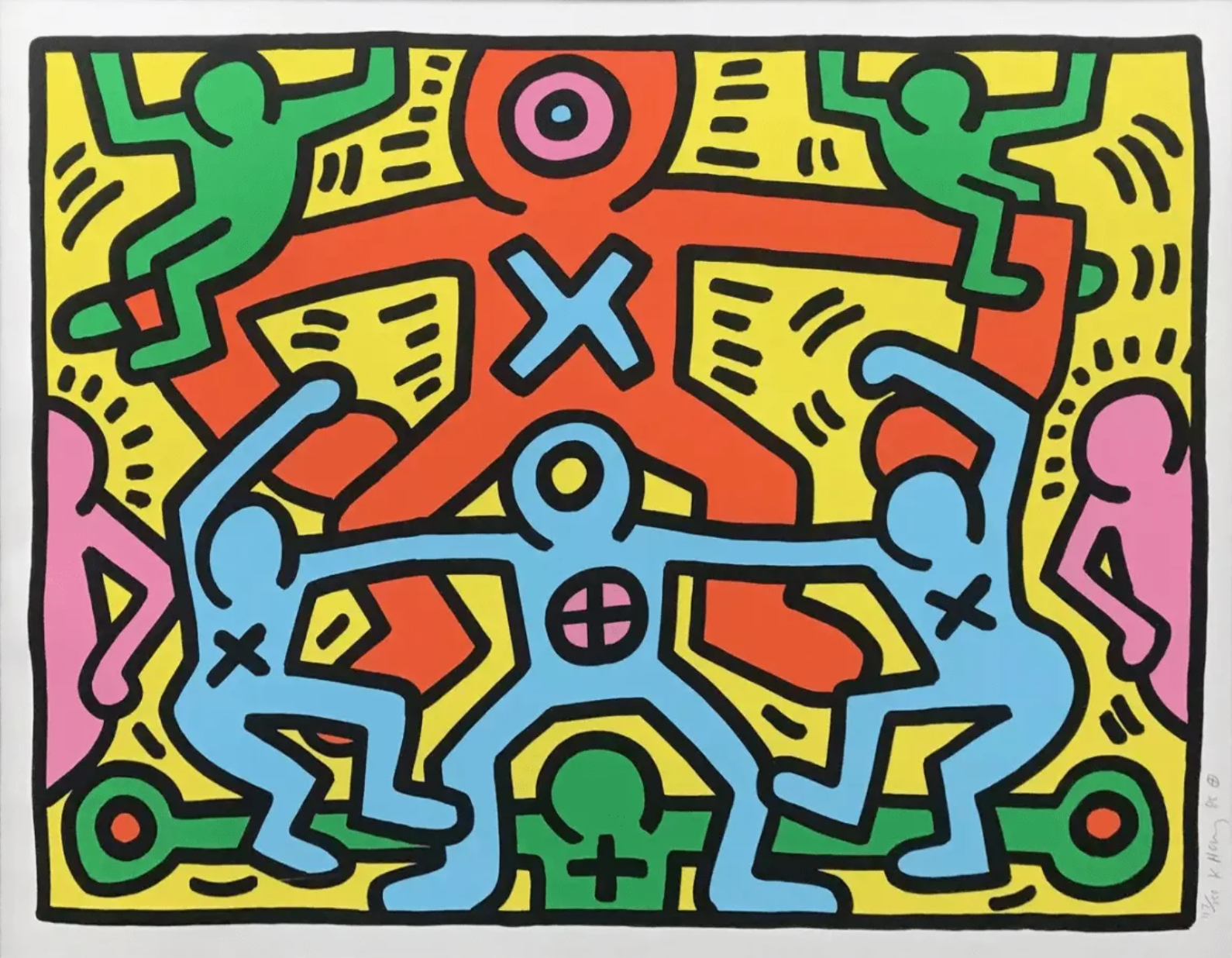
In May 2025, the five Fertility screenprints Keith Haring signed in 1983 sold together at Sotheby’s for $317,500. Tony Shafrazi Gallery also printed small announcement cards of the same five images to promote the original show. A set of those cards sells today for under $2,000.
The images match, but the objects do not, and before you can put a figure on a Haring print you need to know exactly which one you have. The signature and the edition size come first. After that, the series, the condition and the history of the sheet all move the price, and the only reliable benchmark is what the same edition fetched at its last sale.
How Much Is a Keith Haring Print Worth?
Keith Haring prints cover every tier of the market. Most hand-signed sheets from his main series sell in the five figures. Unsigned posters and later reproductions cost far less. Intact portfolios and rare proofs reach six figures, and one set cleared seven.
| Type of print | Typical price range | Examples |
|---|---|---|
| Posters, announcement cards and offset reproductions | Hundreds to a few thousand dollars | Exhibition posters, promotional cards, 1990 offset reproductions |
| Estate-signed and unsigned editions, per sheet | Low thousands to mid five figures | Icons (1990), posthumous editions |
| Hand-signed single sheets | About $5,000 to $80,000 | Pop Shop, Fertility, Growing, Apocalypse |
| Intact portfolios and rare proofs | Six figures and up | Andy Mouse, Growing, The Blueprint Drawings |
Haring never kept his images apart from everyday objects. At the Pop Shop, which he opened in SoHo in 1986, he sold T-shirts, posters and other items printed with his designs, and over the same years he published signed screenprints in editions of 30 to 250. A buyer who sees a radiant baby on a sheet of paper has to work out which of those two worlds it came from.
Age plays a part too. His earliest portfolios from 1983 and the last ones he finished before his death in 1990 draw more interest than the middle years, and scarce editions hold up better than large ones.
Avery Andon, chief executive of ArtLife Gallery, hears some version of the same question every week. “People ask me what a Haring print is worth, and the honest answer is that it depends on which one. I’ve seen two sheets with the same image priced thousands of dollars apart because one was signed by Keith and the other was an estate edition. The first thing we do is pull every detail off the sheet itself, the signature, the number, the publisher’s stamp. Then we look for recent sales of that exact edition. Once you have both, the value usually makes sense pretty quickly, and most owners are surprised by how clear the picture gets.”
What Determines Keith Haring Print Value?
Start with the signature and the edition. A sheet Haring signed in pencil is worth more than one signed by his estate or left unsigned. After that, a small edition, a special proof or an intact portfolio each push the price higher, and the best results come when several of those line up on the same print.
Is the Print Signed by Keith Haring?
Haring usually signed his prints in pencil in the lower margin, as “K. Haring” with the year beside it. On the Andy Mouse screenprints of 1986, Andy Warhol signed each sheet as well, a second signature that no other Haring series has.
Prints finished after his death on February 16, 1990 carry a different kind of signature. Sotheby’s describes each sheet of Icons as signed on a stamped certificate on the back by Julia Gruen, executor of the Keith Haring Estate, and dated June 29, 1990. Flowers, from the same year and the same publisher, bears Haring’s own signature with “90” written beside it. When everything else is equal, buyers pay more for the artist’s own hand.
Unsigned works need more care. Many Pop Shop posters and later reproductions have no signature at all, and their value rests on age, condition and whether they were printed in Haring’s lifetime. A sheet without a signature or an edition number is just a poster until proven otherwise.
What Edition Is It?
The fraction on the sheet shows the impression and the total run. 24/30 means the 24th sheet of an edition of 30. Smaller editions push the value higher. Haring kept Andy Mouse to a tight run of 30. Icons ran to 250.
Sheets printed outside the main run get their own letters. AP marks the artist’s proofs, held back from the numbered run. A TP means a trial pull, often in colors that differ from the final release. You will also see PP for the printer and HC for sheets not meant for sale. The Growing set Sotheby’s sold in 2025 was a group of TP impressions, each printed in a unique color scheme.
Complete sets are a separate market. When every sheet is still there along with the title page and the original box, the group is worth more than its parts sold one by one. Decades later, intact survivors are hard to find.
How Much Are Keith Haring Prints Worth by Series?
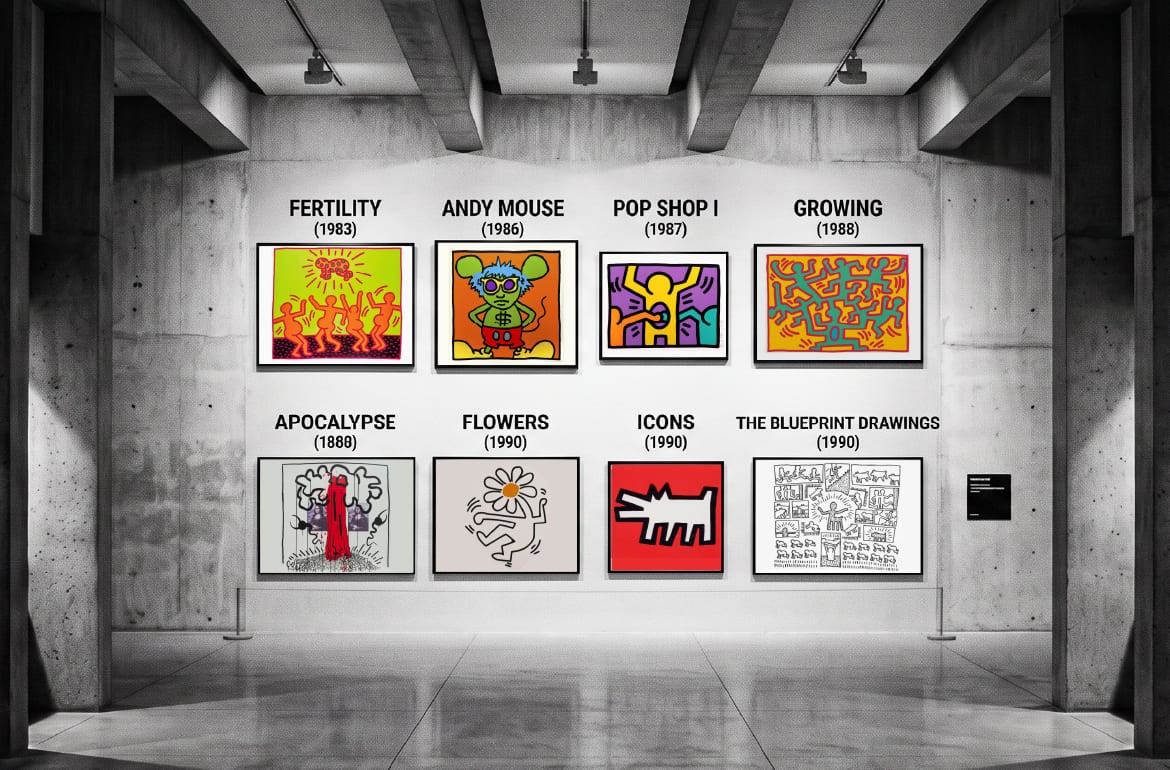
Each Haring portfolio was printed in a different size, edition and year, and those differences set its place in the market. Andy Mouse leads, followed by early and late suites such as Fertility, Growing and The Blueprint Drawings. Pop Shop sheets are the most accessible signed prints. Icons trades as an estate-signed edition.
| Series | Edition details | Signed by | Typical market position |
|---|---|---|---|
| Fertility (1983) | Five sheets, 42 × 50 in, edition of 100 plus 15 AP | Keith Haring | Upper tier, early work |
| Andy Mouse (1986) | Four sheets, 38 × 38 in, edition of 30 plus 10 AP | Keith Haring and Andy Warhol | Top of his print market |
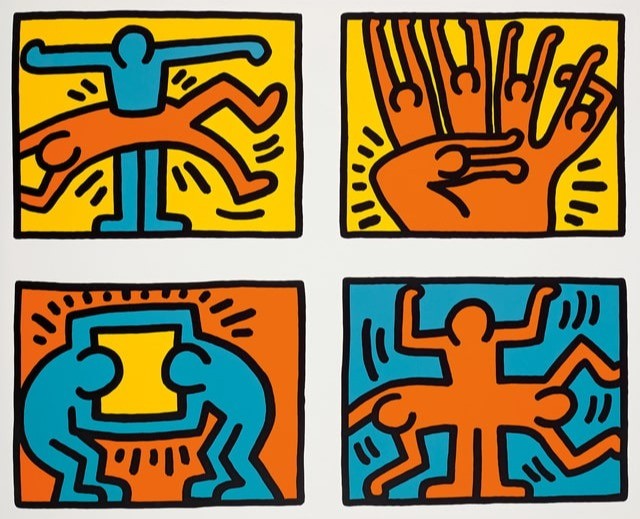
| Pop Shop I (1987) | Four sheets, 12 × 15 in, edition of 200 plus 30 AP | Keith Haring | Entry level for signed prints |
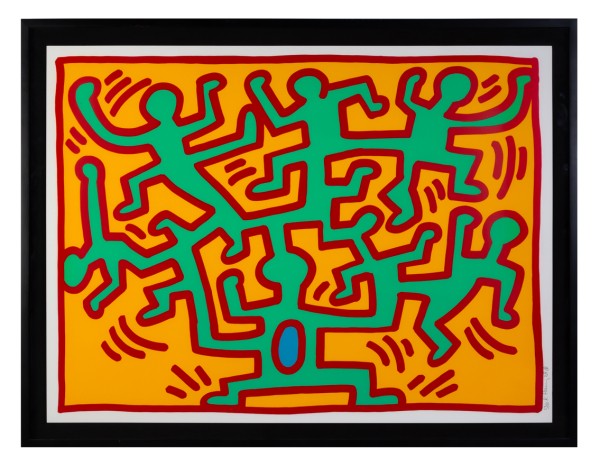
| Growing (1988) | Five sheets, 30 × 40 in, edition of 100 plus 15 AP sets | Keith Haring | Upper tier, proofs and full sets lead |
| Apocalypse (1988) | Ten sheets, 38 × 38 in, edition of 90 | Keith Haring | Upper tier, full sets include Burroughs text |
| Flowers (1990) | Five sheets, 36 × 50 in, edition of 100 plus 15 AP sets | Keith Haring | Upper tier as a full set |
| Icons (1990) | Five embossed sheets, 21 × 25 in, edition of 250 plus 25 AP | Julia Gruen, estate executor | Mid-market, largest edition |
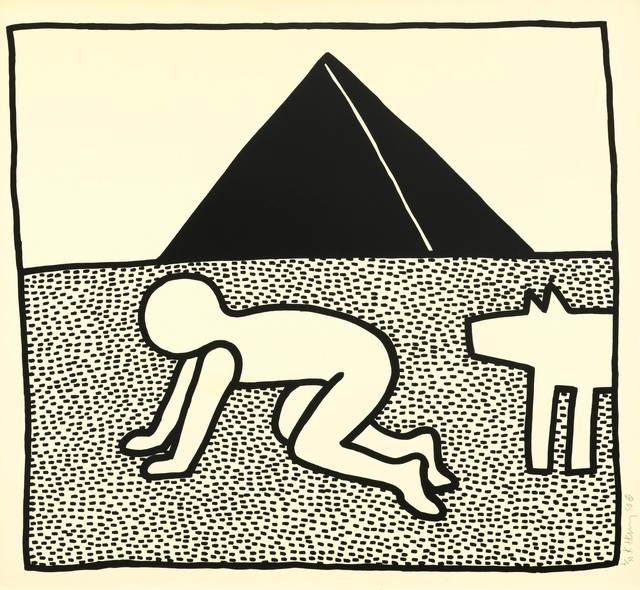
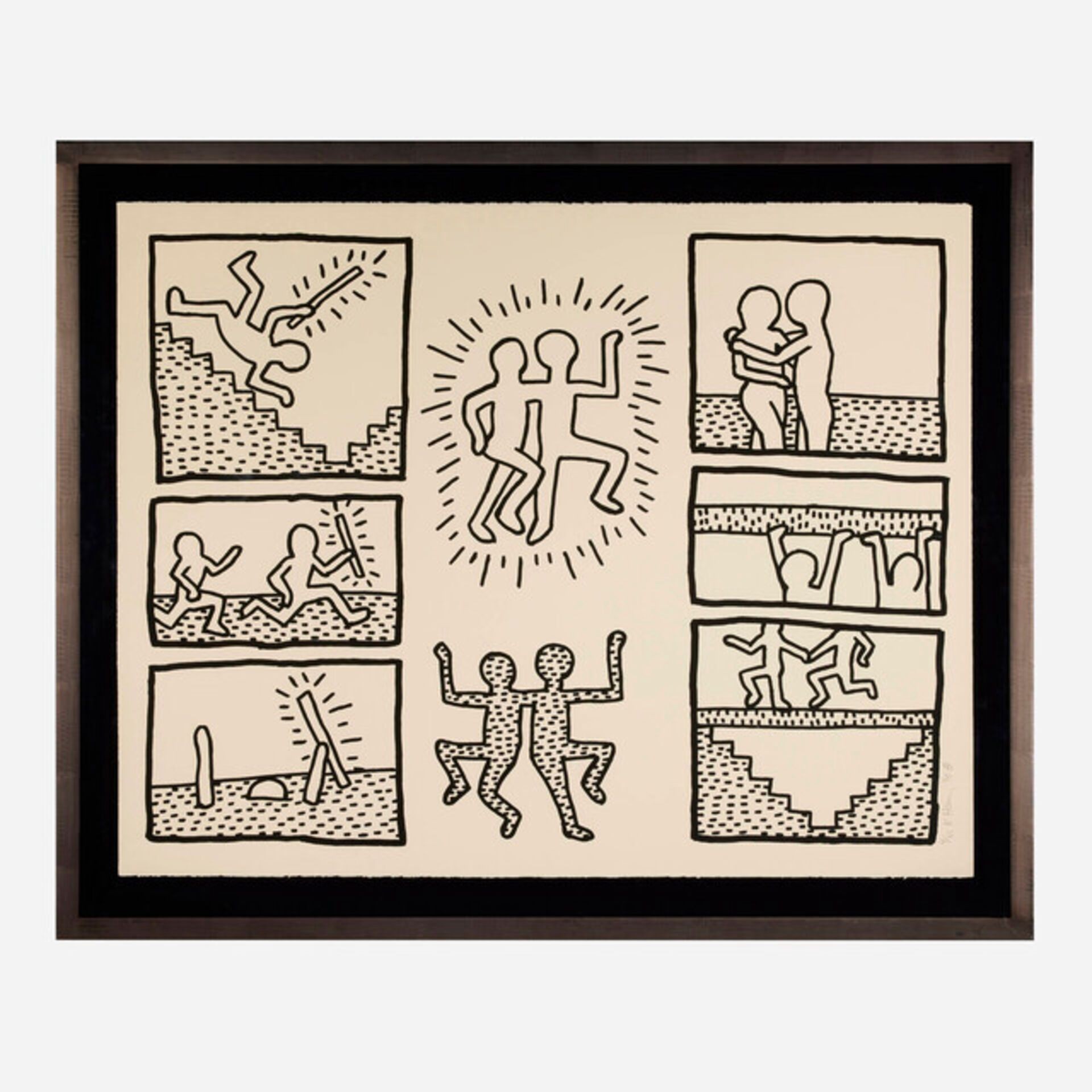
| The Blueprint Drawings (1990) | 17 sheets, edition of 33 plus 5 AP sets | Keith Haring | Top tier, very small edition |
The oldest and the last portfolios attract the most attention. Fertility dates from 1983, when Haring was still drawing in the New York subway. The Blueprint Drawings were printed in 1990 from photostats of 17 drawings he made between December 1980 and January 1981, and Phillips reproduced his own note about them in its catalogue. The Apocalypse suite of 1988 pairs ten large screenprints with text by William S. Burroughs.
ArtLife Gallery currently holds several signed sheets from these years, including The Blueprint Drawings #4 and #17, Pop Shop IV 1 from 1989 and Untitled (Cupman), a 1989 screenprint from an edition of 100.
Pop Shop and Icons are where most collectors start. The Pop Shop sheets are small, about 12 by 15 inches, and printed in editions of 200. Icons isolates five of his best-known symbols, including the radiant baby and the barking dog, two of Haring’s most famous figures, each embossed on heavy Arches paper.
“A full portfolio and a single sheet from the same series are two different purchases,” said Nico Hayes, senior director at ArtLife. “When a set comes to market with every sheet, the title page and the original case, buyers compete for the whole thing, and the price reflects that. Break it up and each sheet sells on its own merits. So before we talk about value, we check whether a portfolio is still intact and whether the numbers match across the sheets. Sets that have stayed together for decades tend to draw the strongest interest when they finally come up.”
Find longer price trends, market risks and blue-chip comparisons in our Keith Haring investment guide.
How Does the Catalogue Raisonné Help You Identify a Haring Print?
The catalogue raisonné is the reference book that records every print Haring published, and it is the fastest way to confirm what you own. For his prints, the standard is Klaus Littmann’s Keith Haring, Editions on Paper 1982-1990, published in Stuttgart in 1993. Auction houses cite it by page in their catalogue entries.
Littmann lists each edition by its date, dimensions, edition size, publisher and printer. You simply check those details against the sheet in front of you. If a print is numbered out of 30 and signed by both Haring and Warhol, the book confirms it is Andy Mouse. This is why Sotheby’s cites Littmann in its listings, alongside Rupert Jasen Smith as the printer and George Mulder as the publisher.
The numbering system catches new buyers off guard. Littmann works by page, so auction catalogues list Andy Mouse as “L. pp. 64-65” and Growing as “pp. 88-91.” When a dealer quotes a catalogue number for a Haring print, it is usually one of these page references.
How Much Does Condition Affect Keith Haring Print Value?
Condition can change the value of a Haring print a great deal. Faded color, creases, stains and damaged edges all pull the price down, sometimes sharply. Many of his prints use bright, saturated inks on large sheets of paper or board, so they are easy to damage and hard to repair without leaving a mark.
Fading is the most common problem. Haring loved bright oranges, pinks and purples, and those inks lose strength when a print hangs in sunlight for years. When Heritage Auctions offered a set of Pop Shop I, its condition report noted the orange and purple had faded and graded the prints 6 out of 10. A buyer reads a note like that and bids lower.
Framing causes its own damage. The big sheets on museum board, such as Andy Mouse and Apocalypse, pick up scuffs at the edges and waves in the paper from old mounting. A Sotheby’s condition report for one Andy Mouse set lists light scuffing along the edges, a tiny pigment loss and slight rippling from the eight hinges holding it to its backing card. At this level, any flaw counts.
Does Provenance Increase the Value?
Yes. A documented history reassures buyers, and they pay more for it. The Keith Haring Foundation stopped accepting authentication requests in September 2012, so the paperwork traveling with a Haring print now does most of the work of proving it is genuine.
Useful provenance includes the names of previous owners, original gallery or publisher invoices, past auction records, exhibition history and publisher certificates. When Heritage sold an Andy Mouse set in 2023, the lot came with copies of the publisher’s certificate of authenticity and of George Mulder’s certificate of tirage. Foundation letters issued while the committee was still active, together with a matching Littmann reference, complete the file. Look closely at any document presented as a new Foundation opinion dated after the committee closed.
In May 2025, Sotheby’s sold a group of Haring prints from the collection of Tony Shafrazi, the New York dealer who gave Haring a solo show at his gallery in 1982. The Growing trial proofs more than doubled their high estimate. Flowers cleared its ceiling too. Their rarity drove the bidding. Coming straight from Haring’s own dealer only helped.
“Paperwork is what lets a buyer relax. Most collectors read the file before they even look at the price, and they notice right away when something is missing,” Andon explains. “An original gallery invoice, a publisher’s certificate, the record of the last auction a print went through. Each of those helps. When a print comes with a clear line of owners going back to the gallery or the publisher, people bid with confidence. When the history has gaps, we work to fill them before the piece goes to market.”
What Are the Most Valuable Keith Haring Prints?
Intact portfolios hold the top results for Haring prints, led by Andy Mouse, the one series signed by both Haring and Warhol. Several other portfolios have passed $200,000 at auction in recent years. Single sheets from the same series bring a fraction of the full portfolio price.
These are among the strongest confirmed results for Haring print portfolios at the major houses.
- The four Andy Mouse screenprints of 1986 sold together for just over $1 million at Sotheby’s in September 2022.
- Growing reached $762,000 at Sotheby’s in May 2025, as a set of five trial proofs from 1988.
- Phillips got $554,400 for all 17 sheets of The Blueprint Drawings in April 2022.
- The five-print Fertility suite of 1983 brought $317,500 at Sotheby’s in May 2025.
- Flowers, from 1990, made $215,900 in that same Sotheby’s sale.
Individual Andy Mouse sheets are the exception and sell above $200,000 on their own. Haring’s overall auction record belongs to a painting, Untitled (1982), sold for $6.5 million at Sotheby’s New York in 2017.
How Are Keith Haring Print Prices Moving in 2026?
Rare Haring portfolios still command strong prices. Common signed sheets trade quietly. In 2026, the major houses tested every price level. Full Pop Shop sets asked tens of thousands, and late suites targeted the hundreds of thousands.
In London, a complete Pop Shop I carried a £20,000 to £30,000 tag, which puts a full signed portfolio within reach of newer collectors. The top of the season came from the collection of Kermit Oswald, Haring's lifelong friend, whose proof set of The Blueprint Drawings went up at $300,000 to $500,000.
Hayes sees a steady market with most of the energy at the top. “The rare portfolios are still finding buyers at strong levels, and that has held through the last few seasons. The more common editions move at a calmer pace, and prices there depend a lot on condition and signature. That works in favor of anyone buying now,” he adds. "There’s room to be selective. Collectors who know exactly which edition they want are in the best position. A good sheet in clean condition can be easier to find at a fair price than it was a few years ago.”
ArtLife holds authenticated editions and follows this market every day. Buy Keith Haring prints or request a free valuation for a piece you already own.
Frequently Asked Questions
How much is a Keith Haring print worth?
It depends on the edition. Start by reading the sheet. A signed and numbered screenprint from one of his main portfolios tends to sell in the five figures. Posters sell for much less, and intact portfolios for much more. For an accurate figure, compare your print with recent sales of the same edition.
Are Keith Haring prints valuable?
Yes. Signed Haring screenprints come up regularly at Sotheby’s, Christie’s, Phillips and Bonhams, and they have a large and active group of buyers. The value lies in the edition, though. A poster with the same image is a decorative piece, and it trades for a tiny fraction of the signed edition.
How much do Keith Haring prints cost?
At auction, always add the buyer’s premium to the hammer price. The final bill is noticeably higher than the winning bid. A good signed sheet from a known series costs five figures. Large-format sheets and proofs cost more, and full portfolios move into six figures.
Are signed Keith Haring prints worth more?
Yes. Buyers pay a premium for Haring’s pencil signature over estate signatures and unsigned impressions. The size of that price jump depends on the series and the edition, so compare like with like when you look at past results.
Can an unsigned Keith Haring print still be worth money?
Yes. Authentic lifetime editions and posthumous prints with an official Estate stamp still sell, often in the low thousands. Prices stay well below pencil-signed works. A sheet with no signature, no stamp and no edition number belongs in the poster category.
Which Keith Haring prints are the most valuable?
Andy Mouse heads the list. With an edition of just 30, one complete set cleared seven figures at Sotheby’s. Late portfolios like The Blueprint Drawings (edition of 33) rank near the top. Intact portfolios sell for several times what the same sheets fetch one by one.
How can I tell if my Keith Haring print is authentic?
Match the sheet against Littmann’s catalogue, where size, edition, publisher and printer should all line up. Look for the pencil signature or the estate certificate, the edition number and any blindstamp in the margin. Without new Foundation opinions, you must rely on solid paperwork and a specialist’s review.
Does condition affect Keith Haring print value?
Yes, and it is one of the few factors you control. Keep the print out of direct sunlight, frame it with UV-filtering glazing and acid-free materials, and never trim the margins. A clean condition report adds real money when you sell.
What is the Keith Haring auction record?
A 1982 painting, Untitled, holds the overall record at about $6.5 million, set at Sotheby’s in 2017. For prints, the top results come from full sets of Andy Mouse, one of which cleared $1 million in 2022.
Where can I get a Keith Haring print valued?
Start with a specialist gallery or an auction house print department. ArtLife offers free, market-led valuations of Keith Haring prints, with no obligation to sell. To speed up the process, have clear photos of the front and back, the edition number, any stamps or certificates and your purchase records ready.
Looking to Buy Keith Haring Fine Art Prints
Success in collecting Keith Haring prints starts with expertise and access. ArtLife offers a curated selection of collectible Pop Art prints, helping you discover works that combine artistic significance with lasting market appeal. Contact ArtLife today to access our collection and find your next acquisition.