The Ultimate Guide to Buying and Investing in Keith Haring Art

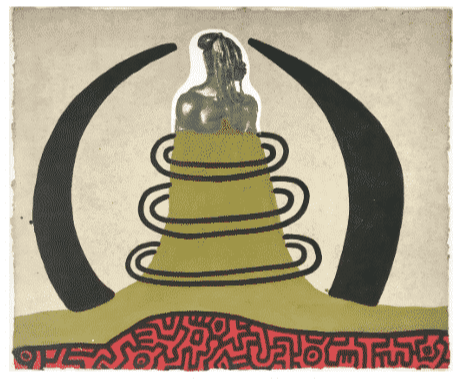
A Keith Haring self-portrait sold at Sotheby’s for $4.34 million in May 2026. Four months later, 41 works from the same collection opened online with estimates starting at $5,000. Both belonged to Kermit Oswald, his closest friend since kindergarten.
No other blue-chip name covers that spread. A period exhibition poster costs a few hundred dollars. A signed screenprint, five figures, and a painting, seven. Buyers exist at every price point. Traffic between those levels keeps the market moving when the top goes quiet.
Who Is Keith Haring and Why Are Collectors Paying Attention?
Haring worked for 10 years, from 1980 until his death from AIDS-related illness in February 1990, at 31. He drew in chalk on the New York subway, was arrested for it more than once, and had a solo show at Tony Shafrazi Gallery by 1982. Collectors follow him because his imagery is recognized worldwide and his output closed permanently 36 years ago.
The Pop Shop accounts for most of what makes his market unusual. He opened it on Lafayette Street in 1986 to sell T-shirts, badges and posters at prices anyone could meet. The signed screenprints and the gallery canvases carried on simultaneously. All of it still circulates.
Is Keith Haring Still a Good Investment in 2026?
The 2026 evidence supports it. His work hangs in three American museum shows this year, a single-owner collection of it is on sale as this is published, and the auction market he trades in grew 12% through 2025 after two weak years.
Artprice’s annual report of March 2026 put global auction turnover up 12% across calendar 2025, with 867,000 works sold, the highest volume ever recorded. The recovery began in the second half of the year.
Haring entered that upturn from a strong position. Hundreds of his works cross the block annually in five price tiers, so a quiet season at the top leaves him far less exposed than artists whose yearly totals rest on three or four canvases.
Avery Andon, chief executive of ArtLife Gallery, notes how this massive price range separates Haring from his peers: “Haring occupies a position almost nobody else has. You can buy a real work by him for a few thousand dollars, or you can spend seven figures, and it is the same artist with the same audience. His market keeps working when other names stall. We sold to a first-time buyer and to an experienced collector in the same week last month, and the pull was identical. People grow up with these images. They recognize the dog and the baby long before they know the name. That recognition turns into demand later.”
Why Has Keith Haring Become One of the World’s Most Collectible Artists?
Haring’s institutional status is absolute. Supply closed in 1990, yet the work commands an audience far outside the art world. Few names hold all three advantages. This formula protects prices during downturns.
- Museum recognition: Programming has been continuous. During 2026, The Brant Foundation in New York mounted a survey, Free Parking presented Keith Haring: In The Street, and Crystal Bridges Museum of American Art prepared Keith Haring in 3D in Bentonville, three shows Sotheby’s cited when it scheduled its own Haring sale against them.
- Global demand: He painted murals in Tokyo, Berlin, Paris, Rio and Melbourne. Buyers now come from all of those cities. A market spread that wide is harder to break than one built on New York alone.
- Fixed supply: Death at 31 capped the output. New material surfaces only when private collections come to market.
- Cross-generational reach: Collectors in their twenties know the Keith Haring figures from clothing. Buyers in their sixties remember the subway. Bridging both demographics keeps the bidding pool unusually deep.
How Has the Keith Haring Market Performed?
Growth has been steady for three decades, punctuated by corrections at the top. His record is $6.5 million for Untitled (1982), an acrylic on tarpaulin sold at Sotheby’s in 2017. Single-owner collections fuel these recent gains. May 2026 offered the clearest proof.
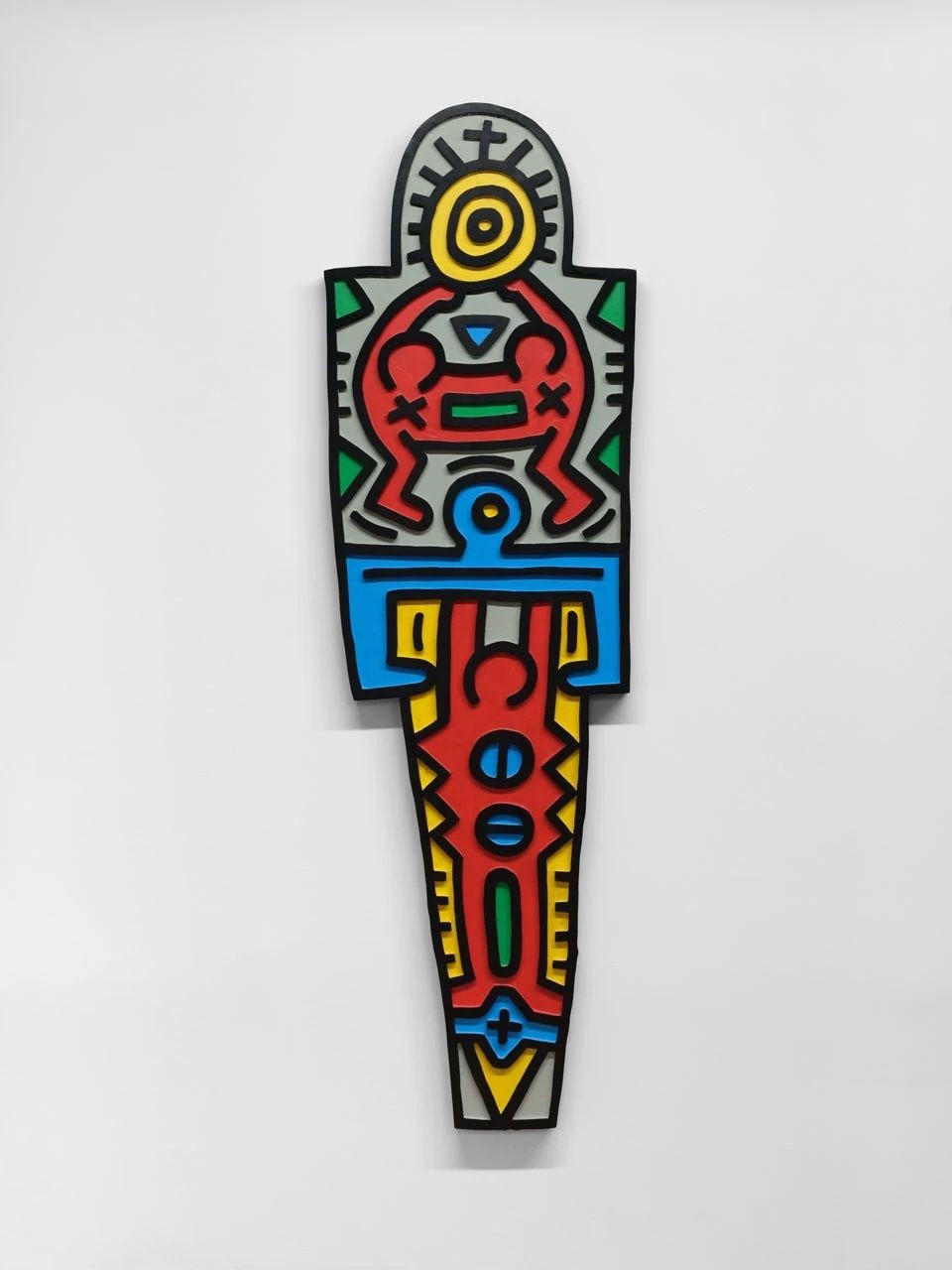
The saleroom dispersed Haring’s House across two days that month. Kermit Oswald assembled the collection directly from the artist. The 1985 self-portrait led the bidding. A carved wood sculpture of 1983 made $832,000 over a high estimate of $800,000.
Not every lot cleared. The Oswald family dresser, painted by Haring in 1986, stalled at $192,000 against a $250,000 low estimate.
The precedent came 18 months earlier. In November 2024, Sotheby’s offered 31 chalk subway drawings from the collection of Larry Warsh. Every lot found a buyer, prices ran between $114,000 and $900,000, and the total reached $9.2 million against a $6.9 million estimate.
Below the seven-figure line, trading never slowed. Prints and works on paper kept moving in quantity. Million-dollar results thinned market-wide.
“Watch what happened in May,” said Nico Hayes, senior director at ArtLife. “Most of the big Oswald lots beat their estimates and one missed badly. That is exactly what a healthy sale looks like. Buyers were being selective. What matters more for anyone holding Haring is how much of his work trades at all. Hundreds of lots a year go through the rooms at every price level, and plenty of artists at his level sell a handful. If you need to sell your Keith Haring artwork, there is a real market waiting for you. Liquidity is the part collectors forget about until they try to sell.”
What Types of Keith Haring Works Make the Best Investments?
The right choice comes down to budget and timeline. Unique works appreciate the most and sell slowest. Signed prints trade quickly at a fraction of the cost. Complete portfolios fall between the two, pairing scarcity with a price tag high enough to thin the competition.
| Category | Entry price | Liquidity | Growth potential | Main risk |
|---|---|---|---|---|
| Posters and ephemera | Hundreds | High | Low | Misattribution, condition |
| Signed single prints | Low five figures | High | Moderate | Overpaying in large editions |
| Complete portfolios | Six figures | Moderate | Strong | Capital locked up longer |
| Works on paper | Six figures | Moderate | Strong | Authentication |
| Paintings and sculpture | Seven figures | Low | Strongest | Few buyers at the exit |
Signed works outperform unsigned ones in every category, and the gap widens as prices climb. Intact portfolios command a steep premium over individual sheets. After 40 years, complete sets with their title page and case have grown genuinely scarce. Our Keith Haring print valuation guide covers what each series fetches.
5 Best Keith Haring Artworks to Invest in 2026
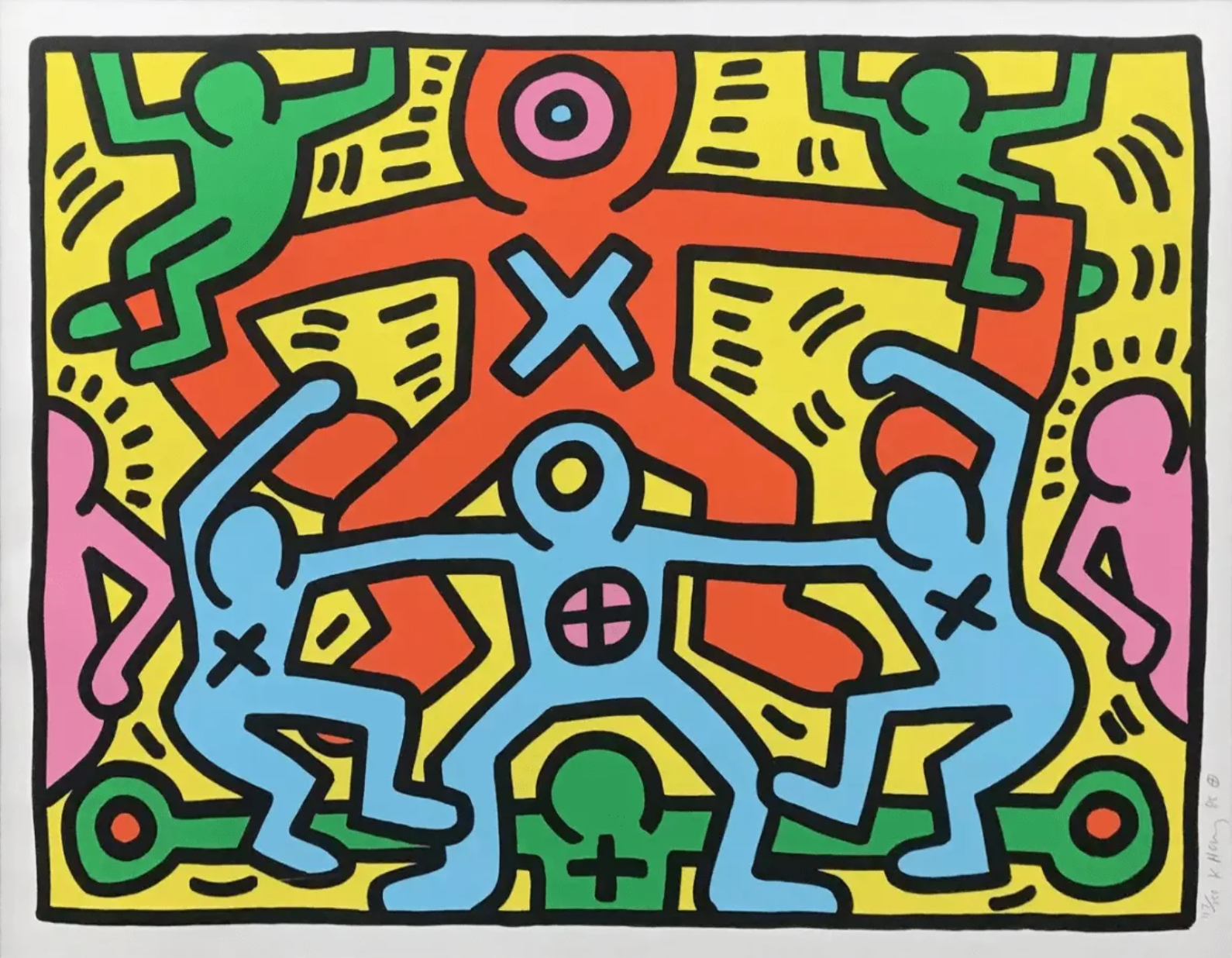
Haring produced thousands of works, so picking the right one requires a clear focus. The strongest options available today stand out for very specific reasons: the double signature on Andy Mouse, the tiny edition size of The Blueprint Drawings, and the early date of Fertility. Pop Shop is the most sensible entry point for a more accessible start.
- Andy Mouse (1986): An edition of 30 signed by both Haring and Andy Warhol, printed by Rupert Jasen Smith and published by George Mulder. The scarcest of his major series and the only one carrying two blue-chip signatures. Complete sets have reached seven figures.
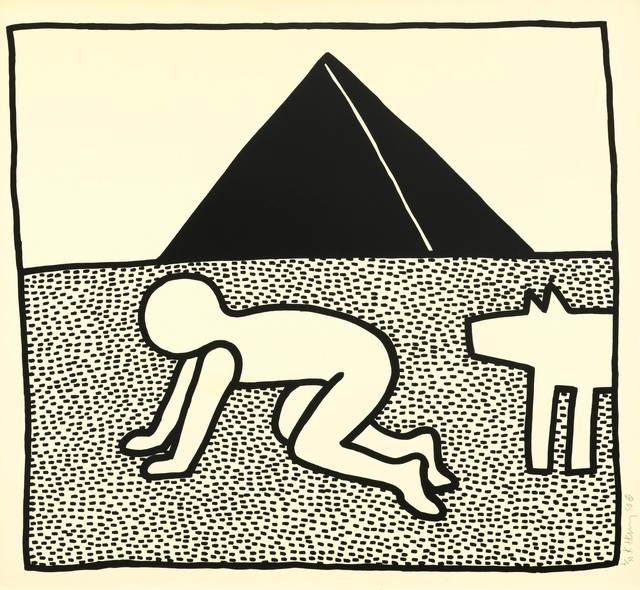
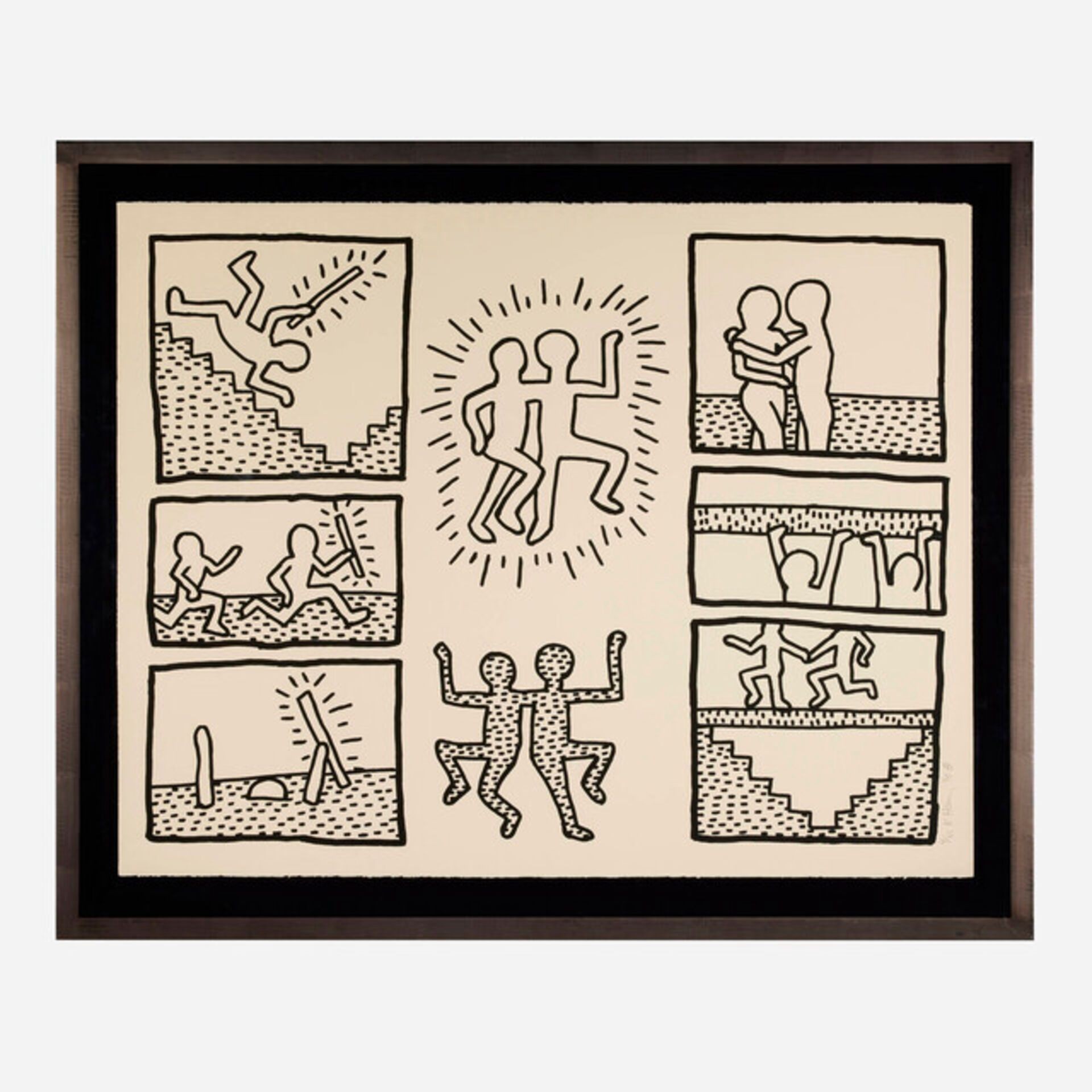
- The Blueprint Drawings (1990): 17 screenprints in an edition of 33, signed in the final months of his life. Sets almost never surface. The Oswald proof set took $486,400 in May 2026, against $554,400 for a numbered set at Phillips four years earlier.
- Fertility (1983): Five large screenprints from his breakthrough year, published by Tony Shafrazi Gallery in an edition of 100. Early date and scale both work in its favor.
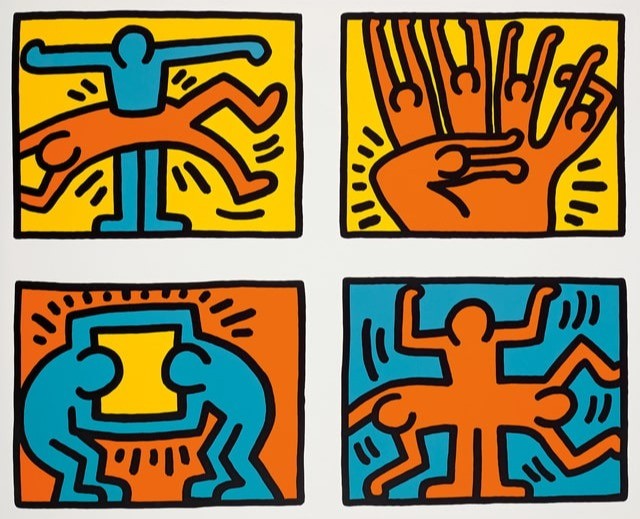
- Pop Shop (1987 to 1989): Editions of 200, small sheets, and the level where most collections begin. Complete sets have held up better than individual plates.
- Icons (1990): The sheets carry the signature of Julia Gruen, the estate executor, and not Haring's own. The series therefore trades a tier below on price despite strong demand.
Sotheby’s is selling 41 further works from the Oswald collection in an online auction running 25 September to 8 October 2026, with estimates opening at $5,000 and reaching $120,000 to $180,000 for Red, Yellow, Blue #3. Provenance of that quality rarely comes to market twice in one year.
How Much Money Do You Need to Invest in Keith Haring?
Entry begins at a few hundred dollars. Serious positions start in the low five figures. Six figures buys complete portfolios or works on paper. Seven figures opens the market for paintings and major sculpture.
- Under $5,000: Exhibition posters, announcement cards, Pop Shop items, unsigned editions. This is the busiest tier of the whole contemporary market by volume and the smallest by value. These are genuine period objects with real collectors behind them, and also where buyers most often overpay, having mistaken them for editions.
- $5,000 to $15,000: Smaller signed sheets and documented ephemera. The October Oswald sale opens at this level, cheap for works that came straight from Haring’s own hands.
- $15,000 to $50,000: The core of the Keith Haring signed prints market, where most first-time investors settle. Individual Pop Shop sheets, smaller works on paper, drawings with a clean history.
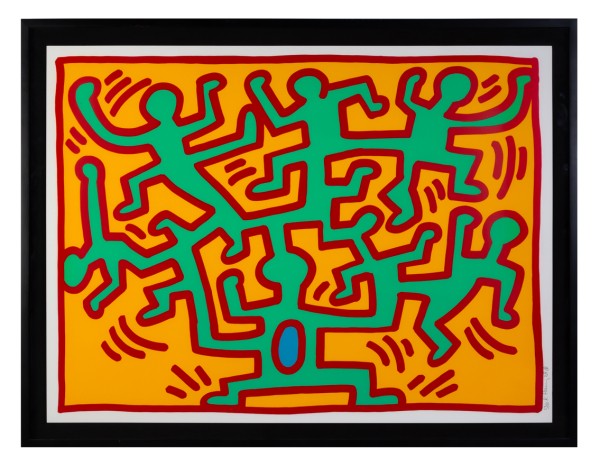
- $50,000 and above: Major signed sheets from Fertility, Growing and Apocalypse, plus the entry point for complete portfolios. Liquidity and appreciation balance best in this band. Above seven figures the buyer pool thins. Budget extra time for an eventual sale.
What Risks Should Investors Know?
Forgeries come first, followed by overpaying in large editions, cyclical weakness at the top end and condition. Nothing on that list is unmanageable, though the first has no institutional fix.
The Keith Haring Foundation closed its authentication committee in September 2012 and accepts no new requests. Nothing replaced it. Every purchase now rests on documents, publisher records and specialist judgment. A clean paper trail is worth more than it used to be.
Fakes circulate in quantity. Writing for Artnet, the appraiser Richard Polsky identified hesitant line work as the most common giveaway. Haring drew in confident unbroken strokes. Polsky also flags signatures that dominate a composition, where Haring kept his own quietly to one side.
Pop Shop sheets appear every season, so chasing one at a premium makes no sense. Faded fluorescent inks cut values sharply and cannot be reversed. And with the 2025 rebound concentrated in the middle of the market, buying quality below the seven-figure line still beats stretching for a trophy.
“The biggest risk with Haring is buying the wrong object. People come to us with something they paid ten thousand dollars for, and it turns out to be a poster worth two hundred,” Andon explains. “Since 2012 there has been no official body to ask, so the paperwork is the only thing standing between a buyer and an expensive mistake. Get the documents before you get attached to the picture. The second risk is paying a peak price for a common edition. Editions of two hundred come up every season, so patience costs you nothing.”
What Drives Keith Haring Prices?
Provenance moves a Haring price further than any other single factor, with exhibition history close behind. Scarcity, museum endorsement and the credit cycle set the broad level. Where two comparable works diverge, the paper trail explains the gap.
The Warsh drawings and the best Oswald lots cleared their estimates on ownership traced straight back to Haring’s circle. Buyers were paying for a story they could verify, not for a better image.
Before it reached a saleroom, the 1985 self-portrait had hung in Rome, Philadelphia, Milan and Fort Lauderdale, and appeared in the artist’s published journals. Exhibition history of that depth is rare, so buyers pay for it.
His figures appear on clothing and homeware worldwide, building recognition among people who will never enter a saleroom. Some collectors argue ubiquity cheapens the originals. The record argues back. His strongest years at auction have also been the years of heaviest licensing.
How Does Keith Haring Compare With Other Blue-Chip Contemporary Artists?
Keith Haring is often considered alongside other blue-chip artists to invest in, with his distinctive visual language, established auction history, and international collector base shaping his position in the contemporary art market. Haring costs less to enter than his peers and trades with higher volume. The trade-off is a lower ceiling. His best results run in the low seven figures. Basquiat has cleared nine. Here is the structural breakdown driving the market:
| Artist | Supply | Authentication route | What it means for a buyer |
|---|---|---|---|
| Keith Haring | Closed 1990 | Littmann catalogue and publisher records. Foundation stopped reviewing in 2012 | Fixed supply, low entry, heavy reliance on paperwork |
| Jean-Michel Basquiat | Closed 1988 | Estate stopped authenticating in 2012 | Very high entry, thin liquidity at the top |
| Andy Warhol | Closed 1987 | Board dissolved in 2011, catalogue raisonné in progress | Deep print market, authentication disputes on unique works |
| Banksy | Living artist, still producing | Pest Control certificates | Supply can grow, certification is centralized and clear |
| Yayoi Kusama | Closed August 2026 | Studio registration | Supply permanently capped, market currently adjusting |
Read the supply column first. Haring, Basquiat, Warhol, and now Kusama share a permanently closed catalog. Only Banksy can issue new work. Then look at authentication. Three of these estates shut their boards within years of each other. With the official committees gone, pristine provenance controls the postwar market. Haring is no exception.
Where Should You Buy Keith Haring?
Target established galleries, major auction houses, and specialist dealers. Auctions offer transparency and comparable results. Galleries provide condition reports, negotiation leverage, and time to think. Private dealers unlock material that never reaches the open market.
Auction is the best place to establish value. Every result gets published, so you can check one sale against another before you bid. The trade-offs are a commission on top of your winning bid and a clock that rewards nerve over patience.
Learn to read the symbols in a catalogue. Sotheby’s carried the 1985 self-portrait as guaranteed property with an irrevocable bid, meaning a third party had committed to buy it before the sale opened. An underwritten result is simply a weaker measure of open demand. Standard lots give you a much clearer read.
A gallery makes more sense for a first purchase. A reputable dealer will unframe a sheet for you, produce the publisher documentation and take the work back into stock when you trade up. Walk away from a seller who cannot name the publisher, printer and edition size from memory.
Expert Tips for Building a Keith Haring Collection
Size the allocation sensibly. Art is illiquid and produces no income. It belongs alongside other assets, not in place of them. Within the Haring portion, spread across two or three categories and avoid putting everything into one series.
Store flat or framed behind UV-filtering glazing with acid-free materials, away from direct light. Insure at replacement value and revisit the figure every two years. Keep invoices, condition reports, catalogue references and past results in one file. The next buyer will want all of it. When the time comes, our guide to selling artwork for the best possible price outlines exactly how to proceed.
For Hayes, a strong collection comes down to three habits: “Buy the best example you can afford of the fewest works. Five good sheets beat twenty average ones every time, and that applies to condition as much as to the image. Then hold for at least five years. This market moves in cycles. You want to sell into strength, not out of necessity. Keep everything as well. The invoice, the condition report, the catalogue reference. 10 years from now that file will be worth more money to whoever buys from you.”
Frequently Asked Questions
Is Keith Haring a good investment?
Recent market evidence says yes. Most lots in a major single-owner sale beat their estimates at Sotheby's in May. Add to that three American museum exhibitions this year, and a global auction market that grew 12% during 2025. Financial success ultimately comes down to the specific work you choose to buy and the price you pay for it.
Why is Keith Haring expensive?
Supply permanently closed in 1990, but market demand kept growing. His entire career lasted only 10 years. Museums absorbed much of the best material. His imagery is recognized globally. Unique works command the highest prices because so few remain outside institutional collections.
Will Keith Haring prices increase?
Nobody can promise it. Fixed supply, widening demand and museum interest all point one way. Seven-figure lots remain thinner than they were in 2021, even after the 12% rebound of 2025. Plan for a long hold and count any short-term gain as a bonus.
Which Keith Haring prints perform best?
Scarce editions with strong images. Andy Mouse, in an edition of 30 carrying Warhol’s signature alongside Haring’s, leads the field. The Blueprint Drawings follow on an edition of 33. Bigger runs like Pop Shop appreciate more slowly and sell faster when you need to move them.
Should beginners buy prints?
Prints are the sensible starting point. They cost less, trade more often and carry edition details that make them easier to verify than unique works. Begin with a signed and numbered sheet from a documented series and read the paperwork before you look at the price.
How do I authenticate Keith Haring?
Match the work against the Littmann catalogue raisonné, confirm the signature and edition number, and trace ownership back to the publisher or a recognized gallery. The Foundation reviews nothing now, so no new certificate exists. Specialist opinion plus complete documentation is the standard.
How long should I hold Keith Haring?
Five years minimum, 10 is better. Auction and gallery costs erase most short-term gains. A longer hold also lets you pick your moment, which matters in a market where one well-curated single-owner sale can lift a whole series.
What affects Keith Haring prices?
The market prices his work based on rarity, signature, condition, provenance and format, roughly in that order. A scarce edition in clean condition with a documented history outperforms a common one with gaps in its record, even when the image is identical.
Can Keith Haring outperform stocks?
Sometimes, over long periods, with no reliability. Art returns are lumpy, illiquid and specific to the individual work, which makes any comparison with an index misleading. Treat Haring as a long-term holding with upside, not a substitute for financial assets.
What is the rarest Keith Haring artwork?
Among prints, Andy Mouse leads the market in its edition of 30. Among unique works, the canvas self-portraits dominate, of which only six are known. One appeared at Sotheby’s in May 2026, after four decades in the same private collection.
Start Building a Keith Haring Collection
You can buy Keith Haring editions and originals every week on ArtLife. We publish what we know about each one. Speak with our specialists about what is available now and about building a position at your budget.